

As Malaysia enters 2026, business owners face dual pressures: rising operational costs and evolving energy tariffs from TNB. However, strategic tax planning combined with solar energy adoption presents an unprecedented opportunity to reduce both your tax liability and monthly electricity expenses. The Green Investment Tax Allowance (GITA) and the newly implemented Solar ATAP programme offer commercial enterprises a clear path to immediate cost savings and long-term financial resilience.
Understanding GITA: Malaysia’s Most Powerful Green Tax Incentive
The Green Investment Tax Allowance (GITA) enables companies to claim tax relief on qualifying capital expenditure for green technology assets, including solar photovoltaic systems. Under the enhanced framework effective from January 2024 through December 31, 2026, businesses can access Tier 1 incentives offering 100% tax allowance on qualifying capital expenditure, which can offset up to 70% of statutory income in the year of assessment [web:3][web:7]. Unutilized allowances carry forward indefinitely until fully absorbed, providing flexible tax planning options for businesses of all profitability levels [web:7].
For commercial solar installations, GITA transforms a significant capital investment into immediate tax savings. A manufacturing facility investing RM 500,000 in solar infrastructure could potentially claim RM 500,000 in tax allowances, offsetting RM 350,000 against taxable income. Applications must be submitted to the Malaysian Green Technology and Climate Change Corporation (MGTC) within 24 months of asset purchase to qualify [web:3].
✓ 100% tax allowance for Tier 1 green assets (solar PV systems included)
✓ Offset 70% of statutory income annually
✓ Carry forward unutilized allowances with no expiration
✓ Application window extends until December 31, 2026
✓ Combine with electricity savings for double financial impact
Solar ATAP 2026: Commercial Advantage
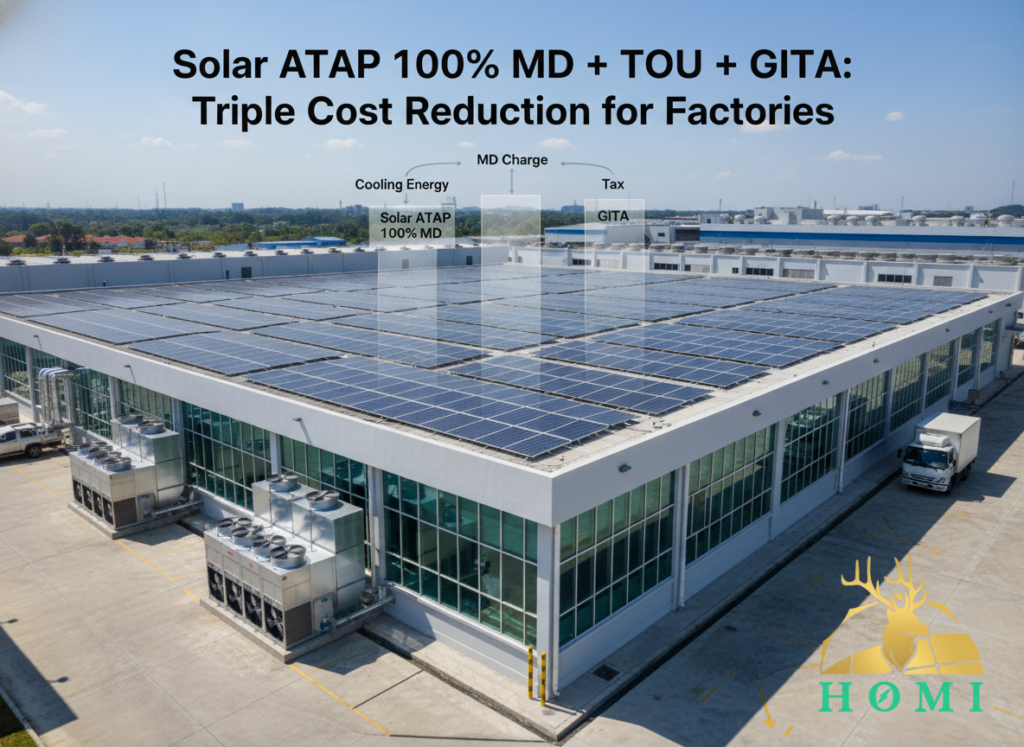
The Solar Accelerated Transition Action Programme (Solar ATAP), which officially launched on January 1, 2026, replaces the previous Net Energy Metering (NEM) scheme with a framework specifically designed to benefit commercial and industrial users [web:12][web:14]. Unlike residential installations, non-domestic consumers can now install solar capacity up to 100% of their Maximum Demand (MD), capped at 1MW [web:11][web:14]. This regulatory change represents a fundamental shift: businesses can now design solar systems that genuinely match their operational energy consumption patterns, particularly during peak demand hours when TNB tariffs are highest.
Maximum Demand capacity directly correlates with your TNB billing structure. Commercial users pay both energy charges (per kWh consumed) and demand charges (based on peak power drawn). By installing solar up to 100% of MD, businesses effectively reduce both components simultaneously. A factory with 200kW Maximum Demand can install a 200kW solar system, generating substantial electricity during business hours when machinery operates at full capacity. This directly displaces expensive grid power during peak periods, where tariffs can exceed RM 0.50 per kWh for industrial users [web:8][web:9].
Self-Consumption Economics
Solar ATAP prioritizes self-consumption over export, aligning with commercial energy usage patterns. Businesses typically consume 70-90% of solar generation during daylight operations, meaning most electricity produced directly offsets TNB purchases at retail rates. Export credits, while available, operate at lower Surplus Metering Programme (SMP) rates, making internal consumption the primary value driver [web:8][web:9]. For commercial operations with consistent daytime energy demand, this mechanism maximizes return on investment without reliance on grid export premiums.
Estimate your monthly electricity cost reduction with Solar ATAP
2026 Economic Outlook and Energy Costs
Malaysia’s commercial electricity landscape in 2026 reflects ongoing inflationary pressures and grid infrastructure investments. TNB tariff structures for commercial users remain among the highest consumer categories, with demand charges and peak-hour rates creating significant cost burdens for manufacturing, cold chain logistics, data centers, and retail operations. Industry analysts project energy costs will continue representing 15-25% of operational expenses for energy-intensive businesses, making cost mitigation strategies increasingly critical for competitive positioning.
The convergence of GITA tax incentives and Solar ATAP’s 100% MD capacity allowance creates a unique 2026 opportunity window. Businesses that act before December 31, 2026, can lock in maximum GITA benefits while establishing long-term electricity cost certainty. Solar systems typically deliver 25-year operational lifespans, meaning today’s investment continues generating savings long after GITA’s current incentive period concludes [web:3][web:6].
Combining GITA with Solar ATAP
The strategic integration of GITA tax relief and Solar ATAP operational savings creates compounding financial benefits. Consider a logistics company with RM 2 million in annual taxable income installing a RM 600,000 solar system. Under GITA Tier 1, the company claims RM 600,000 in tax allowances, offsetting RM 420,000 against statutory income (70% of RM 600,000). At the 24% corporate tax rate, this generates RM 100,800 in immediate tax savings [web:3][web:7].
Simultaneously, the solar system produces approximately 750,000 kWh annually (assuming 4.5 peak sun hours daily in Malaysia). With 80% self-consumption at an average commercial tariff of RM 0.45 per kWh, the business saves RM 270,000 annually in electricity costs. Combined, the first-year financial impact reaches RM 370,800, dramatically shortening payback periods and improving internal rate of return calculations that justify board-level investment approval.
Implementation Timeline
To maximize 2026 GITA benefits, businesses should initiate solar feasibility assessments immediately. The application process involves technical site evaluation, TNB Connection Assessment Study (CAS) for systems above certain thresholds, MGTC green technology asset verification, and final installation commissioning [web:14]. Given the 24-month application window from asset purchase, companies installing systems in Q2 2026 can still claim incentives for the 2026 assessment year, though earlier action reduces administrative risk [web:3].
Who Benefits Most from This Strategy
Solar ATAP’s 100% Maximum Demand provision particularly advantages specific commercial profiles. Manufacturing facilities with high daytime energy consumption, cold storage operations running refrigeration during business hours, educational institutions with 8am-5pm usage patterns, retail complexes with consistent lighting and HVAC loads, and SME factories with predictable production schedules all achieve optimal returns. The key characteristic is significant electricity consumption during solar generation hours (roughly 9am-6pm), maximizing self-consumption economics [web:11][web:14].
Businesses currently spending RM 5,000+ monthly on TNB bills typically reach favorable return-on-investment thresholds. Companies with stable cash flow or access to green financing options can leverage GITA’s tax deferral mechanism to effectively reduce net capital outlay, while electricity savings provide ongoing positive cash flow that services any financing arrangements.
Beyond 2026: Long-Term Value
While GITA’s current incentive structure concludes December 31, 2026, solar installations deliver decades of value [web:3][web:6]. Malaysian commercial solar systems typically maintain 85%+ efficiency after 25 years, continuing to generate electricity savings throughout their operational lifetime. Additionally, as TNB tariffs inevitably increase over time due to infrastructure costs and fuel price volatility, solar-generated electricity provides a hedge against future energy inflation, effectively locking in today’s cost structure for tomorrow’s operations.
Environmental, Social, and Governance (ESG) considerations also play increasing roles in supply chain partnerships and corporate procurement decisions. Major multinational corporations now require suppliers to demonstrate renewable energy adoption and carbon reduction commitments. Solar installation positions businesses favorably for ESG-conscious partnerships while contributing to Malaysia’s national renewable energy targets and climate commitments.
Get Your Free Solar Assessment NowFrequently Asked Questions
Can I still apply for GITA if my solar system is already installed?
Yes, provided you submit your GITA application to MGTC within 24 months from the date of asset purchase (based on supplier invoice date). However, the qualifying capital expenditure must be incurred between January 1, 2024, and December 31, 2026, to qualify for the current GITA framework. Earlier submission reduces processing risk and ensures timely approval for tax assessment year claims.
How does Solar ATAP differ from the previous NEM programme?
Solar ATAP replaces NEM with several key changes. Commercial users can now install up to 100% of Maximum Demand (versus previous capacity restrictions), prioritizing self-consumption over export. The export credit mechanism operates at Surplus Metering Programme (SMP) rates rather than 1:1 offset ratios. Importantly, there are no quota limitations under Solar ATAP, removing the application lottery system that constrained NEM participation. The focus shifts to immediate consumption savings rather than long-term export credit banking.
What is the typical payback period for commercial solar with GITA incentives?
Commercial solar installations in Malaysia typically achieve 4-6 year payback periods without incentives. When combining GITA tax allowances (which can effectively reduce upfront capital by 15-20% through tax savings) with Solar ATAP’s immediate electricity cost reduction, payback periods often shorten to 3-4 years for businesses with strong daytime consumption profiles. Factors affecting payback include current electricity tariff rates, system capacity versus consumption matching, available roof space efficiency, and corporate tax position. Businesses with higher tax liabilities benefit most from GITA’s immediate allowance claims.