


Time of Use and Solar: A Practical TNB Bill Planning Guide
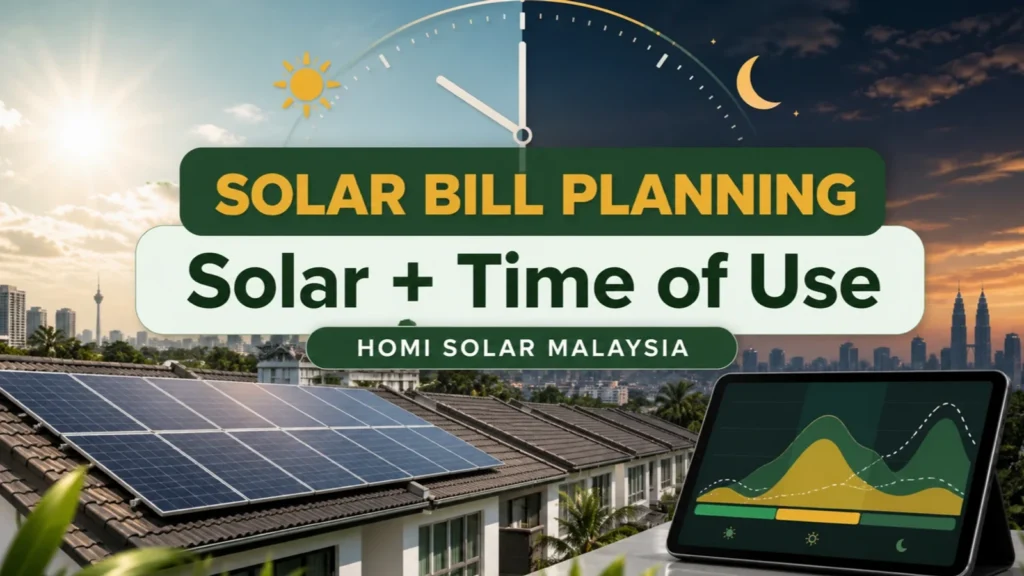
Time of Use and rooftop solar solve two different parts of an electricity bill. Solar can reduce grid import when the system is producing and the property is using electricity. A Time-of-Use plan changes the energy rate according to when grid electricity is consumed. The useful question is therefore not “Which one saves more?” but “How much of my load can use solar directly, and how much grid import can safely move to an off-peak period?”
For eligible domestic and low-voltage non-domestic customers with the required metering in Peninsular Malaysia, the published Time-of-Use schedule places peak hours from 2:00 pm to 10:00 pm on Monday to Friday. Off-peak runs from 10:00 pm to 2:00 pm the following day on weekdays, and throughout Saturday and Sunday. Eligibility, enrolment and the bill treatment must still be confirmed with TNB for the actual account.
Start with half-hourly behaviour, not only monthly kWh
A monthly bill tells you total usage but not when the energy was used. List the appliances and processes that shape the day: air-conditioning, water heating, pumps, refrigeration, cooking, laundry, office equipment, machinery, EV charging and any planned battery. Then separate essential loads from flexible loads. Comfort, safety, food storage and business operations should not be shifted just to chase a lower rate.
If smart-meter interval data is available, compare several ordinary weekdays and weekends. A household with most grid import between 2:00 pm and 10:00 pm has a different case from a home that charges an EV after 10:00 pm. A business that closes before the evening peak also needs a different review from a restaurant or workshop that remains busy at night.
Use solar while it is available
Rooftop solar commonly produces during daylight, while actual output changes with weather, orientation, shading, equipment and season. It can be sensible to run flexible daytime loads when the system is producing, especially before the weekday peak period begins. Moving every load to late night can reduce direct solar use and increase grid import, even though that import may use an off-peak energy rate.
A practical plan can divide flexible loads into three windows: direct-solar hours, the weekday off-peak window before 2:00 pm, and the after-10:00 pm off-peak window. The best window depends on appliance instructions, occupancy, noise, demand limits and whether the load can be controlled safely. Do not use a simple timer where qualified electrical or equipment-specific controls are required.
Do not compare only one energy rate
The Energy Commission explains that the current Peninsular Malaysia tariff framework includes a base tariff and the Automatic Fuel Adjustment mechanism. A bill can also contain capacity, network, retail, taxes, incentives or other account-specific components. The Time-of-Use energy difference is therefore one input, not a guarantee that the entire bill will fall by the same percentage.
Before changing plan, compare a representative period under the general tariff and a reasoned Time-of-Use scenario using the same consumption. Record the assumptions: weekday peak kWh, weekday off-peak kWh, weekend kWh, expected direct solar use and any future EV or appliance. Recheck the official tariff and AFA information because these inputs can change.
What to give a solar adviser
- Several recent TNB bills and, where available, smart-meter interval data.
- Property type, supply phase and normal occupancy hours.
- Major daytime, evening and overnight loads.
- Plans for an EV, battery, renovation, business expansion or new air-conditioning.
- Roof photos from a safe location and any known shading or roof issues.
Use HOMI’s Solar ATAP planning page for programme context, review Malaysia solar policy updates, and see real project evidence. A proposal should state its load, tariff and solar-generation assumptions rather than promise a fixed saving.
Boundary: Time-of-Use eligibility, tariff treatment, Solar ATAP approval and savings depend on the latest PETRA, SEDA, Energy Commission and TNB requirements plus the customer’s actual bill, roof and usage pattern.
Frequently asked questions
What are the published Time-of-Use periods?
The published schedule is peak from 2:00 pm to 10:00 pm Monday to Friday, with off-peak from 10:00 pm to 2:00 pm the next day on weekdays and all day on Saturday and Sunday. Confirm the current schedule and account eligibility with TNB.
Should I move every appliance to night-time?
No. This may reduce direct solar use and may be impractical or unsafe. Separate flexible loads from essential loads and compare direct-solar and off-peak windows.
Does rooftop solar automatically make Time of Use better?
No. The result depends on the property’s import pattern, direct solar use, tariff components and future loads.
Can HOMI guarantee the bill saving?
No. HOMI can model a range from supplied bills, roof and usage assumptions, while tariff, approval, weather and behaviour remain variable.
This article reflects official information checked on 31 August 2026 and is general guidance. Programme rules, tariff treatment, approval and actual savings remain subject to the latest PETRA, SEDA, Energy Commission and TNB requirements plus the property bill, roof and usage pattern.
Official sources
Want HOMI to review your TNB bill?
Send your usage pattern and HOMI can estimate whether Solar ATAP makes sense for your home or business.
Review My Solar Load Pattern