


Beyond the panel life: planning solar panel reuse, disposal and records in Malaysia
A responsible end-of-life plan starts before the panels leave the roof: establish why they are being removed, arrange qualified assessment, confirm an appropriate destination and retain evidence of the handover. A panel removed for roof repairs, a candidate for reuse and a damaged panel awaiting waste classification should not all disappear under a vague invoice line saying “dispose of old panels”.
For a Malaysian property owner, the useful question is not simply whether solar panels can be recycled. It is who will take these particular panels, in their actual condition, and what documents will show where they went. That question belongs in a replacement quotation as clearly as the new equipment and installation scope.
Start with the reason for removal
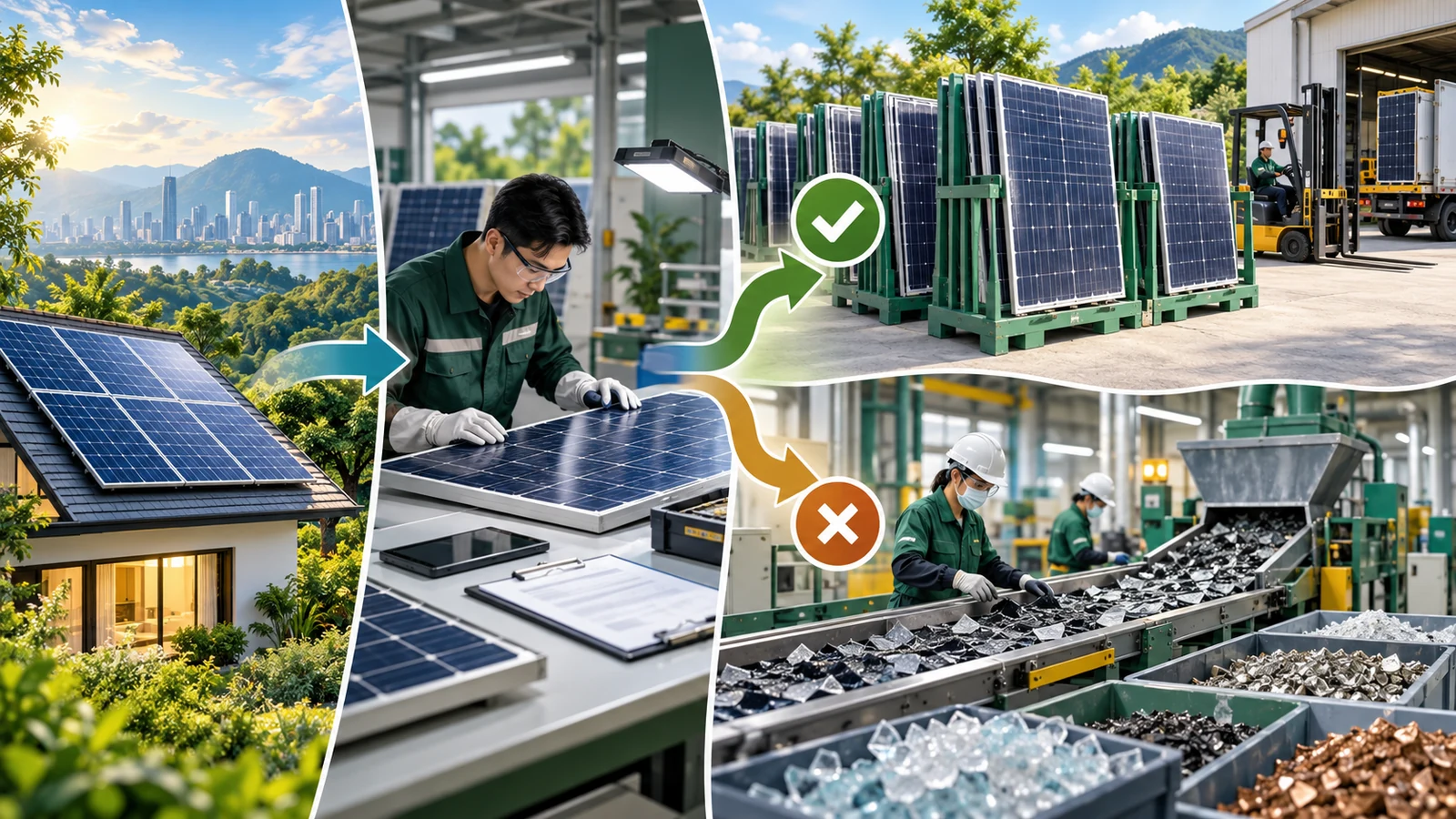
Ask the contractor to distinguish temporary removal from permanent retirement. Roof waterproofing may involve reinstalling the existing equipment; a system upgrade may leave equipment requiring assessment for another use. Damage, uncertain history or a fault calls for a different decision. Describe what is known without turning an assumption into a verdict.
Create a removal list from the original equipment schedule and the contractor’s inspection. Keep the make, model, serial number where legible, location in the array, removal reason and dated condition photographs. An unreadable label should be recorded as unreadable, with another reference linking the item to its photograph. Do not invent a serial number to make the spreadsheet look complete.
Reuse deserves a documented assessment, not an informal promise that the panel “still works”. Specify who evaluates it, what evidence will accompany the proposed transfer and who accepts responsibility for the next installation. The joint IRENA and IEA-PVPS report published in 2016 discusses reuse and recycling as parts of end-of-life management. It does not certify an individual panel or identify an available Malaysian destination today.
Classification comes before choosing a waste route
Malaysia’s Department of Environment (DOE) places classification responsibility on the waste producer, using the source and characteristics of the waste and the applicable scheduled-waste descriptions. Uncertain cases should be referred to DOE. If material is classified as scheduled waste, its recovery or disposal must use DOE-licensed premises.
SW110 is a defined entry in the official waste-code list, not a convenient label for everything electrical that has become old. Do not state that every photovoltaic panel is automatically SW110, or assume that describing a shipment as “for reuse” settles its status. Ask the responsible party for the classification basis and the intended route in writing. This article cannot determine the category of a particular removed batch.
Give each removal scenario a clear next step
| Situation | Decision to document | Evidence to retain |
|---|---|---|
| Temporary removal for roof work | Custody, protection and conditions for reinstalling | Item list, condition photographs and reinstatement scope |
| Proposed reuse elsewhere | Suitability assessment and identified recipient | Assessment, equipment identity and written acceptance |
| Damaged or uncertain-condition panels | Assessment, classification and safe handling route | Condition record, classification basis and contractor scope |
| Material classified as scheduled waste | Appropriate authorised transport and licensed destination | Applicable consignment, recipient and treatment records |
Source basis: DOE classification guidance and DOE scheduled-waste guidance; record suggestions are HOMI editorial recommendations.
Confirm the destination before collection
A familiar recycling logo or a collector’s business card is not enough to establish the route. Ask for the receiving organisation, premises, contact person and written confirmation that the proposed material and condition are accepted. For a regulated route, have the responsible contractor demonstrate that the relevant permissions cover the actual activity and waste category. Confirm who arranges the transport and who follows up if the recipient rejects the load.
Do not assume that a nearby household e-waste collection point accepts rooftop modules. Equally, a quotation that includes removal does not necessarily include assessment, storage, transport or final treatment. Ask those questions before dismantling begins, when the destination can still influence the work plan and price.
The DOE packaging, labelling and storage guidance makes those arrangements part of proper scheduled-waste management. Have the qualified team establish the applicable arrangements before removal. Owners should not break panels apart, strip materials or improvise electrical disconnection to make collection easier.
A good record follows the panel beyond the gate
Keep a project file joining the removal list to the collection and receiving documents. Record quantities and their basis: an item count is different from a measured weight. If a weight is an estimate, label it as such. Where equipment is split between destinations, preserve the link between each group and its paperwork.
Separate what each document proves. A collection receipt shows a handover; a receiving record shows acceptance at a destination. A treatment or recovery record supports a later claim about processing within its stated scope. Request the relevant evidence without assuming that every receipt certifies complete recycling. An unexplained gap is a follow-up item, not a reason to fill the file with a confident environmental claim.
Agree who owns the removed equipment and who can authorise its transfer, particularly where a landlord, tenant, finance provider or management body is involved. Ask for removal charges, possible assessment costs, excluded services and any recovery credit to be stated separately. A useful contract also names who supplies the closing documents and how unresolved items will be reported.
Make the plan part of the next solar conversation
Keep equipment records from installation onwards, even if retirement seems distant. When discussing a replacement or roof project, bring that file and ask for a written removal scope alongside the new-system proposal. Explore the circular-management background, view HOMI’s solar services, or contact HOMI to discuss the assessment and project coordination needed for your property.
Questions owners ask
Are all retired solar panels automatically SW110?
Do not assign that code from age or the word solar alone. Check the applicable description and documented classification; refer uncertainty to DOE.
Can a panel be reused if it still produces electricity?
Output alone is insufficient evidence. Ask a qualified assessor to document condition and suitability for the proposed installation, and retain the recipient’s written acceptance.
Does a collection receipt prove recycling?
It proves a handover to the party named on the receipt. Ask for the destination and the relevant subsequent acceptance or treatment records before making a recycling claim.
When should the owner start keeping records?
At installation, while model information and serial numbers are available. Update the file when panels are repaired, temporarily removed, transferred or retired.
Sources and editorial scope
Sources checked on 8 October 2026. The comparison table and record suggestions are editorial planning tools, not a waste classification, reuse certificate or confirmation that a particular facility accepts solar panels. The 2016 report is used for circular management concepts, not current Malaysian capacity or global forecasts.
- DOE — Scheduled Waste Information
- DOE — Scheduled Waste Guidelines
- DOE — Guidelines for Packaging, Labelling and Storage of Scheduled Wastes in Malaysia
- DOE eSWIS — Waste Code and Description
- IRENA and IEA-PVPS — End-of-life Management: Solar Photovoltaic Panels (2016)
This article reflects official information checked on 8 October 2026 and is general guidance. Programme rules, tariff treatment, approval and actual savings remain subject to the latest PETRA, SEDA, Energy Commission and TNB requirements plus the property bill, roof and usage pattern.
Want HOMI to review your TNB bill?
Send your usage pattern and HOMI can estimate whether Solar ATAP makes sense for your home or business.
Discuss My Solar Plan