


Keep the inverter cool: ventilation and heat checks for Malaysian homes
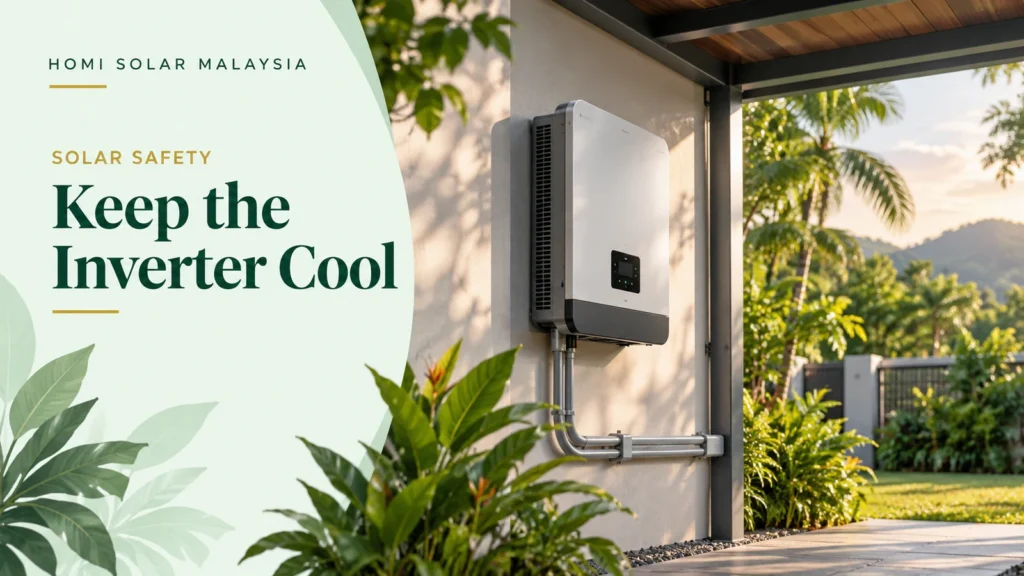
Keep an inverter cool by preserving the installation conditions required by its exact model: a suitable location, the specified clearances and a usable cooling path. In a Malaysian home, a later cupboard, awning or storage rack can change those conditions. Have the installer review such changes before construction, and use safe visual observations and app records when raising a concern.
The inverter deserves attention even when the panels are the most visible part of the system. Its position can look tidy on installation day but become less suitable as a car porch or utility area fills up. The owner’s job is to protect the agreed space and report changes clearly; electrical inspection and corrective work belong with qualified people.
Heat is part of operation; derating is a protective response
An inverter converts direct current from the panels into alternating current, with some energy becoming heat. Cooling arrangements differ by product. SMA’s heat-dissipation guidance explains that temperature derating reduces power to protect sensitive components when monitored temperatures become too high. The relevant limits and behaviour are model-specific.
This explains why an output reduction can be a protection response, but it does not make every afternoon dip a heat problem. Nor does it make repeated temperature warnings something to ignore. Record the actual message and operating context so the service team can investigate the cause instead of trying to diagnose from a screenshot of the power curve alone.
The manual decides the space, not a generic internet diagram
SMA’s mounting-location overview explicitly directs readers to the individual inverter manual because mounting positions and clearances differ by type. Ask your installer to show the applicable diagram for your model, including any arrangement involving neighbouring equipment. There is no universal gap or ambient-temperature threshold supplied by this article.
At handover, keep the model designation and the corresponding manual together. A manufacturer document such as this Sunny Tripower operating manual is an example of the detail that belongs in a system file; it is not a substitute for a different inverter’s instructions. If a replacement model is proposed later, ask for a fresh location review.
Check the whole location before adding a cover
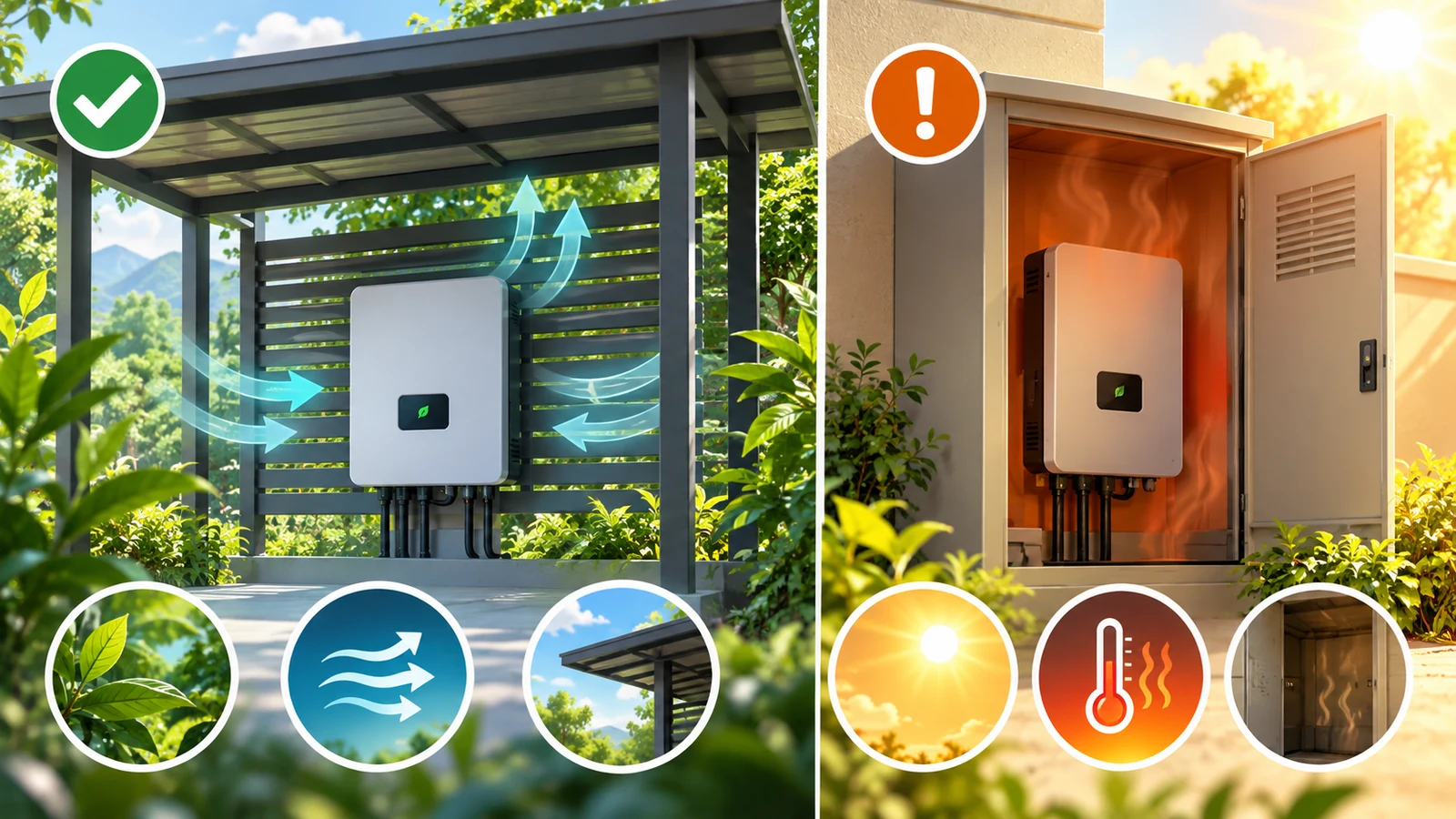
Walk through the proposed location with the installer before the mounting point is finalised. Discuss where afternoon sunlight falls, nearby heat sources, exposure to water, access for servicing and how the space will be used after installation. A sheltered-looking corner should not be approved from a photograph alone.
In a terrace-house car porch, for example, a future shoe cabinet or screen may occupy the space shown as clear on the installation drawing. Treat that as a change to review. Ask the designer of the new enclosure to coordinate with the solar installer, and retain the revised drawing or written confirmation. Do not assume that perforated doors automatically provide sufficient ventilation.
Shading also needs a considered design. A cover intended to block sun may restrict airflow, direct runoff towards equipment or make service access awkward. Let the responsible team resolve those details together. Adding an improvised fan or spraying the casing with water is not an appropriate owner response to a temperature concern.
Turn observations into a useful service request
| What you notice safely | What to record | What needs professional review |
|---|---|---|
| New cabinet, screen or stored items nearby | A general location photograph and when the layout changed | Clearances, cooling path and access against the model manual |
| Repeated temperature-related app message | Exact message, time and associated output history | Cause of the event and the appropriate corrective action |
| Output falls without a temperature message | Full graph, system status and any other event entries | Whether heat or another operating condition explains the change |
| Smoke, burning smell or visible water ingress | Keep people away; do not approach to collect evidence | Urgent response under the site emergency plan and appropriate emergency or service assistance |
Source basis: SMA thermal guidance and model-specific mounting requirements. The observations and record suggestions are HOMI editorial guidance.
Take photographs only from a safe, accessible position. Do not open covers, reach into vents, remove guards or touch the enclosure to judge whether it is “too hot”. If access requires a ladder, entering a wet area or moving close to a suspected fault, leave the inspection to the service team.
When reporting an app warning, retain its wording rather than translating it into a diagnosis. Include the equipment identity from your records, the time shown by the app, whether the event recurs and any recent building work. A missing message is also worth stating accurately: do not claim the app confirmed overheating when it showed only lower output.
Keep electrical work with the qualified team
For installations within its scope, Suruhanjaya Tenaga’s SELCO guideline for Peninsular Malaysia assigns electrical installation, supervision, testing and commissioning to qualified registered parties. Have the installer confirm the requirements applying to your own project. A ventilation concern does not turn opening an inverter, altering wiring or moving it into a household DIY job.
Ask the service team to explain its findings, the action taken and any change to the approved layout or maintenance instructions. If the issue coincided with renovation, share the relevant before-and-after photographs. Keep the response with the original handover file so a future owner or contractor does not undo the remedy.
Planning a solar installation or changing the space around existing equipment? Review HOMI’s solar services and contact HOMI with your layout and equipment details to discuss a suitable assessment.
Questions owners ask
How much clearance should I leave around the inverter?
Use the applicable manual for the exact model and arrangement. Ask the installer to identify the relevant diagram and verify the finished installation; a distance copied from another inverter is insufficient.
Does a warm casing mean the inverter is faulty?
Casing temperature alone does not diagnose a fault. Do not touch it as a test. Use the displayed status and fault history, and ask the service team to assess concerns.
Can I add a cupboard or shade cover around it?
Have the installer assess the proposal before construction. Shade, airflow, weather protection, required clearances and safe service access must be considered together.
Does a midday output dip prove overheating?
No. Preserve the time, status messages and output record. The service team must distinguish a thermal event from other system or operating conditions.
Sources and editorial scope
Sources checked on 8 October 2026. SMA documents are manufacturer examples, not a statement that a HOMI project uses SMA equipment. Clearances, permitted locations, temperature limits and service procedures must come from the exact installed model’s applicable manual. The ST document concerns SELCO in Peninsular Malaysia; it is not presented as the rulebook for every solar programme or jurisdiction.
- SMA — Installation site and heat dissipation
- SMA — General Requirements for the Mounting Location
- SMA — Sunny Tripower Operating Manual, STP8-10-3AV-40-BE-en-20
- Suruhanjaya Tenaga — Guidelines for Solar Photovoltaic Installation for Self-Consumption in Peninsular Malaysia, March 2025
This article reflects official information checked on 8 October 2026 and is general guidance. Programme rules, tariff treatment, approval and actual savings remain subject to the latest PETRA, SEDA, Energy Commission and TNB requirements plus the property bill, roof and usage pattern.
Want HOMI to review your TNB bill?
Send your usage pattern and HOMI can estimate whether Solar ATAP makes sense for your home or business.
Discuss My Solar Plan