


Solar roof orientation in Malaysia: compare tilt, azimuth and time-of-day output

The best solar roof is not decided by copying a single ‘south-facing’ or ‘north-facing’ rule from another country. In Malaysia, compare the actual roof planes, slope, compass direction, nearby horizon and shading, module temperature and the hours when the building consumes electricity. A layout that maximises modelled annual kilowatt-hours may not be the same layout that best matches a home or business load.
The European Commission Joint Research Centre’s PVGIS manual treats slope as the module angle from horizontal and azimuth as its orientation. The tool can compare known roof angles or search for a fixed annual-energy optimum, but its answer still depends on location, horizon, climate database, mounting, module technology and loss assumptions. That makes it useful planning evidence—not a promise of production, savings or return.
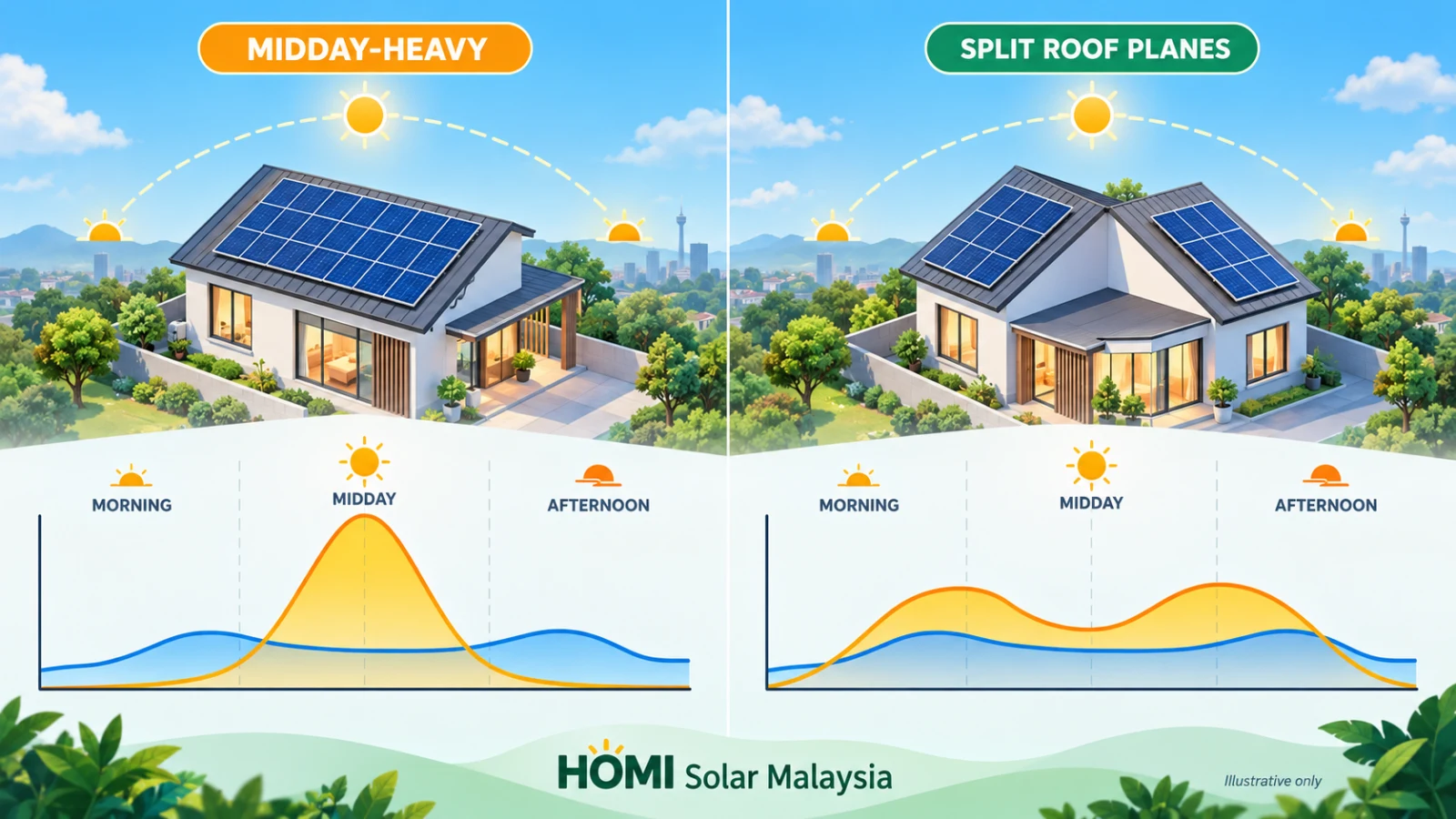
Ask two different questions
Question 1: Which layout produces more energy over a modelled year? This is an energy-yield question. Question 2: Which layout produces electricity when the building can use it? This is a production-profile and self-consumption question. A proposal should answer both. A single annual kWh number hides whether output is concentrated around midday or spread more evenly into the morning and later afternoon.
Worked example: same daily solar energy, different timing
Hypothetical illustration only: the figures below are not measured HOMI project data, a tariff calculation, a savings forecast or a design recommendation. They simply show why time-of-day distribution matters.
| Three daytime periods | Building load | Layout A: midday-heavy | Layout B: split roof planes |
|---|---|---|---|
| Morning | 8 kWh | 6 kWh solar | 9 kWh solar |
| Midday | 5 kWh | 16.5 kWh solar | 12 kWh solar |
| Late afternoon | 10 kWh | 7.5 kWh solar | 9 kWh solar |
| Total solar | 23 kWh load | 30 kWh | 30 kWh |
| Direct-use ceiling before storage or controls | Sum of the smaller load or solar value in each period | 6 + 5 + 7.5 = 18.5 kWh | 8 + 5 + 9 = 22 kWh |
Both examples generate 30 kWh, yet Layout B has a higher simple direct-use ceiling because more output occurs when the hypothetical building needs it. Real results require interval load data, actual roof bearings and slopes, shading, inverter limits, losses and the current export arrangement. Do not use these numbers as a performance promise.
What a comparable roof-layout proposal should show
- Measured roof planes: usable dimensions, slope, azimuth and obstacles for every plane, not a generic satellite sketch alone.
- Horizon and shading evidence: trees, parapets, neighbouring buildings, roof equipment and seasonal sun paths, with the method and date recorded.
- Electrical layout: how modules on different planes connect to inverter inputs or optimisers and what happens under mismatch or clipping.
- Model inputs: location, weather database, module and inverter assumptions, system losses, degradation and any availability factor.
- Energy outputs: monthly and annual estimates plus hourly or representative-day profiles for each roof option.
- Load match: interval consumption evidence that remains private, with only the necessary summary used for design.
- Structural and drainage constraints: wind exposure, attachment, waterproofing, access, drainage and maintenance clearance.
A practical comparison checklist
- Request a roof-plane schedule listing measured tilt and azimuth for every proposed array.
- Ask for at least two feasible layouts modelled with the same weather database, equipment, loss assumptions and system size.
- Compare annual kWh, monthly distribution and morning/midday/afternoon output—not annual kWh alone.
- Record any shading or horizon file and ask which obstacles are included or excluded.
- Compare the solar profile with anonymised interval-load summaries; keep bills, account numbers and customer data out of public comments and AI tools.
- Ask how multi-plane strings, MPPT inputs, optimiser choices and inverter limits are handled.
- Confirm structural, electrical, utility and authority requirements for the exact site before approval.
- Keep the final model, roof plan, assumptions, approved drawings and commissioning record for future maintenance.
Homi Solar Malaysia can help turn competing roof layouts into a like-for-like comparison before a design is approved. Review the current solar service route or contact HOMI for a site-specific review.
Regional boundary: the Energy Commission source checked on 14 October 2026 is the June 2026 self-consumption guideline for Peninsular Malaysia. Sabah and Sarawak may follow different utility and authority routes. The SEDA homeowner page is consumer guidance, while PVGIS is a technical modelling tool. This article is not an engineering approval, regulatory opinion, site survey or guarantee of production, savings, payback or eligibility.
Frequently asked questions
Is south-facing always best for solar in Malaysia?
No universal compass rule should replace site modelling. Malaysia’s near-equatorial sun path, actual roof planes, horizon, shading and load timing must be evaluated for the exact location.
Should I choose the layout with the highest annual kWh?
Not automatically. Compare annual energy with monthly variability, inverter behaviour, structural constraints and how much output occurs when the building can use it.
Can PVGIS replace a site survey?
No. PVGIS can compare slope, azimuth and energy assumptions using climate and horizon data, but it does not inspect your roof, structure, wiring, obstacles, drainage or local approval route.
Do east- and west-facing roof planes have no value?
They may be useful when they are feasible and help distribute production into the morning or afternoon, but the trade-off must be modelled with the same inputs and checked against the actual load.
Official sources checked
- Energy Commission: Guidelines for Solar Photovoltaic for Self-Consumption in Peninsular Malaysia, June 2026
- SEDA Malaysia: Residential homeowner guidance for solar PV
- European Commission JRC: PVGIS 5 user manual
This article reflects official information checked on 14 October 2026 and is general guidance. Programme rules, tariff treatment, approval and actual savings remain subject to the latest PETRA, SEDA, Energy Commission and TNB requirements plus the property bill, roof and usage pattern.
Want HOMI to review your TNB bill?
Send your usage pattern and HOMI can estimate whether Solar ATAP makes sense for your home or business.
Arrange a Roof Layout Review