


Solar panel heat: understand the power rating

A solar panel’s rated watts describe a reference test condition, not a promise of that power throughout a hot Malaysian afternoon. Check the maximum-power temperature coefficient, usually labelled Pmax, and ask which cell-temperature assumptions were used in the proposal. A weather app’s air temperature is not a substitute for cell temperature.
Homi Solar Malaysia prepared this guide for owners comparing panel specifications. It addresses panel temperature, separate from inverter overheating or inverter clipping. All artwork is AI-generated educational illustration, not an actual HOMI installation or measured project data.
Read the rating with its conditions
SAM’s module documentation separates nominal reference ratings from operating values and treats mounting airflow as relevant to thermal modelling. Ask the supplier to identify the exact datasheet and the Pmax coefficient, rather than using a voltage or current coefficient with a similar-looking unit.
The Sandia PVPMC explanation of PVWatts uses irradiance and cell temperature as separate inputs to DC maximum power, referenced to 1,000 W/m² and 25°C. This explains why more sunshine and more heat should not be treated as the same influence. It does not say that a Malaysian roof normally reaches a particular temperature.
A hypothetical power comparison
Invented inputs for teaching only: take a 500 W reference module and a Pmax coefficient of −0.40% per °C, expressed as −0.004 per °C in the formula. Hold irradiance at the reference level and isolate temperature: simplified DC power = 500 × [1 − 0.004 × (cell temperature − 25)].
| Assumed cell temperature | Temperature difference | Illustrative factor | Illustrative DC power |
|---|---|---|---|
| 25°C | 0°C | 1.00 | 500 W |
| 45°C | 20°C | 0.92 | 460 W |
| 65°C | 40°C | 0.84 | 420 W |
The arithmetic is HOMI’s worked example using the cited model form. These temperatures and coefficient are not measured Malaysian conditions, a named product specification, a full simulation, a safe operating limit or a warranty test. At the assumed 65°C point the difference is 80 W, or 16% of the reference power. That is an instantaneous DC comparison under fixed assumptions, not a 16% annual energy or bill loss. Other irradiance levels require their own treatment.
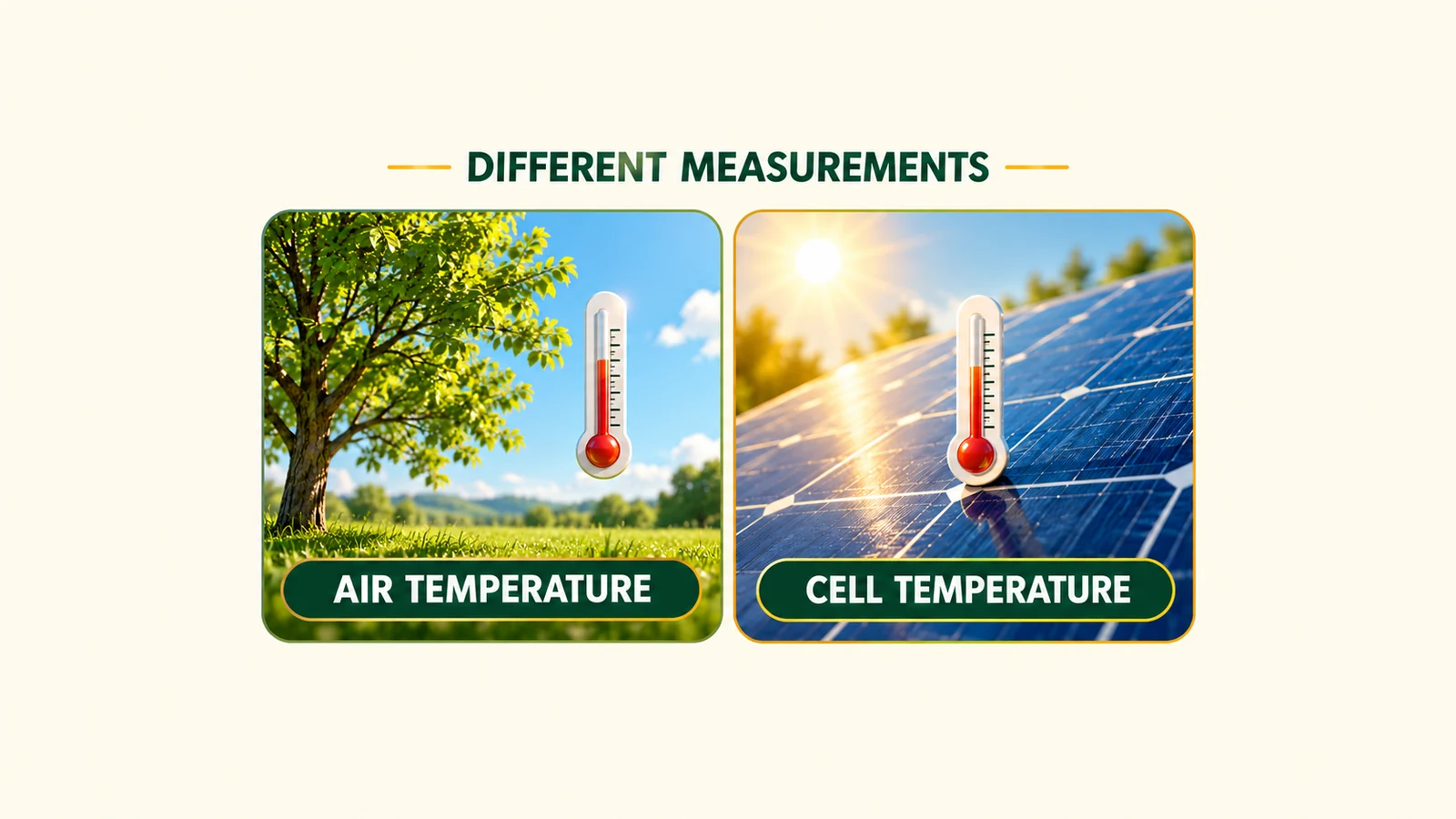
Keep air, cell and energy separate
When a proposal says “temperature”, ask what was measured or modelled. Was it outdoor air, a module back surface or a calculated cell value? Record the time and data source. Do not put an outdoor-air reading straight into a cell-temperature calculation and label the result measured panel output.
Also keep W and kWh separate. A point-in-time power estimate cannot be multiplied into a year’s savings without a time-based energy model, relevant weather, the complete system and the applicable billing treatment. Ask whether the forecast is array DC energy or AC energy after the inverter. If its model already includes thermal losses, subtracting the same allowance again counts it twice.
Five checks before choosing panels
- Request the exact model and dated datasheet used in the quotation.
- Identify the Pmax coefficient, its sign and its units.
- Ask how the model distinguishes outdoor air from cell temperature.
- Request the weather period, mounting assumptions and DC/AC boundary.
- Confirm whether the forecast already includes temperature effects.
These are HOMI editorial procurement questions, not a ranking of panel technologies. To compare two proposals, ask the team to hold the roof, weather, array size and other model assumptions consistent and disclose what changed. A less negative coefficient alone does not establish the best annual result or value for your site. Do not climb onto the roof, touch panels, spray water to chase a temperature target, or alter the mounting gap based on this example; ask a qualified team to assess the complete design.
Malaysia context and human support
The ST SELCO index, checked 26 October 2026, lists June 2026 guidance for Peninsular Malaysia, issued 24 July 2026. This is jurisdiction context, not product approval. Sabah and Sarawak require separate authority and utility checks. Solar ATAP rules, tariff treatment, approval and savings depend on current PETRA, SEDA, ST and TNB requirements and the actual bill, roof and usage pattern.
See our yield forecast checklist. Explore Homi Solar Malaysia services or ask our team to review the assumptions in your proposal. Begin with your question and module model; agree a private document channel before sharing bills. Keep unredacted bills, account numbers, addresses and customer data out of public comments and public AI tools.
Frequently asked questions
Does 25°C mean outdoor air temperature?
In this worked example it is the reference cell temperature. Do not substitute a weather-app air reading for a cell value.
Does the 420 W example prove my panel is faulty?
No. The inputs are invented and isolate one effect. They are not a diagnosis, warranty test or measured result for your system.
Can I subtract 16% from annual generation?
No. That percentage describes one assumed DC power point, not the year. Ask for the complete time-based energy forecast and avoid counting thermal effects twice.
Is the least negative coefficient always the best purchase?
The coefficient is one input. Compare the complete site design, energy assumptions, relevant equipment specifications and proposal terms before deciding.
Sources checked 26 October 2026
- National Laboratory of the Rockies / SAM: SAM Module: reference conditions and temperature correction
- Sandia National Laboratories / PVPMC: PVWatts point-value model
- Suruhanjaya Tenaga: Self-Consumption (SELCO) official index
This article reflects official information checked on 26 October 2026 and is general guidance. Programme rules, tariff treatment, approval and actual savings remain subject to the latest PETRA, SEDA, Energy Commission and TNB requirements plus the property bill, roof and usage pattern.
Want HOMI to review your TNB bill?
Send your usage pattern and HOMI can estimate whether Solar ATAP makes sense for your home or business.
Discuss Panel Temperature Assumptions