


Birds under your solar panels?
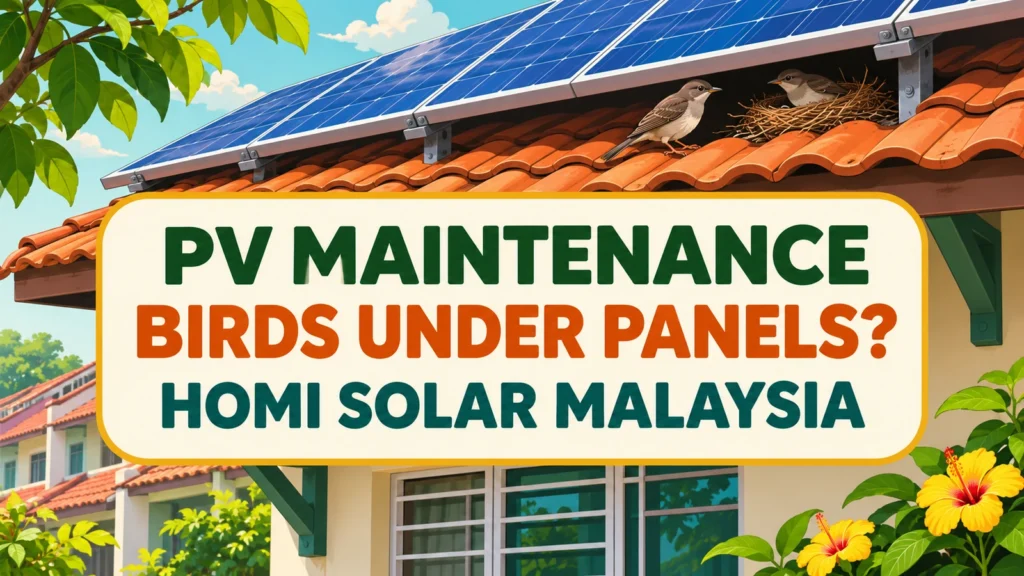
If birds repeatedly disappear under the same panel edge or carry twigs to it, record the pattern from the ground and ask a solar technician to inspect. Birds sitting on a roof or droppings on a panel alone do not confirm a nest. Homi Solar Malaysia suggests reporting the activity and the electrical condition as separate questions, so the visit covers more than cleaning the glass.
Why the gap matters
The U.S. Department of Energy owner’s guide documents animals nesting beneath arrays and cases where wires were displaced or their insulation was damaged. The DOE maintenance guide includes nest and debris removal and cable management in electrical equipment maintenance. Visible droppings are a surface observation and need a separate check for nesting. A clear glass surface or a normal app reading cannot tell you whether hidden cables are sound.
Match the sign to the check
| Ground observation | What it suggests | What to report or ask |
|---|---|---|
| Birds perch above the array | Surface activity. Nesting is unconfirmed. | Record whether they enter a gap and where droppings collect. |
| Repeated entry or twigs at one edge | Possible nesting beneath the panels. | Flag the exact edge and ask about occupancy before any exclusion. |
| Loose cable or new inverter alert | Possible electrical problem. The cause is open. | Share the alert and visible location with a qualified PV technician promptly. |
The first two rows distinguish surface soiling from a possible nest using the two DOE guides. The last row is a reporting trigger. An inverter alarm by itself does not identify the cause. Keep away if you see smoke or sparking and contact local emergency services.
Plan the visit before fitting mesh
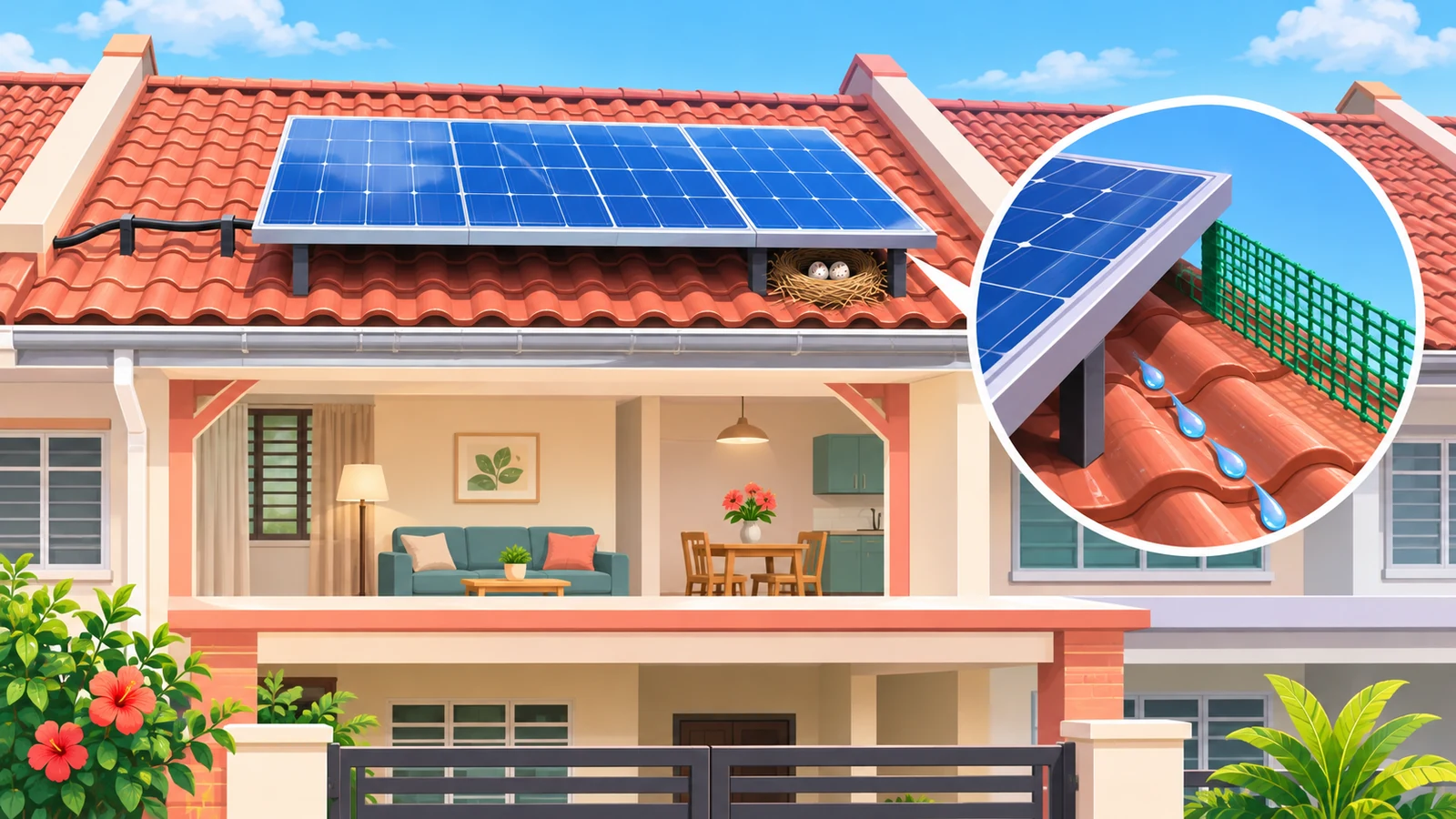
Ask who will check the underside, assess cables and supports, and confirm whether the gap is occupied. If birds, eggs or chicks may be present, leave the opening accessible and ask an appropriate local wildlife or animal-handling professional how to proceed. Then ask the solar installer whether a proposed barrier suits the module and roof, whether it preserves ventilation and rainwater flow, and how technicians will reach the array later. Request written confirmation of attachment details and warranty implications.
Prepare a short report
- Note the time, roof side and frequency of entry from a safe place.
- Use a zoomed photo from the ground only if the area is safe.
- Save any new inverter alert and its timestamp.
- Tell the installer about visible debris near gutters or displaced cables.
- Ask for separate findings on animal activity, cable condition and any proposed guard.
The Homi Solar Malaysia team can discuss what an inspection should cover. See our solar services for the service route. Agree on a private channel before sharing an address, bill, account number or identifying photos. Keep these out of public comments and AI tools.
Sources checked on 12 November 2026. The June 2026 Energy Commission PV guideline covers self-consumption in Peninsular Malaysia. Follow the appropriate local electrical and wildlife guidance for the actual address, including in Sabah and Sarawak. The U.S. guides explain technical observations. This guide is for reporting from the ground, with no roof access, cable handling, removal or DIY mesh fitting.
Common questions
Do droppings confirm a nest?
No. Note whether birds regularly go into the same opening or carry nesting material. A technician can check the hidden space.
Can a normal app reading rule out damage?
No. Normal generation describes current output. The installer should inspect cable support and insulation if the evidence warrants it.
Can I cover an occupied gap?
Keep the opening accessible and get local advice about the birds first. Arrange inspection and any fitting with the appropriate professionals.
Does mesh fix a cable fault?
No. Cable assessment and any electrical repair are separate from deciding how to discourage re-entry.
Source notes
- PV System Owner’s Guide to Weather Vulnerabilities — U.S. Department of Energy, Federal Energy Management Program
- Life Cycle of Photovoltaic Systems: Operate and Maintain an Existing Photovoltaic System — U.S. Department of Energy, Federal Energy Management Program
- Guidelines for Solar Photovoltaic for Self-Consumption in Peninsular Malaysia — Suruhanjaya Tenaga
This article reflects official information checked on 12 November 2026 and is general guidance. Programme rules, tariff treatment, approval and actual savings remain subject to the latest PETRA, SEDA, Energy Commission and TNB requirements plus the property bill, roof and usage pattern.
Want HOMI to review your TNB bill?
Send your usage pattern and HOMI can estimate whether Solar ATAP makes sense for your home or business.
Discuss a Rooftop PV Inspection