
Usage Same, But Bill Higher? Why?
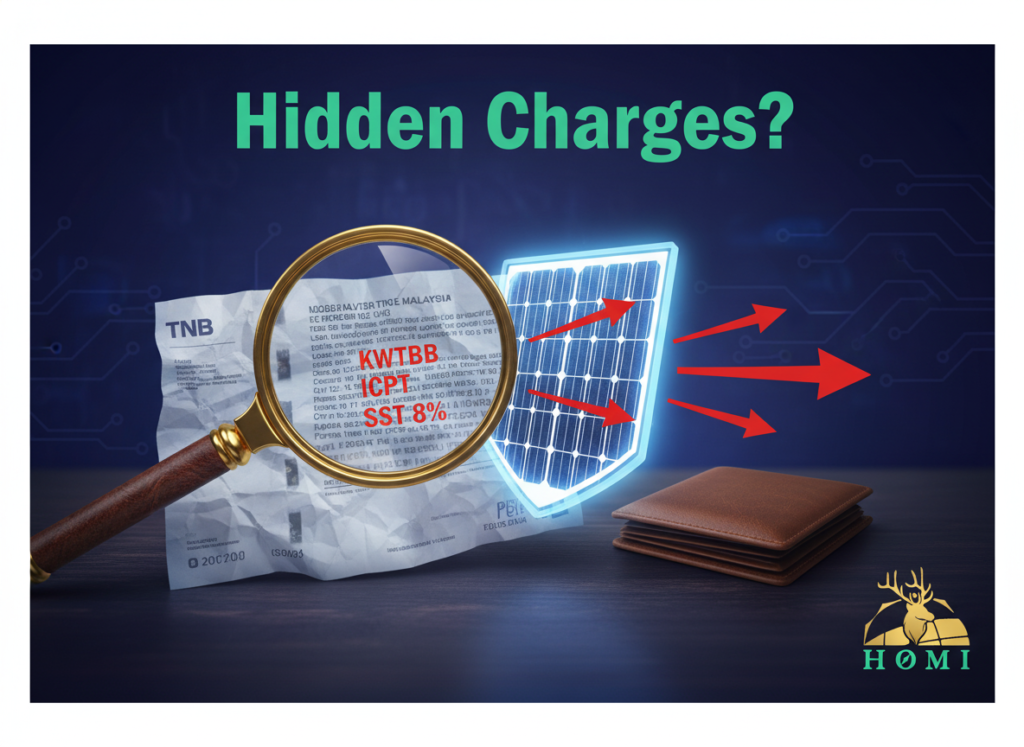
When receiving a TNB bill, most people only look at the “Total Payable.” But if you scrutinize the bottom right corner, you’ll find a confusing list of acronyms and surcharges.
These are the “invisible charges” inflating your bill silently.
1. KWTBB (Renewable Energy Fund)
-
What is it? A fund to support renewable energy development.
-
The Cost: If your monthly usage exceeds 300kWh, TNB charges an extra 1.6% on your total bill.
-
The Irony: You are paying extra to subsidize green energy. Unless you install solar yourself, you are essentially paying for others to go green.
2. ICPT (Imbalance Cost Pass-Through)
-
What is it? A mechanism to pass fuel cost changes to consumers. Simply put, it’s a “fuel surcharge” based on global coal prices.
-
The Cost: This rate fluctuates. For high-consumption users, this surcharge can be significant. When fuel prices go up, your bill goes up—completely out of your control.
3. The Impact of SST (Sales and Service Tax)
-
The Policy: The SST on electricity bills has increased from 6% to 8%, applicable to usage above 600kWh.
-
The Impact: For medium-to-high usage households, every extra unit of electricity incurs this 8% tax.
Solar: Not Just Savings, It’s “Tax Avoidance”
Since these surcharges are calculated as a percentage (%), the only way to fight them is to reduce the “Billing Base.”
Here is the math of installing solar:
-
Direct Reduction of Usage: Solar power is consumed directly by your home, drastically reducing the kWh bought from TNB.
-
Neutralizing Surcharges:
-
Lower bill = Lower 1.6% KWTBB.
-
Lower usage = Lower ICPT surcharge.
-
Crucially, if you can drop your grid import below 600kWh, you can completely avoid the 8% SST!
-
Conclusion: In an era of inflation and rising fuel costs, a solar system is more than a utility device; it is a financial instrument. It helps you lock in future energy costs, turning you from a “passive payer” into an “active manager,” protecting you from the anxiety of those confusing acronyms on your bill.