
Hari Raya 2026 in Malaysia: 5 Holiday “Balik Kampung” Settings Every Solar ATAP Homeowner Should Use to Avoid Letting TNB Credits Expire
For urban Muslim families with Solar ATAP on the roof, that “super long balik kampung break” also means one more thing: several empty, sunny days when your panels keep generating but no one is home to use the energy—and under Solar ATAP, unused export credits simply expire at month-end.
This guide explains what that means under the new Solar ATAP rules and gives you five practical, easy-to-implement “Holiday Mode” settings you can prepare before you leave, so your Raya solar generation is converted into real comfort and convenience—not just free electricity for the grid.
1. Quick Refresher: Hari Raya 2026 = Extra-Sunny + Extra-Long Break
According to current calendars and government announcements, Hari Raya Aidilfitri 2026 in Malaysia is expected around 20–21 March, with a national public holiday on Raya itself and at least one additional day either on the Friday before or Monday after.
- If Hari Raya falls on Friday 20 March, Monday 23 March is an extra holiday.
- If Hari Raya falls on Saturday 21 March, Friday 20 March becomes the extra holiday.
- Many families will combine this with annual leave and school holidays, turning it into a week-long balik kampung break.
For Solar ATAP homeowners, this likely means 4–7 days where your house is mostly empty during the sunniest hours of the day.
2. Solar ATAP Rule That Matters Most for Holidays: Credits Don’t Roll Over
Under Solar ATAP, domestic export credits are very different from older NEM schemes. Three key rules matter for Hari Raya:
- Export credits are calculated based on the prevailing domestic Energy Charge (not Capacity or Network components).
- Credits offset only the Energy Charge portion of your bill—no cash payout, no offset for Capacity/Network or taxes.
- Credits can only be used within the same billing cycle; any unused portion expires at the end of the month with no rollover.
In plain language: if you leave the house empty for a long, sunny Raya week, your panels will still generate, but a bigger share of that generation will be exported and may end up as credits you cannot fully use before the billing cut-off.
3. The Idea of “Holiday Mode” for Solar ATAP Homes
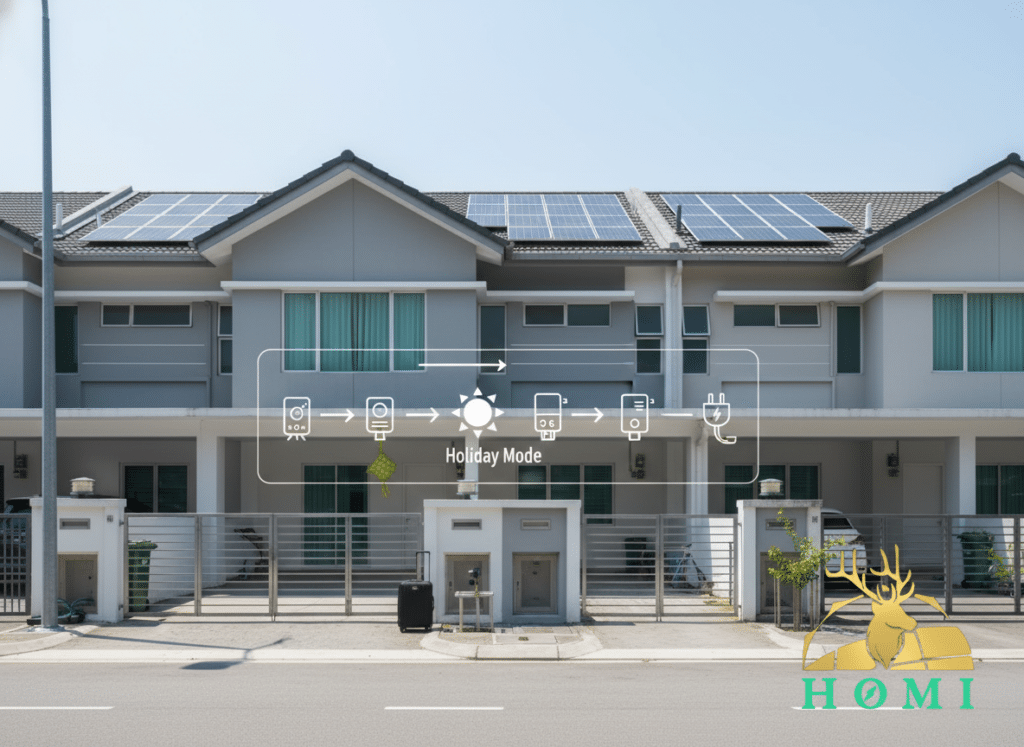
Instead of switching everything off and letting your export credits expire, a smarter approach is to plan Holiday Mode loads that:
- Run mostly between late morning and mid-afternoon (roughly 11am–3pm), when solar output is strongest.
- Automatically turn on and off via timers or smart plugs, so you do not waste energy at night.
- Convert surplus solar into real-life benefits: a drier house, fresher air, pre-heated water and an EV that is ready when you return.
Think of it as: “If I cannot bank my solar credits, how do I bank comfort and convenience instead?”
4. 5 Practical “Avoid Credit Expiry” Settings Before You Balik Kampung
1) Midday Dehumidifier Mode (11am–3pm)
- Set one or two dehumidifiers on timers to run between 11am and 3pm daily.
- This uses your solar peak to keep humidity under control, protecting furniture, wardrobes and electronics from mould.
- Make sure water tanks can drain or have enough capacity for the period you are away.
2) Air Purifier and Circulation Fans on Solar Hours
- Program air purifiers and selected ceiling/stand fans to run in “low” or “medium” mode for a few hours in the midday window.
- This helps keep air moving and reduces stale smells, especially in closed-up rooms and upstairs areas.
3) Water Heater Pre-Heat Schedule
- If you have a storage water heater, set it to pre-heat during midday (e.g. 12pm–2pm).
- Even if no one uses the hot water while you are away, this is a safe way to soak up some surplus solar instead of exporting everything.
- When you return, your system is already in a good “normal schedule” configuration for everyday solar use.
4) EV or Plug-in Hybrid Slow Charging at 11am–3pm
- If a car will remain at home, set the EV charger to a low kW setting and schedule charging to run only during sun-rich hours.
- Use the car app or wallbox timer to block night-time charging so you do not pull from the grid unnecessarily.
- You come home to a fully charged car, and your solar generation has been converted into actual travel km instead of expiring credits.
5) Smart Fridge/Freezer Boost + “Just Enough” Standby Loads
- Most homes already have fridges, router, CCTV, and alarm on 24/7. During Raya, these provide a base “must-run” load.
- Some modern fridges have quick-freeze or boost modes you can schedule around midday before your trip to stabilise temperature and make full use of midday solar.
- Combine this with modest Holiday Mode AC in one key area (e.g. master bedroom at 28°C 1–2 hours midday) if you want to protect sensitive items or finishes from extreme heat.
5. Simple Holiday Mode Planner: How Much of Your Raya Solar Can You Actually Use?
Solar ATAP Holiday Mode Planner – “Avoid Expiring Credits” Snapshot
Adjust the sliders to estimate how much of your midday solar generation you can turn into self-consumption loads while you are away.
Assumptions: very simplified; uses 4.5 kWh/kW/day average generation, with 60% of that produced between 11am and 3pm. Loads are assumed to run only during sun hours. HOMI can build a detailed “Holiday Mode” profile using your real TNB bills, inverter data and appliance list.
6. How HOMI Teaches “Holiday Mode” as Part of Every Solar ATAP Handover
At HOMI, we see “holiday planning” as a core part of Solar ATAP ownership—not an afterthought. Credits that expire every month are wasted potential if you do not have a simple plan to use them during school holidays, Raya, Chinese New Year and long weekends.
- Explains the Energy Charge-only, no-rollover rule in plain language so expectations are clear.
- Reviews your appliances and suggests a practical Holiday Mode list (dehumidifier, air purifier, EV, water heater, etc.).
- Shows you how to set timers or smart plug schedules for 11am–3pm loads and how to avoid night-time wastage.
- Helps you read your inverter portal so you can see how much Raya solar went to self-consumption vs export.
FAQ: Hari Raya, Balik Kampung and Solar ATAP Credits
What actually happens to my Solar ATAP credits if my house is empty for a week during Hari Raya?
Under Solar ATAP, any excess energy your system exports to the grid earns bill credits that offset only the Energy Charge portion of your bill for that month. If your house is empty and daytime consumption is very low, a larger share of your solar generation will be exported. If those credits exceed the Energy Charge for that billing cycle, the unused balance simply expires at month-end. There is no rollover to the following month and no cash payout, so a long, sunny holiday with zero planning can lead to wasted credit value.
Is it safe to leave dehumidifiers, air purifiers or EV charging scheduled while I am away?
Many modern appliances and EV chargers are designed to operate safely on timers or scheduled modes, but safety should always come first. Use devices with proper certifications, ensure wiring and sockets are in good condition and avoid overloading extension cords. Keep power levels modest and limit operation to solar-rich hours so loads are covered by PV as much as possible. HOMI can review your planned Holiday Mode loads as part of a system check and advise on safe configurations based on your home’s wiring and main incoming capacity.
How can HOMI help me set up a good Hari Raya Holiday Mode for my specific home?
HOMI can look at your inverter data, recent TNB bills and appliance list to estimate how much solar your system generates around Raya and how much your house normally consumes when you are away. Based on that, we recommend a simple list of daytime-only loads and timer settings, and can even pre-configure schedules on compatible smart plugs or chargers during handover. The goal is to ensure your Solar ATAP system keeps working for you during balik kampung—improving comfort, preserving your home environment and reducing wasted export credits.