
Hari Raya Electricity Usage: How Many Air-Conditioners Can a “Just Nice” Solar ATAP System Really Cover in a Malaysian Landed House?
On a day like this, every extra hour of air‑conditioning and cooking hits your TNB bill—so how much of that daytime cooling can a “just nice” Solar ATAP system realistically cover between 11am and 4pm?
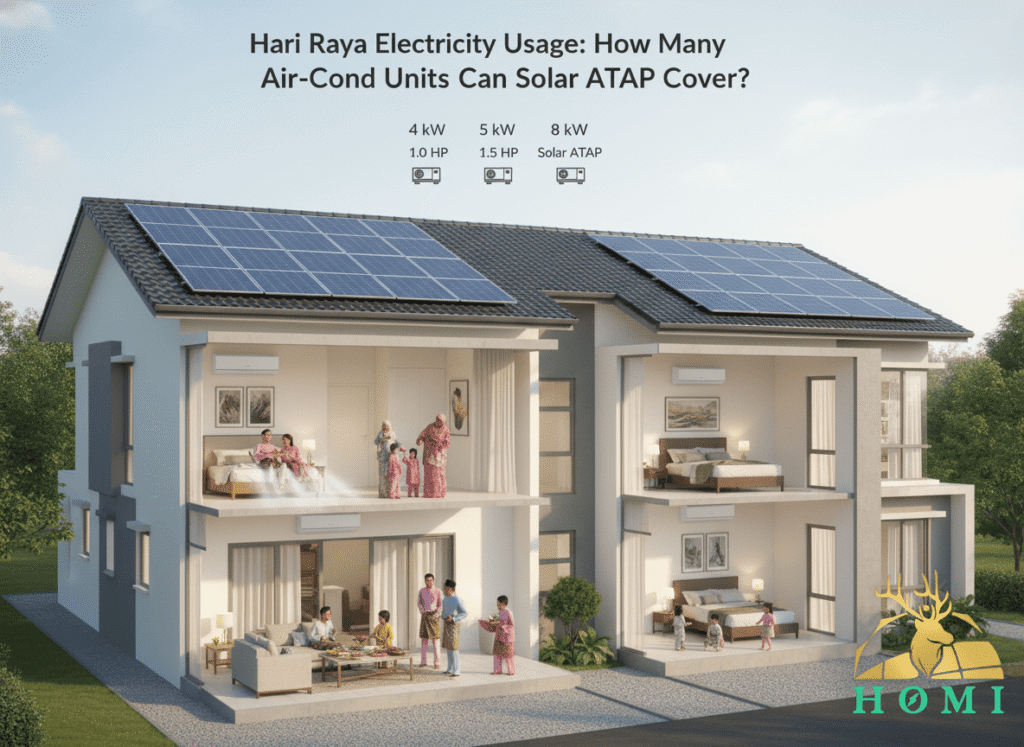
This article uses simple numbers to show what 4 kW, 5 kW and 8 kW Solar ATAP systems can roughly support for 1.0 HP and 1.5 HP air‑conditioners and basic appliances during Raya open house hours—and why aiming for close to 100% daytime self‑consumption is ideal under the no‑rollover ATAP rules.
1. A Few Ground Rules: Solar Output and AC Consumption in Malaysia
Before we plug in numbers, we need realistic assumptions.
Solar output (typical Malaysian landed house):
- 1 kWp of rooftop solar generates roughly 4–5 kWh per day on average; we will use 4.5 kWh/day as a mid‑point. [web:374]
- From that, about 45–55% usually comes between late morning and mid‑afternoon (roughly 11am–4pm) on a clear day.
Air‑conditioner consumption (typical non‑inverter/inverter range):
- 1.0 HP room AC: around 0.8–1.1 kW input while running; we will approximate 1.0 kW. [web:462][web:463][web:468]
- 1.5 HP room AC: around 1.1–1.3 kW input; we will approximate 1.2 kW. [web:465][web:462]
- Fans, lights, fridge, router and basic loads: easily 0.3–0.6 kW combined during open house hours. [web:462][web:381]
Real‑world usage varies with thermostat setting, insulation and guest traffic, but these ballpark figures are good enough to understand capacity.
2. 4 kW, 5 kW, 8 kW Solar ATAP: How Much Midday Energy Do You Have on Raya Day?
| System Size | Daily Output (4.5 kWh/kW) | Approx. 11am–4pm Energy (Raya Day) |
|---|---|---|
| 4 kW Solar ATAP | ≈ 18 kWh/day | ≈ 9–10 kWh in the 5-hour 11am–4pm window. |
| 5 kW Solar ATAP | ≈ 22.5 kWh/day | ≈ 11–13 kWh in the 11am–4pm window. |
| 8 kW Solar ATAP | ≈ 36 kWh/day | ≈ 18–20 kWh in the 11am–4pm window. |
Now we compare that to what your AC and appliances might consume if they run steadily over those same Raya open house hours.
3. How Many AC Units Can Each System “Comfortably” Support from 11am–4pm?
Assume you want to keep your **grid draw low during 11am–4pm**, using Solar ATAP for most of the load, while still accepting some occasional top‑up from TNB when clouds pass.
- 1.0 HP AC ≈ 1.0 kW
- 1.5 HP AC ≈ 1.2 kW
- Base household load (fridge, fans, lights, router) ≈ 0.5 kW
4 kW system (peak PV ≈ 3–3.5 kW):
- Comfortable scenario:
- Living room 1.5 HP AC + 1 small room 1.0 HP AC + base load.
- Total ≈ 1.2 + 1.0 + 0.5 = 2.7 kW.
- On a strong sun hour, solar covers most of it; when clouds pass, a bit comes from TNB.
5 kW system (peak PV ≈ 4–4.5 kW):
- Comfortable scenario:
- Living room 1.5 HP AC + 2 bedrooms with 1.0 HP AC + base load.
- Total ≈ 1.2 + 1.0 + 1.0 + 0.5 = 3.7 kW.
- Gives more headroom for kitchen appliances cycling (rice cooker, induction hob) during prep time.
8 kW system (peak PV ≈ 6.5–7.2 kW):
- Comfortable scenario:
- Living room 1.5 HP + 3–4 rooms with 1.0–1.5 HP AC + base load.
- For example: 1.5 + 1.5 + 1.0 + 1.0 HP ≈ 4.7 kW of AC + 0.8 kW of kitchen/base = 5.5 kW.
- Still some buffer for intermittent heavier kitchen usage during peak Raya cooking hours.
These are not “maximum” numbers but “just nice” scenarios where your Solar ATAP system does most of the work in 11am–4pm without depending heavily on the grid.
4. Simple AC Coverage Calculator – Raya 11am–4pm Scenario
Raya AC Coverage – How Many HP Can My Solar Cover?
Use this simple calculator to estimate how many hours of cooling your Solar ATAP system can support for your chosen mix of 1.0 HP and 1.5 HP AC units during 11am–4pm.
Assumptions: 1 kW solar ≈ 4.5 kWh/day, 50% of output in 11am–4pm, 1.0 HP ≈ 1.0 kW, 1.5 HP ≈ 1.2 kW. Focus is on using as much of your midday generation as possible under Solar ATAP’s self-consumption-first, no-rollover credit rules. [web:374][web:462][web:463][web:465][web:370][web:413]
5. Why “Almost 100% Daytime Self-Use” Matters Under Solar ATAP
Solar ATAP is specifically designed for self-consumption rather than selling energy back.
- Domestic users get credits at the Energy Charge rate for any export. [web:370][web:413][web:429][web:466]
- Credits can only offset that month’s Energy Charge and do not roll over or become cash. [web:370][web:413][web:466]
- Any unused credits at the end of the billing cycle are simply lost. [web:370][web:413][web:466]
This means the ideal Solar ATAP system for a landed Raya-hosting family is not “as big as possible”, but “just nice” — sized so that on most days (including Hari Raya), you use close to 100% of what you generate in real time.
6. How HOMI Designs Around “AC Coverage Rate”, Not Just kW Numbers
When we design systems for Muslim families in landed houses, we do not just ask “How many kW do you want?” We ask: “On a typical hot day, how many rooms must be cool, and at what times?”
- Listing your AC units (HP per room, inverter vs non‑inverter) and typical usage windows (living room, master, kids’ rooms, guest room).
- Checking your past TNB bills to see actual daytime vs night‑time kWh and how much spikes during festive months. [web:374][web:381]
- Running a “cooling coverage” simulation: what % of your Raya 11am–4pm cooling can a 4 kW / 5 kW / 8 kW system cover on a clear day.
- Aligning Solar ATAP capacity with your comfort expectations and your budget so that most midday kWh are self‑consumed, not wasted as unused export credits.
FAQ: Hari Raya Open House, Solar ATAP and Air-Cond Coverage
Can a 4 kW Solar ATAP system really run multiple AC units during Raya?
On a clear day in Malaysia, a 4 kW system can produce roughly 18 kWh, with around 9–10 kWh in the 11am–4pm window. With typical loads of about 1.0 kW for a 1.0 HP room AC, 1.2 kW for a 1.5 HP room AC and 0.5 kW for base loads, a 4 kW system can comfortably support something like a 1.5 HP living room unit plus one 1.0 HP bedroom unit and basic loads during peak solar hours, with occasional top-up from the grid when clouds pass. The exact coverage depends on your AC efficiency, thermostat settings and how much of your kitchen load runs at the same time.
Why is it not always wise to oversize my Solar ATAP system just to cover more AC?
Under Solar ATAP, any excess energy exported to the grid is credited at the Energy Charge rate only, and credits do not roll over beyond the billing month or turn into cash. If your system is much larger than your typical daytime usage, you will export more than your Energy Charge can absorb in many months, causing credits to expire. This reduces the effective financial benefit of the extra panels. A better approach for many landed homes is to size the system around a realistic mix of air-conditioning, fans and household loads so that close to 100% of generation is used directly or as credits that are actually consumed each month.
How does HOMI calculate “AC coverage rate” for my specific home?
HOMI gathers information on your AC units (horsepower, inverter vs non-inverter), typical thermostat settings, which rooms need to be cooled at which times, and your historical TNB bills. Using standard kW input values for each AC type and local solar yield assumptions (for example 4–5 kWh per kWp per day), we simulate how much of your 11am–4pm cooling and other loads can be served by a 4 kW, 5 kW or 8 kW Solar ATAP system during clear and mixed weather. This gives you a practical “coverage percentage” for Raya and everyday conditions, rather than a single kW number with no context.