
Choosing the Right System is Step One for ROI
Many homeowners start their consultation with Homi by saying, “I want the one with batteries!” or “I want to cut ties with TNB completely!” However, after analyzing their usage, we often find their initial idea isn’t the most cost-effective one.
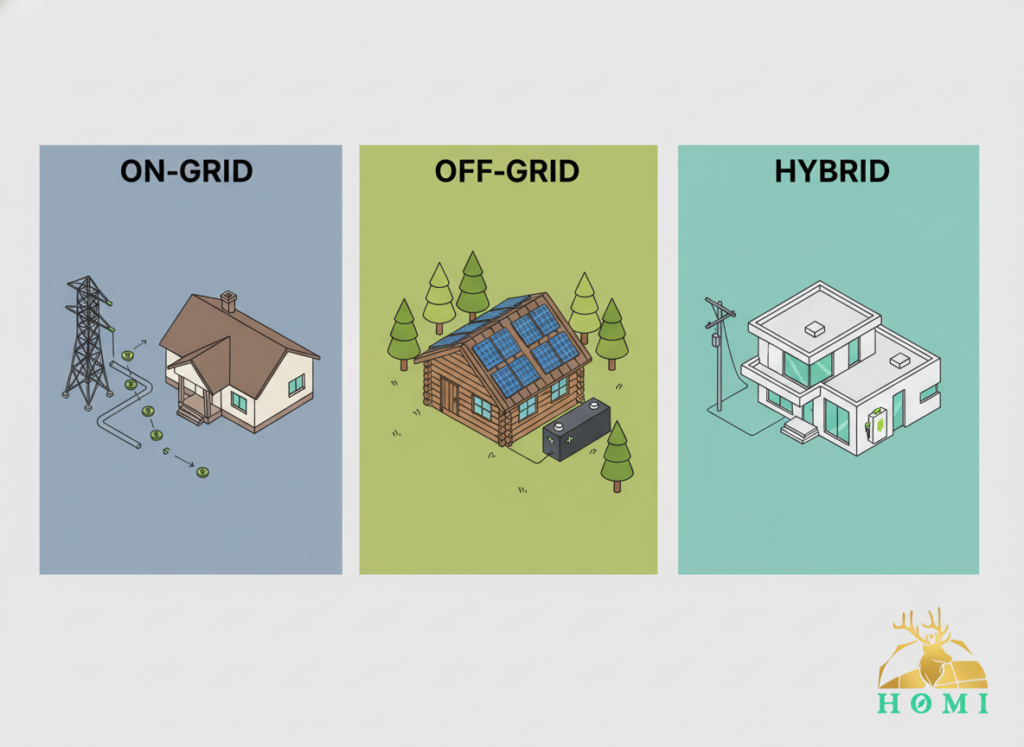
Solar systems fall into three main categories. Understanding them is crucial to maximizing your Return on Investment (ROI).
1. On-Grid System (Grid-Tied) — The “Money Saver” for Urban Homes
This is the choice for over 90% of Malaysian households.
-
How it works: Solar power runs your home appliances directly. Excess energy is “sold” back to the TNB grid via the NEM scheme.
-
Pros:
-
Lowest Cost: No expensive batteries needed. Fastest ROI (approx. 3-5 years).
-
Low Maintenance: Fewer components mean less hassle.
-
-
Cons: Shuts down during blackouts. For safety reasons (Anti-islanding), the system must cut power when the grid goes down.
-
Best For: Urban residents with stable grid power whose main goal is to reduce monthly electricity bills.
2. Off-Grid System — “Self-Sufficiency” for Remote Areas
-
How it works: Completely disconnected from TNB. Solar charges batteries during the day, and batteries power the house at night.
-
Pros: 100% energy independence. Immune to TNB rate hikes or blackouts.
-
Cons:
-
Extremely High Cost: Requires a massive battery bank to cover rainy days.
-
Finite Power: If batteries run dry, you lose power.
-
-
Best For: Deep jungles, orchards (Kebun), or islands where TNB cables cannot reach. For standard urban homes, the ROI is very poor.
3. Hybrid System — The “All-Rounder”
A rising trend that combines the best of both worlds.
-
How it works: Connected to TNB (can sell power via NEM) BUT also has a battery bank for storage.
-
Pros:
-
Double Security: Saves bills daily AND acts as backup power during blackouts.
-
Energy Management: Can be programmed to use stored battery power during peak tariff hours.
-
-
Cons: Higher cost than On-Grid (due to batteries and hybrid inverter).
-
Best For: Areas with frequent blackouts, or homes with critical equipment (koi ponds, servers, medical devices) that cannot lose power.
HOMI’s Professional Advice: Not the Most Expensive, But the Most Suitable
Some salespeople push expensive Hybrid systems to clients who don’t need them just to inflate commissions.
At Homi, our consultation process involves:
-
Bill Analysis: When is your peak usage?
-
Location Assessment: Is your local grid stable?
-
ROI Calculation: Which system pays for itself fastest?
Conclusion: If your goal is pure financial return, On-Grid is king. If you seek energy security, Hybrid is the future. Don’t let technical jargon confuse you—book a consultation with Homi for a tailored solution.