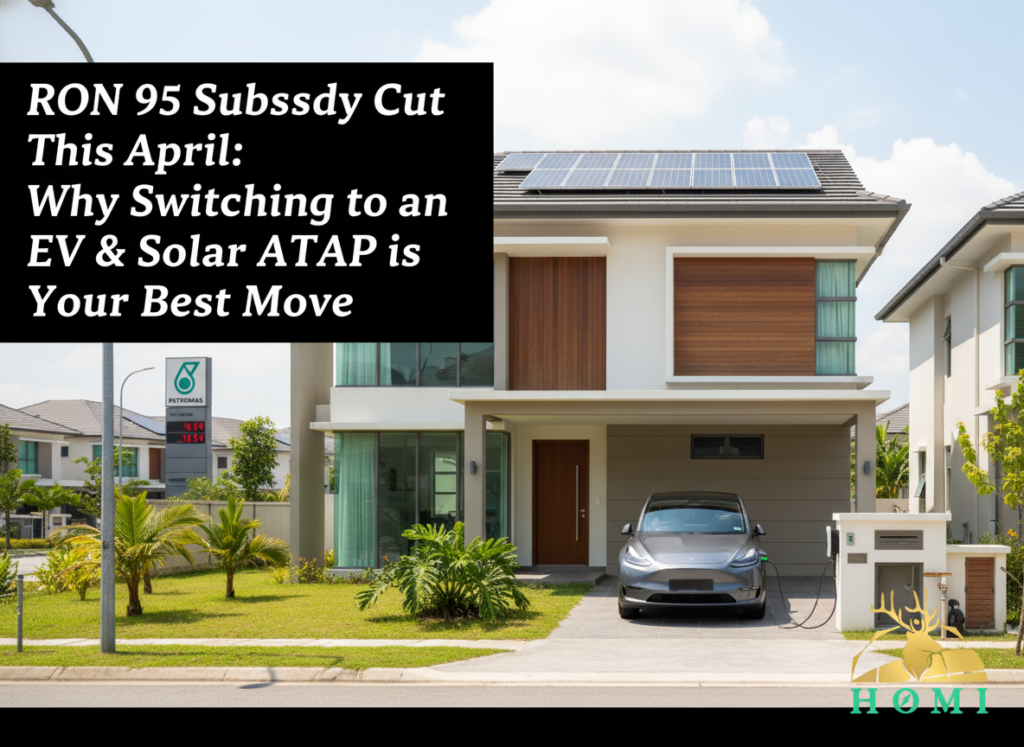

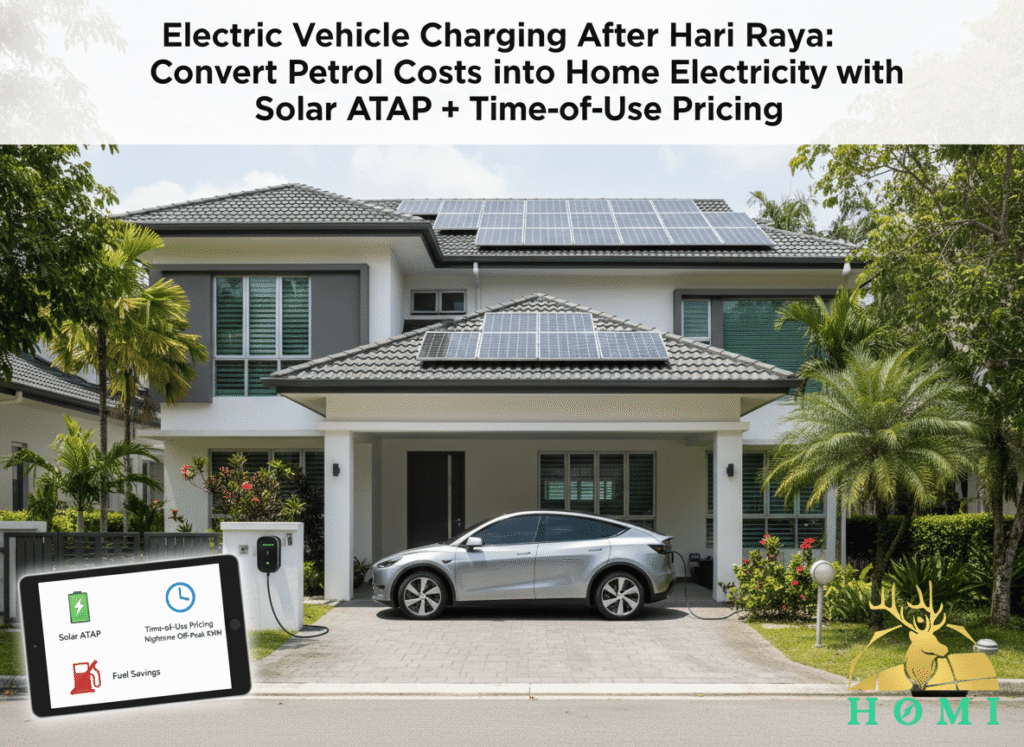
Post-Raya EV Charging: How Malaysia EV Owners Can Use Solar ATAP and TOU Tariffs to Turn Petrol Money into Home “Slow-Charge” Electricity After Balik Kampung
With 33°C heat and strong midday sun, this is exactly when a Solar ATAP rooftop system plus a smart TOU night tariff can quietly convert what used to be “petrol money” into low-cost home charging instead of public DC fast-charging receipts.
In this article, we show how EV owners can use one week of Solar ATAP “slow charging” at home—combined with off-peak TOU hours at night—to add 40–60 kWh back into the battery, and what that looks like compared to petrol spend. We also explain why HOMI designs your Solar ATAP system and home wiring with the EV charger in mind, so you can charge safely without overloading your circuits.
1. The Post-Raya EV Reality: Low SOC, High Tariff, Hot Weather
Raya drives from KL/Selangor/JB/Melaka to northern, east coast or southern hometowns easily add 600–1,000 km in a single week. Even with some DC fast-charging along the highway, most EVs return home with state-of-charge in the 10–40% range.
- Daytime temperatures in March/April sit around 32–33°C, giving you strong solar production windows.
- TNB’s new tariff structure means every kWh above 600 and 1,500 kWh carries more cost weight for landed homes.
- Public DC charging rates are typically much higher per kWh than what you pay to charge slowly at home.
2. Solar ATAP Basics for EV Owners: Self-Consumption First, No Rollover Credits
Solar ATAP is Malaysia’s 2026 rooftop solar scheme that replaced NEM 3.0. For domestic users, it is built around self-consumption, with monthly energy-only credits when you export to the grid.
Key points EV drivers should know:
- Your house always uses solar first to offset real-time grid draw (perfect for weekday slow-charging).
- Any surplus goes out as export credits that offset the Energy Charge component of your bill within the same month.
- Credits do not roll over and cannot be cashed out—unused export value is forfeited at month-end.
This means Solar ATAP is ideal if you can plug your EV in during sunny hours for slow charging. Every kWh that flows into your battery during 10am–4pm is a kWh you are not buying at full domestic tariff (plus AFA) later.
3. One Week of Post-Raya Solar “Slow Charging”: What 40–60 kWh Looks Like
Most modern EVs in Malaysia consume somewhere between about 13–17 kWh/100 km in real mixed driving. For simplicity, we will use 15 kWh/100 km as a reference efficiency for this illustration.
| Scenario | Energy (kWh) | Approx. EV Range at 15 kWh/100 km |
|---|---|---|
| 40 kWh from Solar ATAP “slow charge” over a week | 40 kWh | ~260 km of driving |
| 60 kWh from Solar ATAP “slow charge” over a week | 60 kWh | ~400 km of driving |
At a domestic Energy Charge with all components of roughly RM0.50–0.55/kWh for high-usage landed homes, 40–60 kWh of grid electricity would cost about RM20–33. Public DC could be higher. If rooftop solar covers a big portion of that 40–60 kWh during sunny hours, you are effectively turning what used to be petrol money into “home electrons” generated on your own roof.
For a typical C-segment petrol car at ~6.5 L/100 km and RM2.05/L fuel, that 260–400 km would easily cost RM35–55 in petrol—versus RM0–33 depending on how much of your charging is covered by solar and off-peak TOU.
4. Solar ATAP + TOU Strategy: Daytime Solar, Night Off-Peak, Minimum DC
In KL, Selangor, JB and Melaka, many EV owners can access or switch to a TOU (Time-of-Use) tariff that offers cheaper off-peak night rates. Combined with Solar ATAP, you can build a simple weekly pattern.
- Weekdays: plug in at home on a 7–11 kW AC charger or 3.7 kW wallbox from roughly 11am–3pm to soak up Solar ATAP generation.
- Nights: top up the remaining needed kWh in TOU off-peak windows at lower grid rates.
- Public DC: reserved only for urgent top-ups or long trips, not routine weekly charging.
5. Simple EV “Petrol vs Home Charging with Solar ATAP + TOU” Savings Calculator
Convert One Week of Post-Raya EV Charging into “Petrol Money Saved”
Use this simple calculator to visualise how much one week of EV charging at home, with Solar ATAP + TOU support, can save vs driving a petrol car the same distance.
Assumptions: This is a simplified view that compares fuel cost vs effective home-charging electricity cost for a single week, ignoring EV purchase price and solar CAPEX. Actual Solar ATAP credit behaviour, TOU rates and TNB bill structure should be modelled over a longer period.
6. How HOMI Designs Solar ATAP Systems with EV Charging and Wiring Safety in Mind
Many EV owners in KL/Selangor/JB/Melaka treat Solar ATAP as a “bonus” on top of EV savings—but the engineering needs to be planned properly.
- Include your planned EV charger (kW rating and daily usage pattern) in the overall load profile and solar sizing calculation.
- Check your main distribution board capacity, phase balancing and cable routes to avoid overloading circuits when AC, water heaters and EV charging overlap.
- Align inverter output, solar array size and TOU settings so your charger can automatically prioritise solar and cheaper off-peak energy.
- Model “post-Raya weeks” and other long-trip scenarios so you know how much of your annual EV energy can realistically come from solar and off-peak grid, not just from DC fast chargers.
FAQ: EV Charging with Solar ATAP and TOU in Malaysia
Is it really cheaper to charge my EV at home with Solar ATAP and TOU than to use public DC fast chargers?
In most cases, yes. Public DC fast chargers are priced to cover infrastructure, demand charges and profit, so their per-kWh cost is usually higher than domestic tariffs. When you combine Solar ATAP self-consumption during the day with lower TOU rates at night, your effective cost per kWh can drop significantly below typical DC rates. Over a week of post-Raya charging, this often turns into a clear RM saving compared with relying solely on DC fast-charging, especially if your EV is efficient and you drive a few hundred kilometres.
How does Solar ATAP’s “no credit rollover” rule affect EV owners specifically?
Because Solar ATAP credits only offset the Energy Charge portion of your bill and reset every month, exporting large amounts of solar that you cannot use does not maximise value. For EV owners, this is actually an opportunity: by scheduling slow charging during sunny hours, your vehicle becomes a flexible load that absorbs solar generation that might otherwise be exported. This increases your self-consumption ratio and reduces the risk of credits expiring unused. In other words, your EV helps you “catch” more of your own solar before the billing cycle ends.
Why do I need a solar specialist who understands EV chargers, not just a standard rooftop solar installer?
EV chargers are high-power devices that can add 3.7–11 kW or more of load to your home. If they are not properly accounted for in system design, you may experience nuisance tripping, unbalanced phases or even unsafe cable heating. A solar specialist who understands EV integration will look at your main incoming supply, existing loads, Solar ATAP inverter capacity and future plans, then design both the solar system and the AC distribution so everything works safely together. This ensures that your EV charging is not only cheap and green, but also compliant and reliable over the long term.