

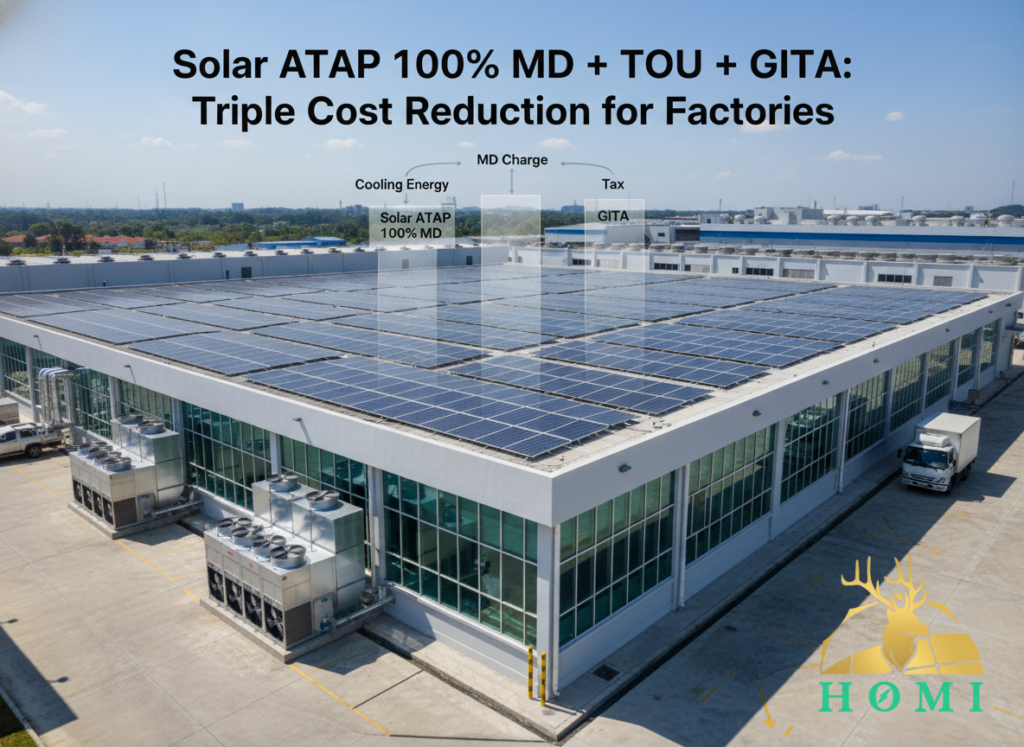
Solar ATAP for Malaysian Factories: How 100% Maximum Demand + TOU Tariff + Smart Cooling Can Triple-Layer Your Cost Reduction in a March Heatwave
Under Solar ATAP 2026, non‑domestic users can now install rooftop PV up to 100% of their Maximum Demand (capped at 1 MW), and combine that with Time-of-Use (TOU) tariffs and tax incentives like GITA to unlock three layers of savings instead of one.
This article gives SME and factory owners a practical framework: how to use March’s high heat and high solar availability as a test month to redesign your cooling and production profile around 100% MD Solar ATAP, TOU shifting and Green Investment Tax Allowance.
1. March Heatwave: Why Your Cooling and Ventilation Curve Spikes
Across many industrial zones in Malaysia, March brings higher daytime temperatures and relatively lower rainfall compared with monsoon months. For large roofed spaces, this means:
- Warehouse and shoplot roofs soak heat, driving indoor ambient temperatures up.
- Chillers, AHUs, compressors, exhaust fans and cold-room systems work harder and longer to maintain setpoints.
- Maximum Demand (MD) peaks often occur in late morning to mid-afternoon when production and cooling overlap.
- Higher kWh consumption from cooling and ventilation across the business day.
- Spiky MD events that lock in a higher MD charge for the month, even if they last only a short window.
- More exposure to peak TOU rates if your tariff includes time‑based pricing.
2. Solar ATAP 100% Maximum Demand: What It Really Means for SMEs and Factories
Solar ATAP allows non‑domestic consumers to install PV systems up to 100% of their contracted Maximum Demand, subject to a 1 MW cap and technical assessment. For factories and SMEs, that is a big shift from older, tighter caps.
In practice, this means:
- If your MD is 500 kW, you can now target a PV system up to 500 kWac (subject to technical checks), instead of being limited to a smaller fraction.
- Rooftop solar can be sized intentionally to follow your cooling and process load curve, not just whatever small quota is available.
- When combined with TOU and proper load scheduling, you can flatten MD and lower your effective daytime Energy Charge.
The 100% MD allowance is an opportunity and a risk: oversizing without understanding your MD curve and TOU pattern can reduce ROI, while smart sizing around cooling and process load peaks can transform your March heatwave from a cost shock into a savings engine.
3. Layer 1 – Solar ATAP to Shave Daytime Cooling and Process Load
First, use Solar ATAP to take a big bite out of the daytime Energy Charge for your most temperature-sensitive loads.
Typical target loads for factories and SMEs:
- Chillers, AHUs and split units serving production areas, warehouses and offices.
- Cold rooms and cold-chain equipment that run almost 24/7, but draw heavily during the day.
- Large exhaust and circulation fans in manufacturing or logistics halls.
- Core process loads that operate primarily between 9am and 5pm.
By aligning your PV system size with these daytime loads, Solar ATAP lets you self‑consume a large share of your own generation instead of pulling those kWh at full commercial rates from TNB, especially during the hottest hours of March.
4. Layer 2 – TOU Tariff to Shift Non-Critical Loads into Off-Peak
Many business tariffs in Malaysia already offer TOU or off-peak tariff riders, where electricity consumed in designated off‑peak hours is significantly cheaper than during peak windows.
| Time Window | Typical Strategy | Example Loads |
|---|---|---|
| Solar-rich hours (approx. 9am–4pm) | Use Solar ATAP to cover cooling, ventilation and core production load as much as possible. | Chillers, AHUs, main production lines, cold rooms. |
| TOU Peak (varies by tariff, typically afternoon/evening) | Avoid introducing new heavy loads beyond what solar can cover; defer where possible. | Non-urgent batch processes, non-critical pumping, some washing or baking cycles. |
| TOU Off-Peak (late night, early morning) | Shift flexible loads here to enjoy lower Energy Charge. | Ice-making, pre-cooling, water pumping, some production prep, EV or forklift charging. |
The objective is not to move everything to off‑peak, but to design your schedule so that “must-run in heat” loads are covered by solar, while “can-shift” loads are pushed into cheaper TOU windows.
5. Layer 3 – GITA and Other Incentives: Turning CAPEX into Tax Savings
On top of monthly bill reduction, Malaysian businesses can leverage Green Investment Tax Allowance (GITA) and related incentives to accelerate payback.
In simple terms:
- GITA typically allows up to 100% of solar CAPEX to be claimed as tax allowance.
- This allowance can offset a substantial portion of your statutory income, effectively letting the government “co-fund” part of your system.
- Combined with monthly Energy Charge savings and MD reduction, this can compress payback periods into the 3–5 year range for many factories and SMEs, depending on tariff and load profile.
However, GITA and related incentives have cut‑off dates, application steps and documentation requirements. Missing the timing or paperwork can mean leaving a five- or six‑figure tax benefit on the table.
6. Simple Triple-Savings Calculator: Solar ATAP + TOU + GITA (Illustrative)
Triple-Layer Business Savings – Quick Illustration
Use this simplified calculator to get a feel for how Solar ATAP (Energy Charge saving), TOU shifting and GITA (tax saving) could interact for your factory or SME. For real decisions, HOMI will run a detailed model.
Assumptions: simple percentage-based illustration; actual savings depend on detailed MD curve, TOU structure, Solar ATAP system size and GITA eligibility/approval. HOMI performs a full load and tariff analysis before making investment recommendations.
7. How HOMI Builds a 100% MD + TOU + Solar ATAP Plan for Your Facility
HOMI’s approach for factories and SMEs goes beyond “how many panels can fit on the roof”. We start with your load behaviour, then layer Solar ATAP, TOU and GITA on top.
- Collecting 12–24 months of half‑hourly or 15‑minute load data (where available) to build your MD curve and TOU profile.
- Identifying cooling, ventilation and process loads that drive your March and annual peaks.
- Sizing Solar ATAP systems up to 100% MD (subject to the 1 MW cap and technical assessment), tuned to your cooling and process profile.
- Designing TOU‑aligned operating windows (pre‑cooling, off‑peak shifts, process scheduling) to reduce both MD and Energy Charge.
- Preparing high‑level GITA and fiscal incentive estimates so you see the combined benefit in RM terms.
FAQ: 100% MD Solar ATAP, TOU and GITA for Factories and SMEs
What does “100% Maximum Demand” actually allow my business to install under Solar ATAP?
Under Solar ATAP, non-domestic consumers can typically install a solar PV system with an AC capacity of up to 100% of their contracted Maximum Demand, capped at 1 MW and subject to technical assessment by the utility. In practical terms, if your MD is 600 kW, you may be eligible to install a PV system up to around 600 kWac, as long as the network and site conditions are suitable. This is a major increase compared with past caps and lets factories and SMEs match solar capacity more closely to their real peak usage.
How do TOU tariffs and Solar ATAP work together for cooling-heavy factories?
TOU tariffs reward businesses that can shift significant portions of their consumption into off-peak hours, where the Energy Charge is lower. Solar ATAP complements this by reducing the kWh you draw from the grid during sunny daytime hours. For cooling-heavy factories, a combined strategy often involves using solar to cover as much daytime cooling and process load as possible, while moving flexible loads such as ice-making, pre-cooling, water pumping or certain batch processes into the TOU off-peak window. This combination tackles both peak demand and average cost per kWh.
How does GITA affect the ROI of a commercial Solar ATAP project?
Green Investment Tax Allowance (GITA) allows eligible companies to claim up to 100% of their solar project capital expenditure as a tax allowance, which can then be used to offset a significant portion of their statutory income. For example, a RM500,000 solar investment at a 24% corporate tax rate could generate around RM120,000 in tax savings, effectively reducing the net project cost by that amount. When combined with monthly electricity bill reductions from Solar ATAP and TOU optimisation, GITA can substantially shorten the payback period for commercial and industrial solar projects.