
Solar ATAP 2026 Malaysia: Complete Beginner Guide to Replacing NEM 3.0 and 3 Mindset Shifts You Must Make
As of 1 January 2026, new rooftop solar applications in Malaysia move from NEM 3.0 to Solar ATAP for both homes and SMEs. ATAP looks similar on the surface, but the rules for credits, capacity limits and ROI are very different—and your mindset must change with them. [web:33][web:57][web:177]
This guide explains, in plain English, how Solar ATAP 2026 works, how it differs from NEM 3.0, and how HOMI designs systems that fit your TNB bill and load profile instead of simply filling your roof.
1. NEM 3.0 vs Solar ATAP: The Core Rule Changes
NEM 3.0 was built around generous credit rollover and broader offsets. Solar ATAP is stricter and clearly pushes you towards self-consumption first. [web:33][web:57]
| Feature | NEM 3.0 | Solar ATAP 2026 |
|---|---|---|
| Programme Status | Ended for new apps (mid‑2025). [web:57] | Active for new rooftop solar from 1 Jan 2026. [web:33][web:12] |
| Contract Tenure | 10 years | 10 years [web:33][web:57] |
| Credit Value | 1‑to‑1 energy offset up to certain limits. [web:57] | Export valued at System Marginal Price (SMP), a wholesale market-linked rate. [web:178] |
| What Credits Offset | Energy, capacity & network charges (domestic). [web:57] | Energy charge component only. [web:33][web:57] |
| Credit Rollover | Carry forward up to 12 months. [web:57] | No rollover, must be used within the same billing month. [web:33][web:57] |
| Residential Capacity | Up to 12.5 kW (3‑phase typical). [web:57] | Single‑phase: 5 kW, Three‑phase: 15 kW. [web:15][web:33][web:44] |
| Commercial Capacity | Quota‑based, % of maximum demand. | Up to 100% of Maximum Demand (MD), capped at 1 MW. [web:15][web:33][web:44][web:12] |
| National Quota | Yes, limited quotas. | No national quota for ATAP. [web:57][web:14] |
The key takeaway: under ATAP, “unused” export is not a savings bank anymore. Once your monthly energy charge portion is fully offset, extra credits and extra kWh have little to no effect on your TNB bill—and they do not roll to next month. [web:33][web:57]
2. Capacity Limits: Homes vs SMEs (Who Can Install What?)
Residential (Domestic)
- Single‑phase homes: Up to 5 kW AC capacity. [web:15][web:33][web:44][web:177][web:179]
- Three‑phase homes: Up to 15 kW AC capacity. [web:15][web:33][web:44][web:177][web:179]
- Larger than this may trigger a Connection Confirmation Check (CCC) by TNB. [web:15][web:44][web:179]
These caps are intentionally conservative vs roof size, nudging designs towards realistic daytime usage, not oversized export farms. [web:33][web:44]
Commercial & SME (Non‑Domestic)
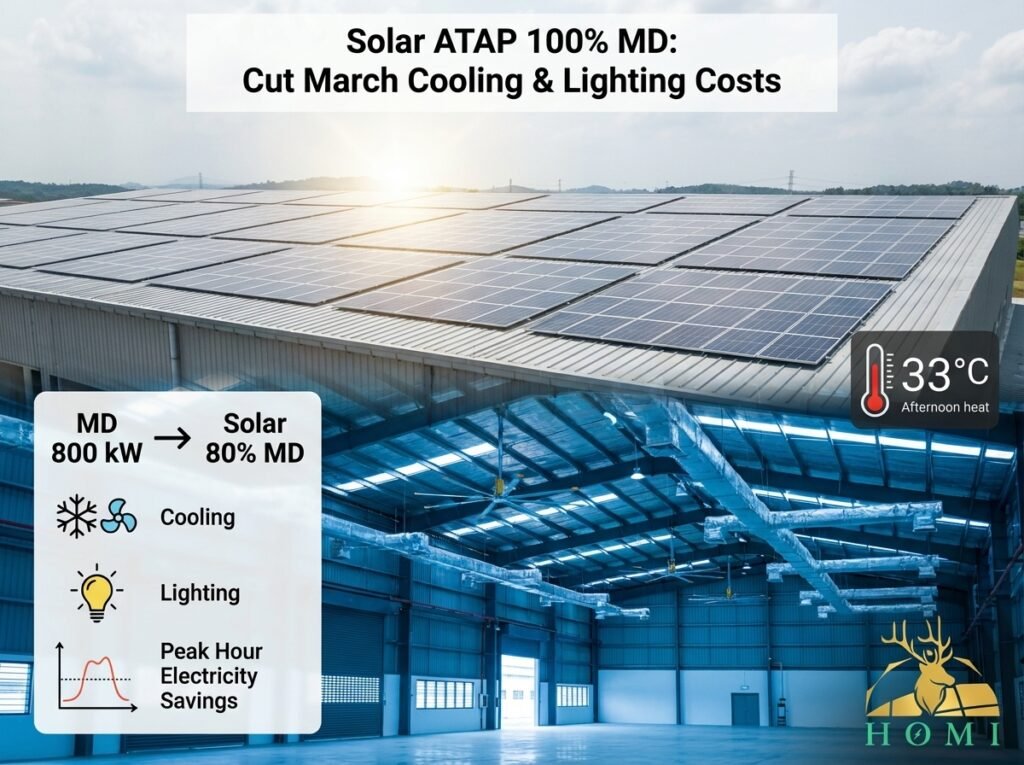
- Can install up to 100% of Maximum Demand (MD). [web:15][web:33][web:44][web:12]
- Absolute cap: 1,000 kW (1 MW) per TNB account. [web:15][web:33][web:44][web:12]
- Larger or edge cases may require CAS/PSS technical studies. [web:15][web:33][web:44]
Because SMEs and factories typically run daytime loads, they often align very well with ATAP’s self-consumption-first philosophy. [web:33][web:44]
3. Three Mindset Shifts You Must Make When Moving from NEM 3.0 to Solar ATAP
- From “Sell As Much As Possible” → “Use As Much As Possible”.
Under NEM 3.0, exporting lots of surplus was fine because you had 1‑to‑1 offsets and 12‑month rollover. [web:57] Under ATAP, export credits only offset energy charges and expire monthly, so the priority is to match your system to your own daytime consumption curve, not to fill every inch of roof. [web:33][web:44][web:57] - From “Fill the Roof” → “Precision Sizing from TNB Data”.
ATAP punishes oversizing: chronic daytime surplus can hit the credit ceiling and then do nothing for your bill before it expires. [web:33][web:44] HOMI’s approach is to read your TNB bills, model your load profile and design a system that targets 80–95% self-consumption instead of chasing a “RM 0 bill fantasy”. - From “Residential Only” → “Think Business Loads Too”.
SMEs and factories can now legally solarise up to 100% MD under ATAP within a 1 MW cap. [web:15][web:33][web:44][web:12] If you own both a home and a business, the best ATAP ROI may actually sit on your shoplot, clinic or factory roof, where 9am–5pm consumption is naturally high.
4. HOMI’s Precision Sizing: From TNB Bill to “Just Right” System
Step 1: Read Your TNB Bill History
Our consultants review 12–24 months of your TNB bills to understand:
- Monthly kWh consumption and seasonal spikes.
- Tariff type (domestic vs commercial, single‑phase vs three‑phase). [web:33][web:174]
- Daytime vs night usage patterns (WFH, EV, weekend usage).
Step 2: Build a Load Curve, Not Just a Monthly Total
Using your lifestyle and appliances, we build an approximate hourly load curve: what runs at 11am, 3pm, and 8pm. ATAP guidelines emphasise that alignment with daytime usage beats raw system size for financial performance. [web:33][web:44]
Step 3: Simulate ATAP Rules, Not Old NEM Assumptions
We apply the latest ATAP mechanics to your case: no credit rollover, export offsetting energy charges only, residential caps, and commercial 100% MD rules. [web:33][web:44][web:57] Then we test multiple system sizes to see:
- Self-consumption ratio (% of solar used instantly).
- Export volume and how much would realistically move your TNB energy charge before expiring.
- Payback period and true ROI once ATAP constraints are applied.
Step 4: Recommend the “Zero Waste Zone” System Size
The result is a proposal that aims for:
- High self-consumption.
- Low expired credits.
- Expandable design (especially for future EV or load growth).
In other words: “not the most expensive, just the most correct” for your TNB bill and lifestyle.
Quick ATAP Readiness & Mindset Checklist
Tick what applies to you, then check where you stand.
FAQ: Solar ATAP 2026 vs NEM 3.0
Can I keep my NEM 3.0 and also apply for Solar ATAP?
No. For most consumers, you cannot be on an active NEM contract and apply for Solar ATAP on the same account. NEM 3.0 continues under its original terms until your contract ends, while new applications from 2026 fall under ATAP rules. [web:33][web:57][web:177]
What happens to unused Solar ATAP credits at the end of the month?
Under Solar ATAP, export credits for new applicants do not roll over. Any credits that are not used to offset your energy charge within the same billing cycle simply expire, with no cash payout. This is a major change from NEM’s 12‑month rollover. [web:33][web:44][web:57]
How do I know if my quote is oversized for Solar ATAP?
Warning signs include export estimates above 25–30% of your solar generation, proposals that ignore ATAP’s no-rollover rule, or installers who push you to “max out” 5 kW / 15 kW / 100% MD without analysing your TNB load curve. HOMI can run a second-opinion simulation based on your bills. [web:33][web:44]