Solar ATAP 2026 Malaysia: How To Use TNB ToU Tariffs and Timers to Maximise Daytime Self-Consumption and Avoid Wasting Credits
Under Solar ATAP, export credits for homes offset **energy charges only** and **expire at the end of each billing cycle with no rollover**. [web:33][web:56][web:44] At the same time, TNB’s Time-of-Use (ToU) tariff gives different rates for Peak versus Off-Peak hours—Peak from 2:00 pm to 10:00 pm, Off-Peak from 10:00 pm to 2:00 pm on weekdays, with weekends and public holidays fully Off-Peak. [web:271][web:268]
If you are a high-usage landed home with a Solar ATAP system (or planning one), learning how to combine ToU hours with simple appliance timers is one of the most powerful ways to drive your bill down and your self-consumption up.
1. Quick Refresh: Solar ATAP vs NEM – Why Self-Consumption Matters More Now
Solar ATAP replaced NEM and changed how rooftop solar is credited. [web:33][web:56][web:77]
- You self‑consume your solar first; only surplus is exported to the grid. [web:44][web:14]
- For homes, export credits can offset the **Energy Charge** portion of your bill only—capacity, network and other charges still need to be paid. [web:33][web:62]
- Credits are calculated monthly and **do not roll over**; any unused balance is forfeited at the end of the billing cycle. [web:33][web:56]
This means a “big export hero” system with lots of leftover credits every month can be financially disappointing compared with a modest system that is used heavily during the day. [web:33][web:77]
2. Understanding TNB ToU: Peak vs Off-Peak for Domestic Users
TNB’s residential ToU tariff (opt-in) gives you cheaper Off-Peak energy and slightly more expensive Peak energy, with clearly defined hours. [web:270][web:271]
| Time Window | ToU Rate (≤1,500 kWh) | ToU Rate (>1,500 kWh) |
|---|---|---|
| Off-Peak (Weekdays 10:00 pm – 2:00 pm) | 24.43 sen/kWh | 34.43 sen/kWh |
| Peak (Weekdays 2:00 pm – 10:00 pm) | 28.52 sen/kWh | 38.52 sen/kWh |
| Weekends & Public Holidays | All-day Off-Peak (24 hours). [web:271] | |
For Solar ATAP homes, this means:
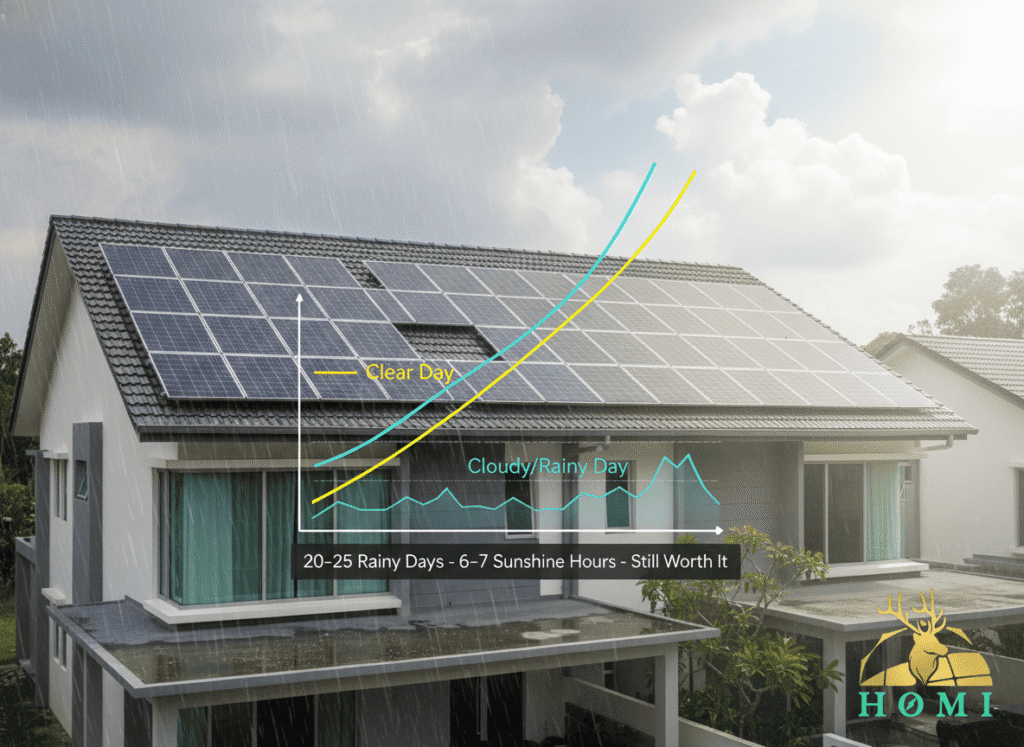
- Most solar generation happens from about 10:00 am to 4:00 pm, overlapping Off-Peak and the start of Peak. [web:270]
- Using solar for real-time loads during these hours avoids buying grid kWh at 24–38 sen/kWh plus non-energy components. [web:169][web:33]
Your strategy is not “export as much as possible” but “feed as many useful loads as possible exactly when your panels are strongest”.
3. Appliances You Can Safely “Move” into Midday Solar Hours
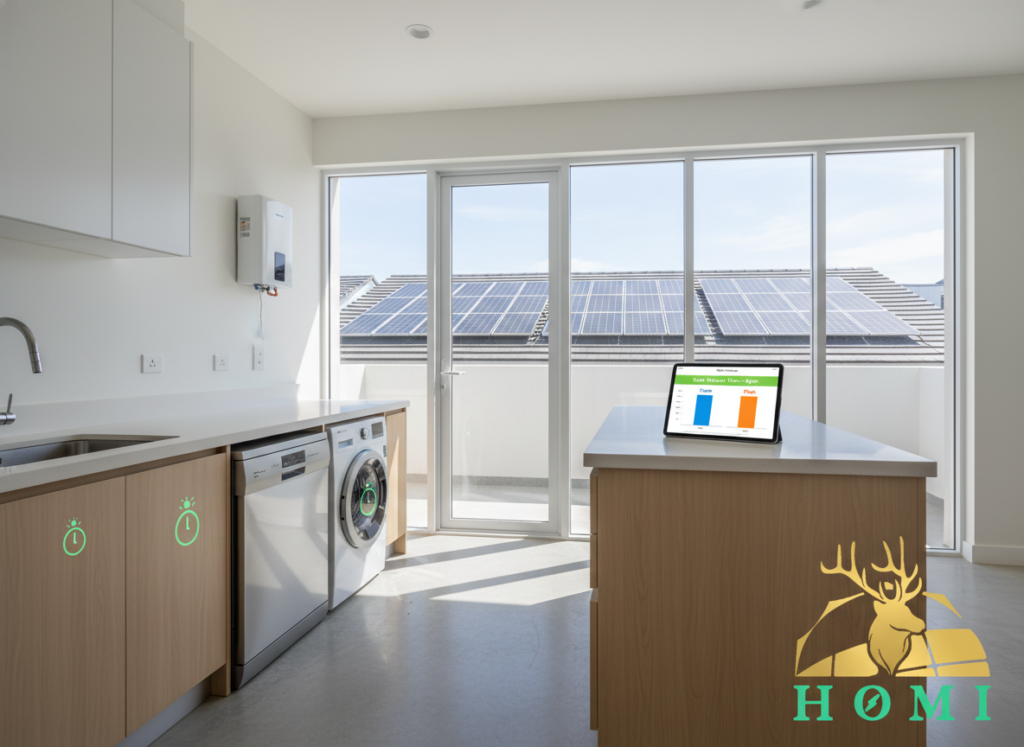
Many high-energy appliances do not care whether they run at 11:30 am or 9:30 pm—as long as the work is done. These are perfect candidates for Solar ATAP + ToU scheduling. [web:269][web:272]
- Washing machine & dryer – Often 0.5–2.5 kW for 1–2 hours per cycle.
- Dishwasher – 1–2 kW for 1–2 hours, ideal for late morning / early afternoon. [web:269]
- Storage water heater – 1–3 kW; can pre‑heat water using midday solar, then coast into the evening. [web:272]
- Pool pump or water feature – Long runtime but schedule‑friendly.
Most modern appliances come with built‑in delayed start timers, smart plugs or simple mechanical timers that make this easy without changing your lifestyle much.
4. Practical Scheduling Ideas: From “Random Use” to “Solar-First Use”
Here is how a typical landed home can restructure its day to use more solar directly and rely less on exporting under Solar ATAP. [web:33][web:271]
Morning (Off-Peak, Growing Solar: ~10:00 am – 1:59 pm)
- Run the first load of **laundry** around 10:30–11:00 am so solar covers most of the cycle.
- Start the **dishwasher** late morning instead of at midnight.
Early Afternoon (Peak ToU, Strong Solar: 2:00 pm – 4:00 pm)
- Let solar support **air‑cond in key rooms** and a **storage water heater** cycle.
- Run a second laundry/dryer cycle here if solar output and house load allow it.
Night (Off-Peak, No Solar: 10:00 pm – 2:00 pm next day)
- Keep only essential loads (fridge, minimal AC) where possible.
- Use ToU’s cheaper Off-Peak rate for any loads that truly cannot be shifted. [web:270][web:271]
The goal is to line up your “flexible” loads with solar production first; ToU Off-Peak rates are a backup, not your primary optimisation lever when you already have panels on the roof. [web:33][web:270]
5. Interactive: Solar Self-Consumption & ToU Savings Snapshot
Solar + ToU Scheduling Savings Estimator
Estimate how much you gain by shifting appliance kWh into your solar window and ToU Off-Peak hours.
Assumptions: Solar-covered kWh avoid paying ToU rates entirely; ToU rates approximated at 0.2852 RM/kWh (Peak ≤1,500 kWh) and 0.2443 RM/kWh (Off-Peak ≤1,500 kWh) for illustration. [web:169][web:271]
6. How HOMI Builds a Personalised “Timer Map” from Your ToU & ATAP Data
HOMI’s role is to turn all of this into a practical, personalised schedule—not just theory.
Step 1: Analyse Your ToU and TNB Usage Pattern
- We look at your monthly kWh, ToU breakdown (if available) and whether you cross key thresholds like 1,500 kWh. [web:169][web:271]
- We estimate your real daytime vs night-time usage based on lifestyle (WFH, kids at home, etc.).
Step 2: Simulate Solar ATAP Self-Consumption vs Export
- Using typical Malaysia yields (1 kWp ≈ 4–5 kWh/day), we model how much of your solar is self‑consumed vs exported for different system sizes. [web:206][web:230]
- We factor in ATAP’s “energy‑only, no rollover” credits to show where export becomes low-value. [web:33][web:62][web:56]
Step 3: Recommend Appliance Schedules & Timer Settings
- We propose a simple “Solar Window Plan”: which appliances to run between 10am–4pm on weekdays and how to adjust on weekends. [web:269][web:270]
- We help you map these to your actual machines—delayed start buttons, smart plugs or dedicated timers.
The result is a home where your Solar ATAP system is not just “on the roof”, but deeply integrated into how you use AC, water heating and major appliances every day—so very little of your generation ends up as wasted, expiring credits.
FAQ: Solar ATAP, ToU Tariffs & Appliance Timers
Why is exporting less attractive under Solar ATAP compared with NEM?
Under Solar ATAP, export credits for domestic users can only offset the Energy Charge portion of the bill and any unused credits expire at the end of each billing cycle with no rollover, whereas NEM allowed credits to be carried forward for up to 12 months. [web:33][web:56][web:77] This makes real-time self-consumption more valuable than banking large export credits.
Do I need a smart home system to schedule appliances for solar?
Not necessarily. Many washing machines, dryers and dishwashers already have delayed-start functions, and simple plug-in timers or Wi‑Fi smart plugs can control storage water heaters and similar loads. [web:269][web:272] A full smart home platform makes this easier, but it is not mandatory.
Is ToU always better if I have Solar ATAP?
ToU can be beneficial if you can shift a meaningful portion of remaining grid usage into Off-Peak hours, but it also makes Peak hours slightly more expensive than the general tariff. [web:270][web:271] For Solar ATAP homes, the best outcome usually comes from combining a right‑sized solar system with targeted load shifting; HOMI can simulate both ToU and standard tariff scenarios using your TNB data.