Solar ATAP for EV Owners in Malaysia: How a 5–8kW System Can Weekend-Charge Your EV from 20% to 80% and Cut DC Fast Charging Costs
In Malaysia, home EV chargers usually deliver 3.7–7 kW AC, while public DC fast charging often costs RM 1.20–1.80 per kWh (or more at some sites). [web:297][web:299][web:300] At the same time, Solar ATAP lets 3‑phase homes install up to 15 kW of rooftop solar (5 kW for single‑phase), explicitly recognising EV charging as a new daytime load. [web:147][web:188]
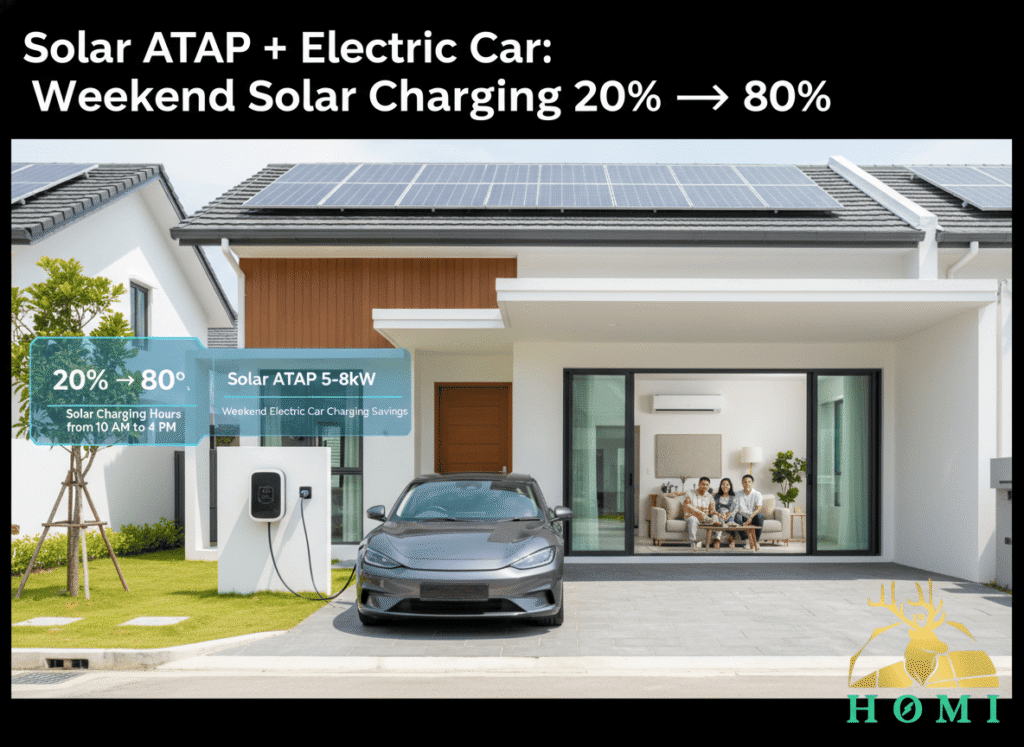
This article walks through a realistic 32°C weekend scenario: you are at home, AC is running, and a 5–8 kW Solar ATAP system is slow‑charging your EV from 20% to 80% between 10 am and 4 pm. We estimate how many kWh you can actually push into the battery, and how much you save versus only using public DC fast charging or grid AC charging.
1. The Weekend “Solar Slow Charge” Scenario
We will use a simple reference EV and charger to illustrate the numbers. You can adjust later with the calculator below.
- Battery: 60 kWh pack, charging from 20% to 80% = 36 kWh needed. [web:304]
- Home AC wallbox: 7 kW single‑phase charger. [web:302][web:306]
- Solar ATAP system: 5 kW to 8 kW, facing roughly south with no major shading.
- Charging window: 10:00 am to 4:00 pm (6 hours of strong sun at ~32°C).
Typical 7 kW AC charging from 20% to 80% on a 50–60 kWh pack takes around 4.5–5.5 hours, adding roughly 30–36 kWh to the battery. [web:304][web:302] That fits nicely into your 10am–4pm solar window, provided your system is sized well and household loads do not eat everything first.
2. How Much Energy Can a 5–8kW Solar ATAP System Deliver Between 10am and 4pm?
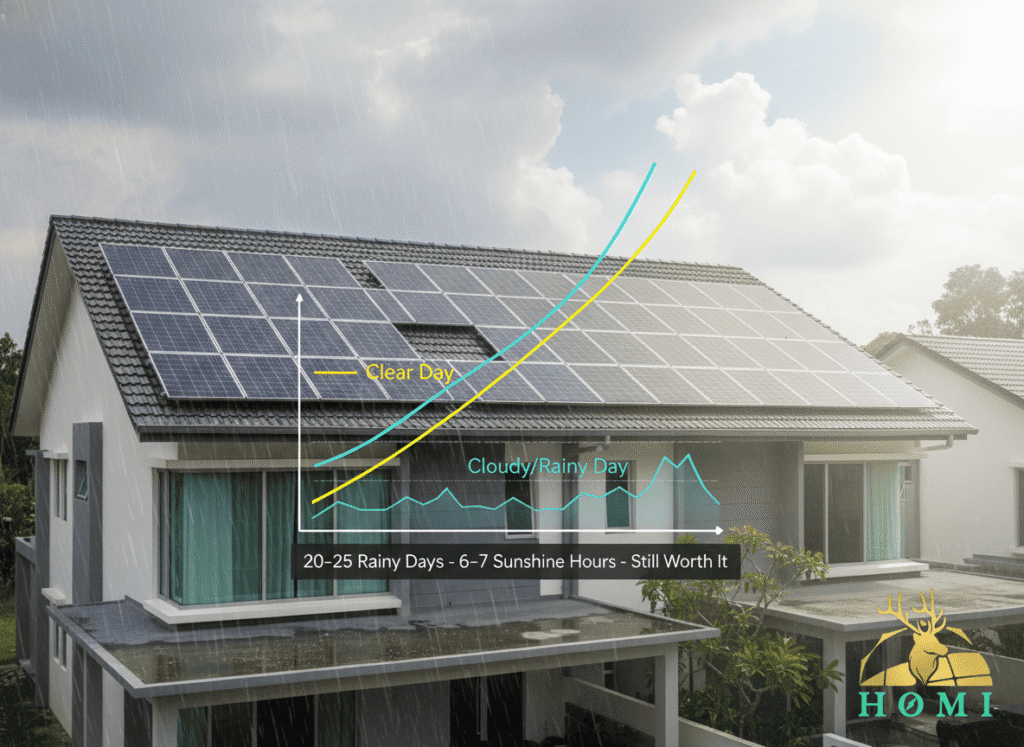
In Malaysia, residential solar arrays typically yield about 4–5 kWh per day per kWp on average. [web:206][web:230] A big chunk of that falls between late morning and mid‑afternoon, when irradiance is strongest.
| System Size | Typical Daily Generation | Approx. 10am–4pm Window (Strong Sun) |
|---|---|---|
| 5 kWp | ≈ 22 kWh/day (5 × 4.5). [web:206] | ≈ 13–16 kWh (60–70% of daily yield in that 6‑hour block). |
| 6 kWp | ≈ 27 kWh/day. | ≈ 16–19 kWh. |
| 8 kWp | ≈ 36 kWh/day. [web:206][web:230] | ≈ 21–25 kWh. |
If your other daytime loads (AC, fridge, IT gear) consume, say, 4–6 kWh during the same 6‑hour window, the remaining solar can go into your EV battery via the home charger. For many EV owners, that means:
- 5–6 kWp: significant partial solar contribution to each 20→80% weekend charge.
- 7–8 kWp: most or all of the 36 kWh needed can be covered by solar on a clear day, with the grid topping up when clouds roll in.
Under Solar ATAP, your own solar is consumed first; you only buy grid kWh for the deficit and only export when there is surplus. [web:77][web:188]
3. Cost Comparison: Solar Weekend Charge vs Public DC Fast Charging vs Grid AC
Let us compare the cost of adding 36 kWh to your EV battery (20%→80%) using three different paths. [web:297][web:299]
| Charging Method | kWh Price (Typical MY) | Cost for 36 kWh (20→80%) |
|---|---|---|
| Public DC Fast Charging | ≈ RM 1.20–1.80/kWh (some promos as low as RM 0.88). [web:295][web:297][web:305] | ≈ RM 43–65 (or RM 32 at promo sites). |
| Home Grid AC (TNB Residential) | ≈ RM 0.22–0.57/kWh depending on block and usage. [web:299][web:300] | ≈ RM 8–21. |
| Solar ATAP + Home AC (Self-consumed) | Marginal energy cost ≈ RM 0/kWh (capex already paid). | Operationally ≈ RM 0 for the solar portion; only pay TNB for any shortfall. |
So each weekend “20→80%” session where solar covers most of the 36 kWh can save you:
- Roughly RM 35–60 versus using only public DC fast chargers.
- Roughly RM 8–20 versus buying all that energy from TNB at residential rates, depending on your tariff band.
You will not always hit perfect sunshine or 100% solar‑covered sessions, but over a year of weekends, the cumulative difference between solar‑assisted AC charging and pure DC fast charging becomes very significant for high‑mileage EV owners. [web:297][web:299]
4. Interactive: EV Weekend Solar Charging Savings Calculator
Weekend Solar EV Charging Savings Calculator
Estimate how much you could save by using Solar ATAP to slow‑charge from 20% to 80% on weekends.
Assumptions: you charge from 20% to 80% (60% of pack), solar yield ≈ 4.5 kWh/day per kWp with ~65% of that between 10am–4pm, and solar energy is fully self‑consumed by the EV during this window. [web:206][web:230][web:304]
5. How HOMI Designs Solar ATAP Systems with EV Charging in Mind
Instead of treating EV chargers as an afterthought, HOMI bakes them into both the **electrical design** and the **Solar ATAP sizing model** from day one.
Step 1: Understand Your EV Profile
- Battery size, typical weekly mileage and how often you use public DC vs home AC charging. [web:300][web:302]
- Whether your home is single‑phase (up to 5 kW solar) or three‑phase (up to 15 kW under Solar ATAP). [web:147]
Step 2: Integrate EV Load into Solar ATAP Sizing
- We treat the EV charger as a flexible but real daytime load, not “bonus”.
- We simulate how many kWh per week can realistically come from solar at 7 kW (or 11 kW) AC, considering household loads and Solar ATAP’s self‑consumption focus. [web:77][web:188]
Step 3: Electrical Safety & Distribution Board Upgrades
- Check main incoming supply, phase balance and available spare capacity for a 7–11 kW EV charger plus solar backfeed. [web:302][web:306]
- Design proper breakers, RCCBs/RCBOs, surge protection and wiring sizes so your EV charging and PV system remain safe and compliant over the long term.
In short, HOMI helps EV owners design a Solar ATAP system that turns weekends into a predictable “solar refuelling ritual”—without overloading your board or oversizing your rooftop just to chase exports.
FAQ: EV Charging with Solar ATAP in Malaysia
Is it really cheaper to charge an EV at home compared to public DC fast charging?
Yes. Typical public DC fast charging in Malaysia ranges from about RM 1.20 to RM 1.80 per kWh, while residential TNB tariffs range roughly from RM 0.22 to RM 0.57 per kWh depending on usage blocks. [web:297][web:299][web:295] So even without solar, home AC charging is usually cheaper; with Solar ATAP, self‑consumed solar kWh effectively bring the marginal energy cost close to zero once the system is paid for.
Can Solar ATAP support EV charging limits for Malaysian homes?
Solar ATAP raises rooftop capacity limits to 5 kW for single‑phase and 15 kW for three‑phase homes, specifically to better support loads like EV charging in addition to household consumption. [web:147][web:188] A 5–8 kW system combined with a 7 kW home charger can meaningfully offset regular weekend charging sessions, especially if most charging is done in daytime hours.
How much energy is needed to charge from 20% to 80% for a typical EV?
For a 50–60 kWh battery pack, charging from 20% to 80% usually adds around 30–36 kWh, taking roughly 4–5.5 hours on a 7 kW AC charger. [web:304][web:302][web:300] A well‑sized 5–8 kW Solar ATAP system in Malaysia can cover a significant portion of that energy in a sunny 10am–4pm window, especially if household loads are managed.