
Solar ATAP for Retirees in Malaysia: With No More NEM Sell-Back or Rollover, Is a Small 3–4 kW Home Solar System Still Worth It?
Under Solar ATAP, credits no longer roll over and the value of exports is clearly limited—so the big question is: if you are already retired or about to retire, is solar still worth considering?
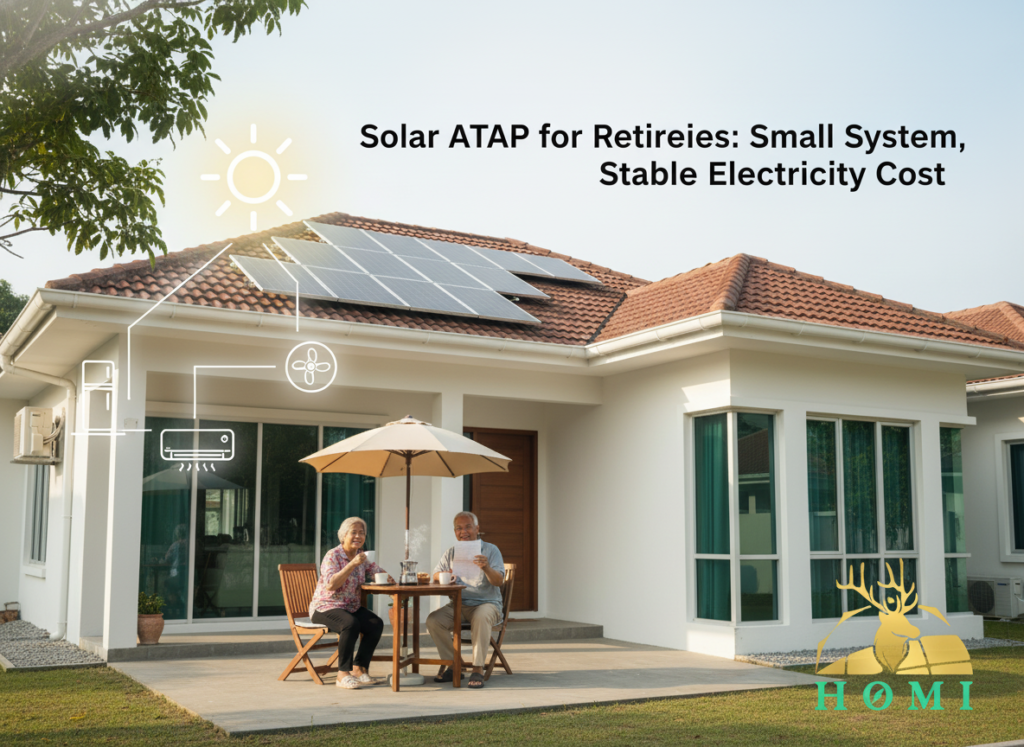
This Q&A is written specifically for landed homeowners who care less about “maximum ROI” and more about stable, predictable electricity costs in their 60s and 70s. The focus is on small, right‑sized 3–4 kW systems that quietly cover daytime essentials instead of chasing profit.
1. What Changed from NEM to Solar ATAP?
Under the old Net Energy Metering (NEM) scheme, many households liked the idea of “selling” excess power back to TNB. Unused credits could roll over for months, and in some cases exports could offset multiple parts of the bill.
| Feature | Old NEM | Solar ATAP (2026) |
|---|---|---|
| Main purpose | Self-consumption + generous export offset with rollover. | Self-consumption first; exports are a bonus, not the main income. |
| Export credits | Could roll over for many months, sometimes offsetting multiple charges. | Offset Energy Charge only; reset every billing month with no rollover or cash payout. |
| Message to homeowners | “Install bigger, export more, bank your credits.” | “Right-size your system to your real daytime usage and enjoy more stable bills.” |
For retirees, this shift actually fits the real goal better: not “playing the game” of selling back, but quietly lowering and stabilising monthly electricity costs so your retirement income goes further.
2. Q&A – “If I Can’t Really ‘Sell Back’ Like Before, Why Bother with Solar ATAP?”
Q1: Is Solar ATAP still worth it without rollover and big sell-back income?
Yes—if you think of solar as a tool to stabilise your cost of living rather than a way to earn. A right‑sized 3–4 kW system on a landed house in Malaysia can typically generate around 12–18 kWh per day on average over the year, depending on location and roof conditions. That is enough to cover a large share of your daytime “must-have” loads: fridge, lights, fans, routers and part of your daytime air‑conditioning.
Q2: What does “right-sized” mean for a retiree?
For many retired couples who are at home in the day, right‑sizing means:
- Choosing a 3–4 kW system instead of “filling the whole roof” just because you can.
- Aiming for most of the solar energy to be used in real time by your house, not exported.
- Planning for comfortable daytime living (cool enough, bright enough) without worrying that every hour of AC will make next month’s bill jump.
Q3: So is Solar ATAP a “bad” deal compared to NEM 3.0?
It is different, not necessarily bad. Under NEM, some younger, high‑usage families aimed to maximise exports and rollover. Under ATAP, retirees who spend more time at home can benefit by using their own solar every day and caring less about export value. The key is to set expectations: Solar ATAP is about steady savings and protection against future tariff increases, not about “beating the system”.
3. How a 3–4 kW System Can Cover Daytime Retiree Essentials
Let’s translate kW and kWh into something more relatable for daily life in a Malaysian landed home.
Typical daytime “essential” loads for retirees:
- Fridge and freezer running 24/7.
- Wi‑Fi router, TV, laptop or tablet usage.
- Ceiling or standing fans in the living room and bedroom.
- Occasional daytime air‑conditioning in one or two rooms.
- Light cooking with rice cooker or induction hob.
If a 3–4 kW system produces on average around 12–18 kWh per day across the year, and most of that is generated between 9am and 5pm, it can:
- Take care of your fridge, fans and basic appliances almost every sunny day.
- Support several hours of moderate air‑conditioning in the hottest afternoon hours.
- Reduce how much grid electricity you buy at Energy Charge rates that may increase over the next 10–15 years.
The result is not “zero bill”, but a bill that feels calmer—less sensitive to heatwaves, lifestyle changes and future tariff adjustments.
4. Simple “Retirement Stability” Calculator – Not ROI, but Monthly Comfort
Retiree Solar ATAP Stability Calculator
Use this simple tool to see how a small 3–4 kW system could reduce and stabilise your monthly electricity cost based on your real TNB bill and daytime habits.
Assumptions: 1 kW ≈ 4–4.5 kWh/day average output; higher self-consumption if you are often at home in the day; we focus on Energy Charge reduction and long-term stability, not aggressive “zero bill” targets.
5. Why Solar ATAP for Retirees Is About Stability, Not Speculation
As you move into retirement, two realities become more important than ever:
- Your monthly income is more predictable—and often fixed—than when you were working.
- Future electricity tariffs and fuel costs are uncertain and can move up over time.
Solar ATAP addresses both by turning a portion of your daytime consumption into something you largely control. The panels on your roof do not “worry” about future tariff changes; they quietly produce energy every sunny day, for at least 20–25 years, with relatively low maintenance if properly installed.
For retirees, the real value is psychological as well as financial: knowing that a chunk of your basic daytime usage is shielded from future bill shocks can make monthly budgeting far less stressful.
6. How HOMI Models “Cash Flow Stability” for Retirees, Not Just Payback
HOMI’s approach for retirees is deliberately conservative. Instead of promising “free bills”, we show you how much of your current and future daytime usage can realistically be covered by a modest Solar ATAP system.
- Reviewing 6–24 months of TNB bills to understand your real kWh pattern (before and after retirement if possible).
- Estimating a safe, modest generation range for a 3–4 kW system on your actual roof, not a perfect “blue sky” scenario.
- Simulating your monthly bill for the next 10 years under different assumptions: “no solar”, “small solar, same tariffs”, and “small solar with gradual tariff increases”.
- Highlighting how much of your daytime fridge, fan and basic cooling load can remain effectively “pre-paid” by your solar system once it is installed.
FAQ: Solar ATAP, NEM and Small Systems for Retirees
Is Solar ATAP only for big, high-usage families, or can a retiree couple also benefit?
Solar ATAP is suitable for many retiree couples, especially those who spend more time at home during the day. A small, well-sized system of around 3–4 kW can cover a significant share of daytime essentials such as fridges, fans, lights and some air-conditioning, reducing monthly Energy Charge and exposure to future tariff increases. The key is to avoid oversizing purely for export and instead match the system to your realistic daytime usage.
What happens to my extra solar energy if I do not use it during the month?
Under Solar ATAP, any surplus solar energy that you do not consume in real time is exported to the grid and used as a bill credit to offset your Energy Charge for that billing month. However, credits cannot reduce other components of the bill and do not roll over into the next month. Any unused credits at month-end are forfeited, so it is better for retirees to design systems that favour self-consumption instead of relying on export income.
What does HOMI need from me to check if a 3–4 kW solar system makes sense for my retirement plan?
HOMI typically needs your recent TNB bills (ideally 6–24 months), information on who is at home during the day, your usual use of air-conditioning and fans and basic photos or a layout of your roof. With this, we can estimate how much a 3–4 kW Solar ATAP system would generate on your roof, what portion of that energy you are likely to use directly and how much your monthly bill could stabilise over the next decade under conservative assumptions.