
Solar ATAP for Malaysian Factories: Using 100% Maximum Demand to Cut March Cooling and Lighting Costs Without Wasting Generation
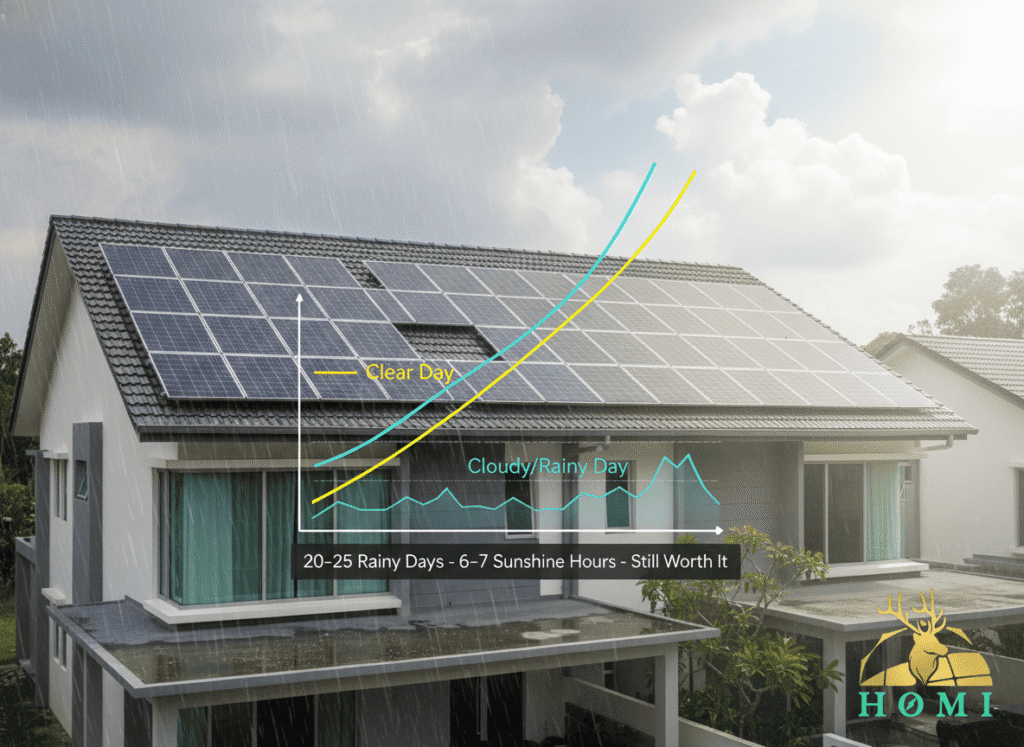
Long‑term data shows daytime highs around 33°C in March with very high heat and humidity, roughly 7 hours of sunshine per day and 12–17 days with some rainfall, depending on region. [web:315][web:316][web:312] Under the new Solar ATAP scheme, non‑domestic consumers can size rooftop PV up to **100% of Maximum Demand (MD)**, capped at 1 MW, giving factories and warehouses a unique chance to offset Peak‑hour cooling and lighting costs—if the system is sized and scheduled around real load, not just roof area. [web:176][web:17][web:307]
This article explains how March conditions drive cooling and ventilation loads, how the 100% MD allowance works for commercial Solar ATAP, and how to design a system that aggressively covers weekday production and lighting while avoiding large wasted exports on weekends or shutdown days.
1. March Heat + Humidity: Why Your Factory or Warehouse Feels Extra Stuffy
As the northeast monsoon tapers off, much of Malaysia experiences hot, humid and relatively wet conditions in March. [web:315][web:316][web:312]
- Typical March daytime highs reach around 33°C across many industrial regions, with night temperatures near 23–24°C and humidity often 80–85%. [web:315][web:316]
- Rainfall totals around 170–240 mm per month in Kuala Lumpur and west‑coast cities, spread over 10–17 days with some rain. [web:315][web:316]
- Despite the rain, there are still about 7 hours of sunshine per day on average, with extreme UV levels around midday. [web:315]
For large roofed spaces like warehouses, production halls and cold rooms, this means high heat build‑up under the metal deck, more fan and blower hours, longer AC or chiller runtime and frequent use of high‑bay lighting even on dull afternoons.
2. Solar ATAP for Non-Domestic: 100% Maximum Demand as a Design Lever
Solar ATAP’s commercial rules give factory and warehouse owners much more headroom than before. [web:176][web:17][web:307]
| Parameter | Domestic | Non-Domestic (Factory / Warehouse / SME) |
|---|---|---|
| Capacity limit | 5 kW (single‑phase), 15 kW (three‑phase). [web:176][web:17] | Up to 100% of Maximum Demand, capped at 1 MW. [web:176][web:17][web:307] |
| Contract tenure | 10 years; then self‑consumption only. [web:307] | 10 years; then self‑consumption only. [web:307] |
| Export principle | Energy offset at Energy Charge rate (no long rollover). [web:17] | Energy offset for non‑domestic accounts, based on tariff structure. [web:176][web:12] |
In plain language: if your factory’s MD is 800 kW, you can now design up to 800 kWp (subject to the 1 MW cap and technical assessment), allowing you to match solar output closely to cooling, ventilation and lighting loads in March Peak and Mid‑Peak hours. [web:176][web:17][web:307]
3. Design Goal: Maximise Weekday Cooling + Lighting Coverage, Minimise Idle Weekend Exports
Solar ATAP still functions fundamentally as a net‑metering style, energy‑offset scheme, but with stronger emphasis on aligning export with TNB’s energy charges and load profile. [web:176][web:17][web:12]
- Use the 100% MD allowance to cover **daytime fans, blowers, AHUs, chillers and high‑bay lighting** during production days.
- Size and schedule to avoid a huge PV field dumping energy into the grid on **weekends, public holidays or frequent shutdown days** when there is low load.
- Focus on **Peak and Mid‑Peak TOU windows**, where both kWh and MD charges are highest, so each solar kWh saves more. [web:307][web:12]
In March, when inside‑shed temperature and humidity stay high for longer, this alignment between solar output and cooling load is especially strong: from roughly 11am–4pm, your roof is hot and your chillers and fans are working hardest—exactly when solar is at its peak. [web:315][web:312][web:206]
4. Simple Savings Calculator: 100% MD Solar ATAP vs March Cooling + Lighting Load
March Cooling & Lighting Coverage Calculator (Illustrative)
Estimate how much of your weekday 11am–4pm cooling + lighting load could be covered by a Solar ATAP system sized as a percentage of your MD.
Assumptions: typical Malaysian yield ≈ 4.5 kWh/day per kWp with ~65% of that between 11am–4pm; Solar ATAP for non‑domestic allows up to 100% of MD (capped at 1 MW); savings are focused on energy charges in higher‑priced TOU windows. [web:206][web:176][web:17][web:307]
5. Avoiding Weekend Waste: Why MD-Only Sizing Is Not Enough
Using “100% of MD” as your only design target can be dangerous if your production schedule is irregular. [web:176][web:17][web:307]
- MD is the highest 15–30 minute demand in the month, not your typical load; maintenance days, partial production or Ramadan shifts can change the pattern dramatically.
- If you size purely to MD and run only one shift, Saturdays, Sundays and non‑production days can see very low internal load but strong March sun, causing large exports with weaker marginal bill impact.
- Solar ATAP still works best when generation aligns with **actual weekday load**, not just theoretical MD capacity. [web:176][web:12]
A better approach is “load‑anchored MD sizing”: start with your 12‑month MD profile and TOU breakdown, then choose a Solar ATAP capacity (e.g. 60–90% of MD) that gives strong coverage in March weekdays but keeps weekend and shutdown exports manageable.
6. How HOMI Designs 100% MD-Aware Systems with TOU & GITA Optimisation
HOMI’s commercial design process combines engineering, tariff analytics and tax planning so factory and warehouse owners can fully exploit 100% MD and GITA without oversizing.
Step 1: MD Profile & TOU Load Analysis
- We pull 12–36 months of half‑hourly MD and kWh data to see when your true peaks occur (e.g. hot March afternoons, pre‑iftar runs, or specific shifts). [web:307]
- We overlay TNB’s TOU structure to identify high‑value Peak and Mid‑Peak windows where solar kWh and MD shaving generate the biggest RM impact. [web:307][web:12]
Step 2: Solar Generation & Weekend Export Simulation
- We simulate several kWp options (e.g. 60%, 80%, 100% of MD) using local irradiation data and March‑style weather assumptions (≈33°C, ~7 sunshine hours, multiple rainy days). [web:315][web:316][web:206]
- For each option, we quantify: weekday cooling + lighting coverage, export on weekends/public holidays, and impact on Peak MD readings.
Step 3: GITA and Cash-Flow Modelling
- We apply Green Investment Tax Allowance (GITA), which currently allows eligible companies to claim up to 100% of qualifying capex on approved green technology projects (including solar) against statutory income for a limited period (through 31 Dec 2026 under Budget 2024). [web:10][web:346][web:345]
- We combine this with TOU savings to show payback, IRR and “after‑tax” cost of capital for each MD‑based sizing scenario.
The result is not just “you can install up to 100% MD”, but “here is the MD‑anchored system size that best matches your March cooling and lighting load, TOU tariff and GITA window, with minimal wasted exports.”
FAQ: 100% Maximum Demand, March Weather and Commercial Solar ATAP
What does the 100% Maximum Demand limit mean for factories under Solar ATAP?
Under Solar ATAP, non‑domestic consumers such as factories, warehouses and SMEs can install rooftop solar systems up to 100% of their premises’ Maximum Demand, subject to a technical cap of 1 MW. [web:176][web:17][web:307] This is significantly more flexible than previous schemes and allows solar capacity to be closely aligned with peak cooling, ventilation and lighting loads.
How does March weather affect the business case for commercial solar in Malaysia?
March in Malaysia typically brings daytime maximum temperatures of around 33°C, very high heat and humidity, and moderate to high rainfall with roughly 7 hours of sunshine per day. [web:315][web:316][web:312] These conditions drive higher daytime cooling and ventilation loads inside industrial buildings, but also provide strong solar irradiance during the same hours, improving alignment between solar output and cooling/lighting demand.
How does GITA improve the ROI of a 100% MD Solar ATAP project?
Malaysia’s Green Investment Tax Allowance (GITA) currently allows eligible companies to claim up to 100% of qualifying capital expenditure on specified green technology projects, including solar PV for own consumption, against a portion of their statutory income over a defined incentive period running to 31 December 2026. [web:10][web:346][web:345] When combined with TOU energy and demand savings under Solar ATAP, GITA can materially shorten payback periods and improve project IRR for factories and warehouses.