Solar ATAP Malaysia for Factories: How the 100% Maximum Demand Rule and GITA Help Cut TNB Bills in Hot Weather
Under the new Solar ATAP scheme, non‑domestic users can now install rooftop solar systems up to **100% of their Maximum Demand (MD)**, capped at 1 MW per account. [web:11][web:251] Combined with Malaysia’s **Green Investment Tax Allowance (GITA)**, this opens a new path for factories and SMEs to tame rising cooling‑driven electricity costs in 2026.
This article explains how to use the 100% MD flexibility to match your daytime production load, avoid wasted export when production dips, and accelerate payback with GITA—using HOMI’s end‑to‑end engineering and tax support.
1. Hotter Days, Heavier Cooling Loads, Higher Bills
Malaysia’s climate is hot and humid year‑round, with average sunlight around 6 hours per day and peak solar radiation near midday. [web:257] Climate and building studies show that as temperatures rise, **midday cooling loads in commercial buildings can increase by more than 15–20%** over time. [web:253] For factories and process‑driven SMEs, that means:
- Higher chiller and HVAC runtime from late morning to late afternoon.
- More frequent compressor and pump operation to keep production stable. [web:253]
- A growing share of your TNB bill tied directly to weather, not just output.
In short, hotter days are quietly turning “electricity cost” into a structural risk on your P&L.
2. What the 100% Maximum Demand Rule Really Changes
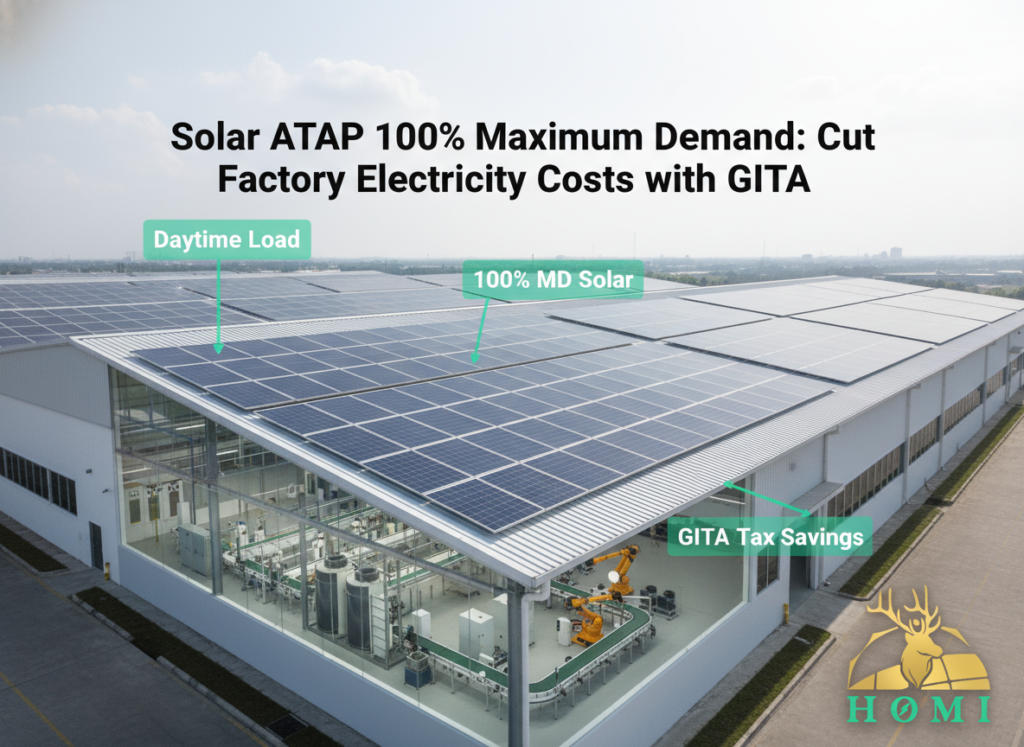
Under Solar ATAP, non‑domestic consumers (factories, warehouses, commercial buildings) can size their rooftop solar systems up to **100% of their MD**, with a cap of 1 MW per account. [web:11][web:251][web:176]
| Previous Schemes (NEM Era) | Solar ATAP 2026 Onwards | |
|---|---|---|
| System Size vs MD | Typically limited to 60–80% of MD, depending on voltage level. [web:251] | Up to **100% of MD**, capped at 1 MW per account. [web:11][web:251] |
| Design Flexibility | Harder to match solar output to actual peak demand. | Can closely match solar to daytime process and cooling loads. [web:11][web:166] |
| Strategy | “Offset a portion of daytime energy.” | “Potentially cover most or all daytime working‑hour demand, if engineered correctly.” [web:11][web:176] |
For a factory with a 700 kW MD, Solar ATAP now permits up to 700 kWp of rooftop solar (subject to 1 MW cap and technical checks), rather than being capped at 420–560 kWp as in older schemes. [web:11][web:251]
3. Designing Around Daytime Self‑Consumption (and Production Fluctuations)
Solar ATAP works on a self‑consumption‑first basis: your site uses solar, and only surplus is exported and credited. [web:34][web:44][web:166] Critically, credits are applied monthly and do not roll over indefinitely, so exporting much more than your energy charge can deliver little incremental benefit. [web:33][web:56]
- Matching solar generation to **typical daytime load**, especially 9am–5pm cooling and process loads.
- Accounting for **production variability** (slow days, maintenance shutdowns) to avoid chronic over‑export. [web:166][web:34]
- Ensuring that most solar kWh are either consumed instantly or offset energy charges you will actually pay monthly.
For example, if your factory’s MD is 500 kW but your average working‑hour load is 300–350 kW, HOMI may recommend a solar size closer to that stable band rather than “full 500 kWp” to avoid frequent under‑utilisation when lines slow down.
4. Simple Factory Savings Calculator: 100% MD + GITA Effect
100% MD Solar + GITA Impact Estimator (Illustrative)
Get a rough sense of how rooftop solar up to your MD, plus GITA, could affect your annual electricity cost and tax.
This is a simplified illustration and not tax advice. HOMI works with your finance team and MGTC/MIDA guidelines for detailed GITA modelling. [web:252][web:256][web:258]
5. How GITA Accelerates Payback for 100% MD Solar
For qualifying companies, Malaysia’s **Green Investment Tax Allowance (GITA)** offers a tax allowance of up to **100% of qualifying capital expenditure (QCE)** for approved green technology assets, including solar PV. [web:252][web:256][web:258]
- The allowance can be set off against a significant portion of statutory income (subject to prevailing rules). [web:252][web:256]
- In combination with standard Capital Allowance (CA), total tax relief can reach **up to ~48% of project cost** in some structures. [web:252]
In practical terms, this means a RM 1 million rooftop solar project could generate hundreds of thousands of ringgit in tax savings over its early years, materially shortening payback while your 100% MD system cuts daytime grid consumption. [web:252]
6. HOMI’s End-to-End Approach for Factories & SMEs
HOMI’s role is to keep the 100% MD flexibility and GITA incentives from becoming a “DIY experiment” on your P&L.
Step 1: Load & MD Analysis
- We analyse 12–36 months of half‑hourly or hourly load (where available) to separate base load, cooling load and process load. [web:253][web:255]
- We study MD patterns, weekend vs weekday usage, and known production cycles.
Step 2: Solar ATAP System Design up to 100% MD
- We simulate multiple system sizes (e.g. 60%, 80%, 100% of MD) against your load to find the sweet spot where self‑consumption is maximised and over‑export risk is controlled. [web:11][web:166][web:34]
- We model seasonal weather variations to see how hot‑season cooling interacts with solar output. [web:253][web:257]
Step 3: GITA & Fiscal Support
- We help prepare technical documentation and data needed for GITA applications (through your tax advisors and MIDA/MGTC channels). [web:252][web:256][web:258]
- We align assumptions (system cost, yield, degradation) so your finance team can integrate solar into budgeting, not just projects.
From first load curve to final GITA file, HOMI’s objective is simple: make your electricity cost in hot weather more predictable, more controllable and less of a competitive disadvantage.
FAQ: 100% Maximum Demand, Solar ATAP & GITA for Businesses
Can every factory really install solar up to 100% of Maximum Demand?
Solar ATAP guidelines state that non‑domestic consumers can install rooftop solar systems up to 100% of their Maximum Demand, subject to a 1 MW cap per account and technical studies by the utility. [web:11][web:251][web:176] In practice, grid constraints, roof conditions and connection limits can still affect final approved size, which is why a proper engineering assessment is essential.
How does GITA practically improve solar project ROI for SMEs?
GITA provides a tax allowance up to 100% of qualifying capital expenditure for approved green technology assets like solar PV. [web:252][web:256] Combined with normal Capital Allowances, total tax relief can reach a substantial share of project cost, effectively reducing payback time by providing tax shields in profitable years when corporate tax would otherwise be payable. [web:252]
What is the risk of oversizing a 100% MD system under Solar ATAP?
Because Solar ATAP relies on self‑consumption and monthly credits, a system that frequently generates more than your daytime load and energy charge will export surplus at low or zero marginal value once credits saturate within a billing cycle. [web:33][web:34][web:166] This risk is higher for factories with highly variable production, making proper load analysis and scenario modelling critical before deciding to use the full 100% MD allowance.