Solar ATAP Malaysia Balik Kampung Guide: 4 Holiday Tips to Avoid Wasting Credits and Use Your Home Solar for EV and Comfort
Under Solar ATAP, any export credits you do not use within the same billing cycle are forfeited with **no rollover**, and domestic credits can only offset the energy charge portion of your TNB bill. [web:33][web:56][web:44] If your house is completely “off” during a long Balik Kampung break, a big chunk of your generation simply becomes free energy for the grid instead of comfort and convenience for your family.
This guide shares four practical “holiday mode” ideas so your rooftop solar quietly works for you—drying, cooling, pre‑heating water and topping up your EV—while you are away or only back at night.
1. Quick Refresher: How Solar ATAP Credits Work During Holidays
Solar ATAP is designed as a self-consumption‑first programme: your home uses solar power in real time, and only surplus flows out as export credits. [web:33][web:44][web:77]
- Domestic users receive credits against the energy charge component of the tariff only. [web:33][web:44]
- Credits do not roll over; any unused balance at the end of the billing cycle is lost. [web:33][web:56]
- There is no cash payout, and credits cannot be used to offset taxes, surcharges or other charges. [web:33][web:44]
If everyone leaves the house and everything is turned off, a right‑sized system can still end up exporting most of its midday generation as low‑value, non‑rollover credits. [web:33][web:56]
2. Holiday Tip #1: Use Midday Solar to Run Dehumidifiers and Circulation Fans
Malaysia’s hot, humid climate means closed‑up houses can develop musty smells and mould, especially during long holidays. [web:230] A simple way to convert “wasted” solar into value is to schedule a modest dehumidifier and a couple of circulation fans to run for a few hours around noon.
- Dehumidifier: 0.3–0.5 kW for 3–4 midday hours (≈ 1–2 kWh). [web:230]
- 2–3 circulation fans: 0.05–0.08 kW each for 4–5 hours (≈ 1–1.5 kWh total).
- Result: fresher indoor air and lower humidity, using solar instead of buying grid kWh later for drying or cleaning. [web:230]
These loads are relatively small but steady, helping your Solar ATAP system self‑consume more energy while protecting your home environment.
3. Holiday Tip #2: Pre‑Heat Water with Timed Electric Water Heater
If you have an electric storage heater, you can shift part of its energy use into the solar‑rich midday window. Many heaters allow simple timer control to run a few hours around noon, even when no one is showering at that exact moment.
- Storage heater: often 1–3 kW; a 1–2 hour run at midday can store several kWh as hot water. [web:230]
- When you return late evening, you benefit from a pre‑heated tank powered mostly by solar instead of night‑time grid energy.
Done correctly, this turns a portion of your “unused midday credits” into tangible comfort your family actually feels when they are back.
4. Holiday Tip #3: Slow EV Charging Midday Instead of Fast Charging at Night
For EV owners, Balik Kampung trips typically involve a mix of highway fast‑charging and home top‑ups. One powerful Solar ATAP strategy is to slow‑charge your EV at home during midday windows when sunlight is strongest. [web:233]
| Scenario | Charge Timing | Impact |
|---|---|---|
| Standard Behaviour | Charge at night after reaching home. | All kWh drawn from TNB, no help from solar, higher bill and no use of expired ATAP credits. |
| Solar‑Aware Behaviour | Schedule 3.7 kW or 7 kW AC charging for 11am–3pm (when at home during holiday days). | A portion of EV kWh is supplied by rooftop solar, reducing energy charges and making use of energy that would otherwise go out as non‑rollover credits. [web:33][web:233] |
Most modern EV chargers and apps also offer basic monitoring, so you can track how much of your charging aligns with solar‑heavy hours. [web:233]
5. Holiday Tip #4: Use a Simple “Holiday Mode” Planner Instead of Leaving Everything Off
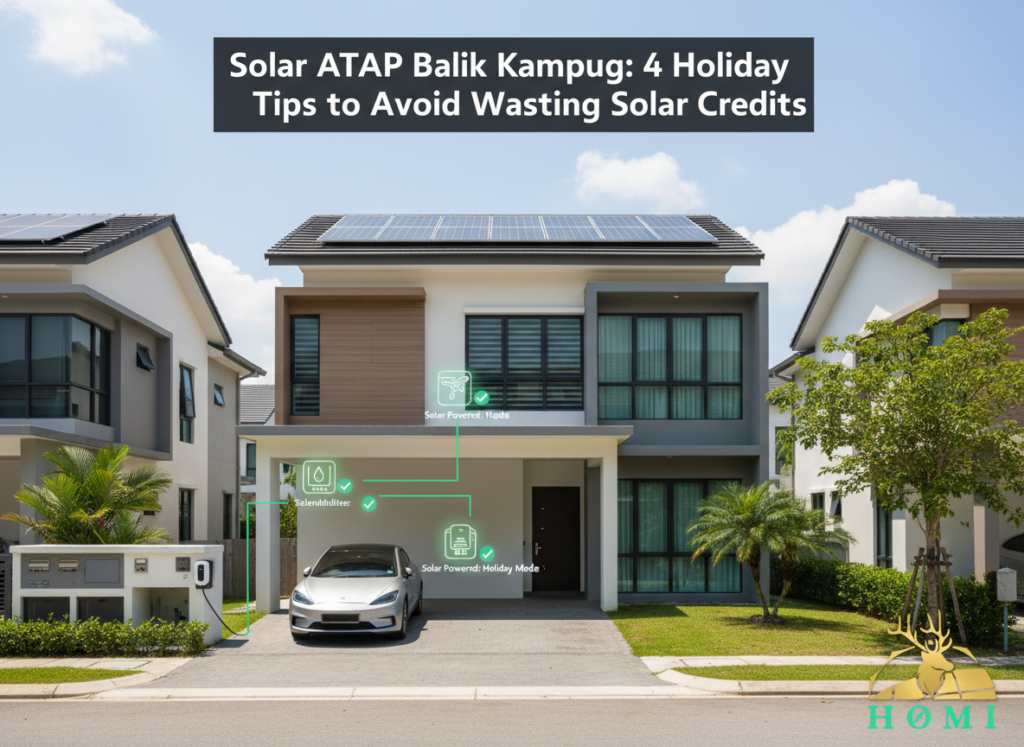
Rather than only choosing between “everything off” and “everything on”, you can pre‑plan a holiday mode load bundle that roughly matches your midday solar generation—dehumidifier, fans, water heater and, if the car is at home, slow EV charging. [web:33][web:230]
Holiday Mode Solar Usage Planner
Estimate how many kWh of your daily solar production you can intentionally self‑consume while you are away.
This is not a precise bill calculator. It is a planning tool to help you think of solar in terms of kWh you can convert into comfort and convenience instead of unused export credits. [web:33][web:44][web:206]
6. How HOMI Designs a “Holiday Mode” for Your Home and EV
HOMI’s role is to turn these concepts into a clear, personalised holiday strategy instead of random guesses at timers and loads.
Step 1: Analyse Your TNB Bills and Solar Production Pattern
- We look at 12–24 months of TNB usage to see typical daytime vs night consumption and seasonal trends. [web:206]
- We review your system size and expected daily generation (1 kWp ≈ 4–5 kWh per day, adjusted for your roof and location). [web:206][web:230]
Step 2: Map Your “Holiday Loads”
- Identify essential devices: dehumidifier, circulation fans, water heater, fridge, routers, security systems.
- For EV owners, we incorporate your charger rating and typical kWh per day when the car is parked at home. [web:233]
Step 3: Create a Holiday Mode Load Schedule + Monitoring View
- We propose a simple schedule (time blocks and targets) that roughly matches your midday solar generation under Solar ATAP rules. [web:33][web:44]
- We set up or advise on monitoring so you can see how close your real usage is to the plan, and make adjustments over future holidays.
The result: instead of your Solar ATAP system idling while you Balik Kampung, you come home to a drier, fresher house, pre‑heated water and, where possible, an EV that has quietly charged on solar while your ATAP credits are maximised—not wasted.
FAQ: Solar ATAP, Balik Kampung & Holiday Solar Usage
What happens to my Solar ATAP credits if my house is empty for most of the month?
Under Solar ATAP, unused export credits expire at the end of each billing cycle and cannot be carried forward. [web:33][web:56][web:44] If your home is empty and your daytime consumption is very low, a larger share of your generation will be exported as credits you may not fully use, especially in quieter months.
Is it safe to run devices like dehumidifiers or slow EV charging when I am away?
When used within manufacturer guidelines and with proper wiring, running dehumidifiers, fans or scheduled EV charging is similar to any other long‑duration load. It is important to follow electrical safety standards and, where needed, consult your installer or electrician. HOMI’s role is to help size and schedule loads to align with solar output; we still recommend basic home safety practices. [web:230][web:233]
How can HOMI see whether my “holiday mode” is actually working?
With suitable monitoring (inverter portal, smart meter or third‑party app), HOMI can review your generation and consumption patterns over the holiday period and compare them with the planned loads. [web:33][web:44] This allows us to refine your holiday mode strategy for future trips so that more of your solar is self‑consumed instead of becoming unused ATAP credits.