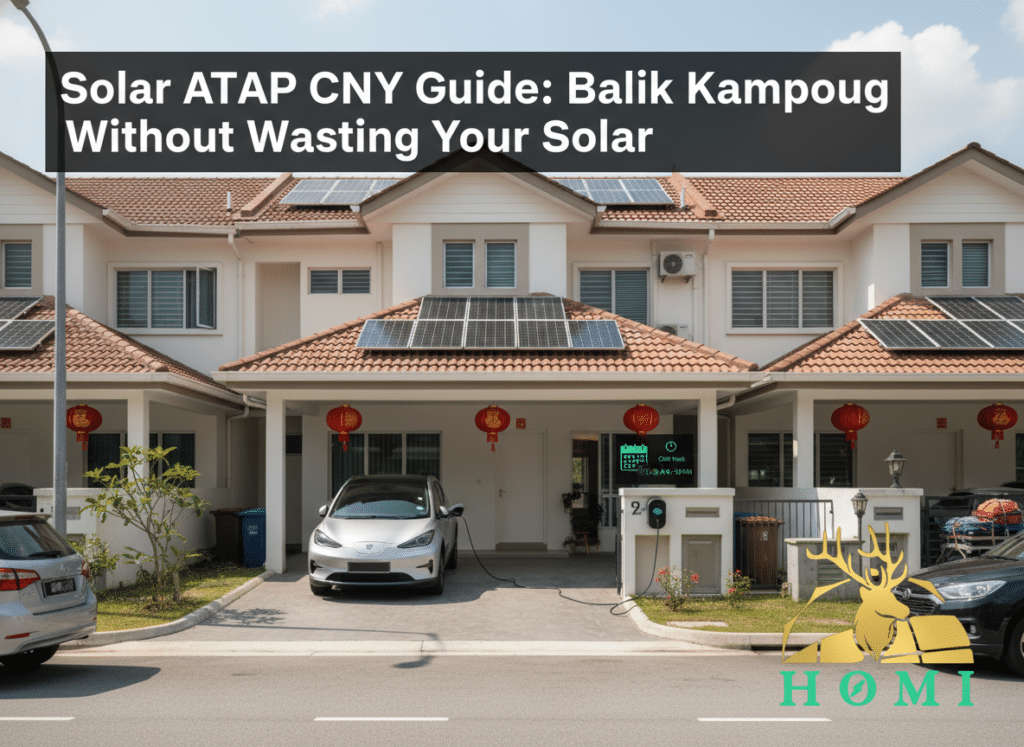
Solar ATAP Malaysia CNY Guide: Balik Kampung Without Wasting Your Home’s Solar Power (TNB Bill & EV Charging Tips)
In the last week before Chinese New Year, many Solar ATAP homeowners in Malaysia face the same dilemma: you balik kampung, your house is quiet, yet your rooftop system keeps generating power. Under Solar ATAP, any export credits you cannot use within the month do not roll over, so a “fully switched-off” house can mean free energy for TNB and zero benefit for you. [web:33][web:147][web:188]
This guide shows how to plan a simple “holiday mode” for your Solar ATAP home—especially if you own an EV—so your system still works for you while you are away.
1. Quick Reminder: How Solar ATAP Treats Your Holiday Exports
Solar ATAP follows a clear order: your panels generate, your home uses that energy first, only surplus is exported, and you receive energy-only credits on your monthly TNB bill. [web:147][web:34] These credits offset the energy charge portion only and expire at the end of the billing cycle, with no rollover and no cash payout. [web:33][web:57][web:188]
- If everything is off, almost 100% of your daytime generation is exported.
- Once your monthly energy charge is fully offset, extra credits bring little or no additional benefit. [web:33]
- Unused credits at month-end are forfeited—no carry-forward to “cover” next month’s bill. [web:33][web:188]
For short trips, this might not matter. But if your balik kampung stretches 7–10 days, a bit of planning can help you convert some of that holiday sun into useful work instead of pure export.
2. Holiday Mode Principle: Shift Useful Loads into Midday Sun
Solar ATAP is a self-consumption-first system: the more you use your own generation while the sun is up, the more value you get. [web:33][web:44][web:147] During holidays, think like this:
- Keep safety and security loads on (CCTV, alarm, some lights on timer).
- Add “good” automated loads that can safely run when no one is home.
- Schedule these loads around your peak solar window (roughly 11am–3pm). [web:147]
1) Dehumidifiers & Ventilation
Malaysia’s humidity can damage furniture and wardrobes while you are away. A small dehumidifier or exhaust fan timer can protect your home and consume some midday solar. Set it to run a few hours between late morning and mid-afternoon. [web:33]
2) Pre-heating Electric Water Heater
If you have a storage water heater, schedule it to heat water around noon so the tank is hot when you return in the evening, and so the heater draws mainly from solar instead of TNB at night. Use a reliable timer or smart plug. [web:33][web:44]
3) Slow EV Charging at Midday
For EV owners, set your vehicle or wallbox to charge slowly (lower kW) during daytime hours on the days you are still in town, including the final “CNY eve” morning before you drive. This soaks up surplus solar that would otherwise be exported. [web:147][web:189]
Modern EV chargers and many EV models allow you to schedule charge windows by time-of-day, which you can align with your typical solar production hours. [web:189]
3. Balik Kampung Holiday Scheduling Ideas (Home + EV)
Before You Leave (2–3 Days Window)
- Top up EV charging between 10am and 3pm over 1–2 days instead of one big night charge.
- Run washing machine and dryer loads in early afternoon to use more solar, less grid. [web:33]
- Pre-cool or pre-dry spaces that tend to get mouldy, then maintain with dehumidifier timers.
While the House Is Empty
- Keep essential security loads on (router for CCTV, alarm). [web:33]
- Set dehumidifier/ventilation to cycle a few hours daily at midday.
- If you have a smart home system, group these loads into a “Holiday – Solar Noon” scene.
When You Return
- Schedule EV charging again to daytime for the first 1–2 days as you resume normal life.
- Shift back gradually from “holiday mode” to your usual “workday or schoolday” schedule.
Holiday Solar Usage Planner (Quick Self-Check)
Tick what you can realistically do this CNY, then see your potential to reduce wasted Solar ATAP credits.
4. How HOMI Designs a “Holiday Mode” Around Your Lifestyle
HOMI’s Precision Sizing method is not just about panel capacity; it is about how you actually live in the house across normal days, weekends and holidays. [web:33][web:147]
Step 1: Study Your TNB Bill & Annual Pattern
- We review 12–24 months of TNB bills to see how your usage rises and falls around festive seasons. [web:174]
- We note when the house is empty vs full (Balik Kampung, guests visiting, school holidays).
Step 2: Map Your Daytime Loads and EV Behaviour
- We ask when you usually charge your EV, run AC, wash clothes, cook, and shower.
- For EV owners, we design around using solar for regular top-ups, not just night charging. [web:147][web:189]
Step 3: Size the System for High Self-Consumption, Low Waste
- We simulate Solar ATAP’s “use first, export later, no rollover” rules on your profile. [web:33][web:44][web:147][web:188]
- We identify a system size where most generation is either self-consumed or meaningfully used as credits within each month.
Step 4: Propose a Simple Holiday Strategy
- We suggest a “Holiday Mode” that uses safe, automated loads to soak up part of the midday surplus.
- We can coordinate with your installer or smart home provider to turn these into pre-set scenes.
The result: you enjoy your CNY reunion without feeling like your empty home is donating free solar to the grid.
FAQ: Solar ATAP, Holidays & EV Charging
Do my Solar ATAP credits roll over if I am away for most of the month?
No. Under Solar ATAP, export credits for both homes and businesses must be used within the same billing cycle and do not roll over to the next month. Any unused credits expire with no cash payout, which makes long empty periods more prone to wasted exports. [web:33][web:57][web:188]
Is it safe to schedule loads like dehumidifiers or water heaters when nobody is home?
It can be, if you use properly installed equipment, adequate ventilation and certified timers or smart plugs. Always follow manufacturer and electrician guidance. HOMI focuses on the energy strategy and recommends that any automation is implemented by qualified professionals.
How should I time my EV charging with Solar ATAP?
Where possible, schedule slower EV charging during your peak solar hours (around late morning to mid-afternoon) instead of at night. Many EVs and chargers allow you to set time windows, which you can align with sunny periods to maximise self-consumption and reduce TNB imports. [web:147][web:189]