Solar ATAP for Malaysian Factories: How To Use TNB TOU + 100% Maximum Demand Without Wasting Generation
Under the new Solar ATAP guidelines, non‑domestic consumers can install rooftop solar systems up to 100% of their premises’ Maximum Demand (MD), capped at 1 MW. [web:64][web:11][web:17] At the same time, TNB’s Enhanced Time-of-Use (ETOU) tariff splits your energy and MD charges into Peak, Mid-Peak and Off-Peak periods, with significantly different rates. [web:273][web:242] If you size solar only to the MD number and ignore your TOU and load patterns, you can end up exporting “free” kWh on weekends and low‑production days instead of cutting your real bill.
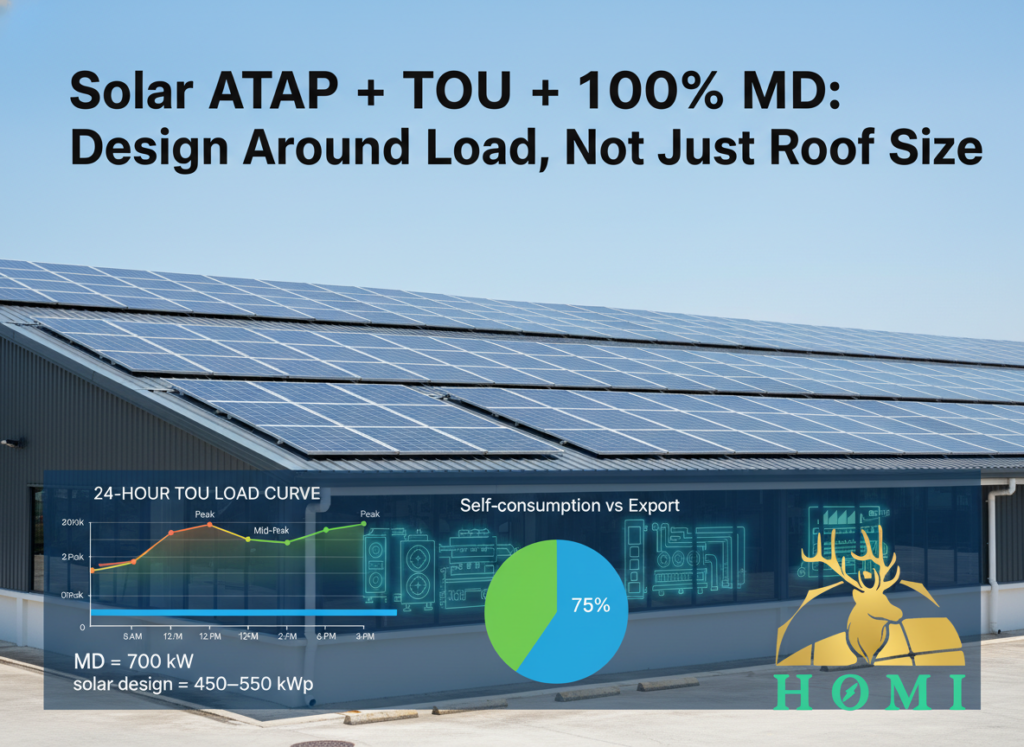
This guide shows SME and factory owners how to use TOU + 100% MD as an opportunity, not a trap: by starting with your 12‑month load curve and designing Solar ATAP capacity around self-consumption, not just roof space.
1. Quick Refresher: 100% Maximum Demand Under Solar ATAP
The Energy Commission’s Solar ATAP framework and recent legal commentaries confirm that businesses can now size PV up to 100% of their MD, capped at 1 MW per account. [web:64][web:66][web:11][web:17][web:290]
| Scheme | Non-Domestic Capacity Limit | Practical Implication |
|---|---|---|
| Previous NEM (Typical) | Often 60–80% of MD depending on voltage and scheme. | Solar could only offset part of daytime load; harder to fully cover key peaks. [web:290] |
| Solar ATAP (2026) | Up to 100% of MD, capped at 1 MW per account. [web:64][web:11][web:17] | Flexibility to match solar capacity closely to actual MD and production profile. |
However, MD is just your highest 15‑ or 30‑minute kW in a billing month. It does not tell you how your load behaves across Peak, Mid-Peak, Off-Peak, weekends or public holidays, which is where TOU comes in. [web:273][web:292]
2. TNB Commercial TOU 101: Peak, Mid-Peak and Off-Peak
TNB’s ETOU for businesses divides the day into three energy time zones and two MD time zones. [web:273]
| Time Zone | Energy Charge (Example C2/E2) | MD Charge |
|---|---|---|
| Peak | Highest sen/kWh; for some MV TOU customers, around 31–32 sen/kWh or more. [web:242] | Higher RM/kW demand charge in Peak MD window. [web:242][web:273] |
| Mid-Peak | Intermediate rate between Peak and Off-Peak. [web:273] | Lower MD rate than Peak. |
| Off-Peak | Lowest sen/kWh; e.g. MV TOU Off-Peak 27–28 sen/kWh versus higher Peak. [web:242] | No separate Off-Peak MD charge (MD only in Peak/Mid-Peak). [web:273] |
Factories with heavy chillers, compressors and process loads during Peak and Mid-Peak hours pay the most per kWh and per kW; shifting consumption or covering it with solar in those windows often produces the biggest savings. [web:242][web:273]
3. The Risk of “Install Up to MD” Without Load-Based Design
Solar ATAP for businesses still works on a self‑consumption‑first model, with export credits focused on energy offset rather than cash payout, and contract periods up to 10 years. [web:44][web:17][web:12]
- Weekend & public holiday over‑generation: When lines are idle but the sun is strong, a large MD‑sized system can export most of its output with limited bill impact, especially if energy charges are already low in Off-Peak. [web:273][web:290]
- Partial or seasonal production: Factories with strong seasonality or frequent line stoppages will have many days where solar output exceeds actual daytime kWh needs. [web:242]
- MD reduction not maximised: If solar peaks when MD occurs, you can reduce kW demand; if not, even a large system may leave MD charges almost unchanged. [web:273][web:292]
Using the 100% MD limit without understanding your 12‑month TOU load curves can lead to a high‑capex system that mostly benefits the grid—not your P&L.
4. Interactive: Simple Load-Based Solar ATAP Sizing Snapshot
TOU + MD Solar Sizing Snapshot (Illustrative)
Estimate how aggressively you might size solar based on your MD and typical working‑hour load.
This is a screening tool, not a design. HOMI uses 12–36 months of half‑hourly data, full TOU breakdown and Solar ATAP export modelling before recommending final kWp. [web:242][web:273][web:44]
5. HOMI’s Load-Based Design Process: From MD & TOU Data to kWp
HOMI’s commercial design process is built to avoid over‑sizing while still leveraging 100% MD and TOU.
Step 1: 12–36 Month Load Curve & MD Analysis
- Collect half‑hourly or hourly kW/kWh data from TNB or your EMS, including MD timestamps. [web:292]
- Segment usage into Peak, Mid-Peak and Off-Peak by tariff (C1/C2/E1/E2 etc.). [web:242][web:273][web:292]
- Identify weekday vs weekend patterns, planned shutdowns and seasonal peaks.
Step 2: Solar Generation & Self-Consumption Simulation
- Use your location and roof characteristics to simulate hourly PV output for several kWp options (e.g. 60%, 80%, 100% of MD). [web:44][web:11]
- Overlay output on your TOU load to calculate: on‑site self‑consumption, export volume, and MD reduction potential. [web:12][web:273]
Step 3: Financial & GITA Modelling
- Apply TNB TOU rates (energy + MD) to calculate annual bill reduction for each kWp option. [web:242][web:292]
- Model Green Investment Tax Allowance (GITA)—up to 100% tax allowance on qualifying green capex—and, where relevant, GITE. [web:193][web:291]
From there, we recommend a kWp band where self‑consumption remains high across production scenarios, export is limited, and TOU + GITA savings justify the investment without depending on perfect production every day.
FAQ: TOU, 100% MD & Solar ATAP for Businesses
Can every factory install solar up to 100% Maximum Demand under Solar ATAP?
Solar ATAP guidelines and industry summaries state that non‑domestic consumers may install rooftop solar systems up to 100% of their premises’ Maximum Demand, subject to a 1 MW cap and technical approval. [web:64][web:11][web:17][web:290] Grid constraints, roof area and connection limits can still restrict the final size, so engineering checks are essential.
How does TNB’s TOU tariff affect the business case for Solar ATAP?
Commercial TOU tariffs charge different rates for Peak, Mid-Peak and Off-Peak energy, and different MD charges for Peak and Mid-Peak demand. [web:242][web:273][web:292] Solar that aligns with Peak and Mid-Peak load can significantly reduce both energy and MD costs, whereas solar that mainly produces during Off-Peak or non‑production times may have lower financial impact.
What role does GITA play in a TOU + 100% MD Solar ATAP project?
Green Investment Tax Allowance (GITA) can provide a tax allowance of up to 100% of qualifying solar PV capex, which can be offset against a portion of statutory income over several years. [web:193][web:291] When combined with Capital Allowance, this substantially improves project ROI and can help justify an optimally sized system that focuses on self‑consumption and TOU savings rather than just maximum kWp.