
Solar ATAP in Malaysia: Why Hot and Humid 33°C March Days Are the Golden Month for Self-Consumption Solar and Air-Cond Savings
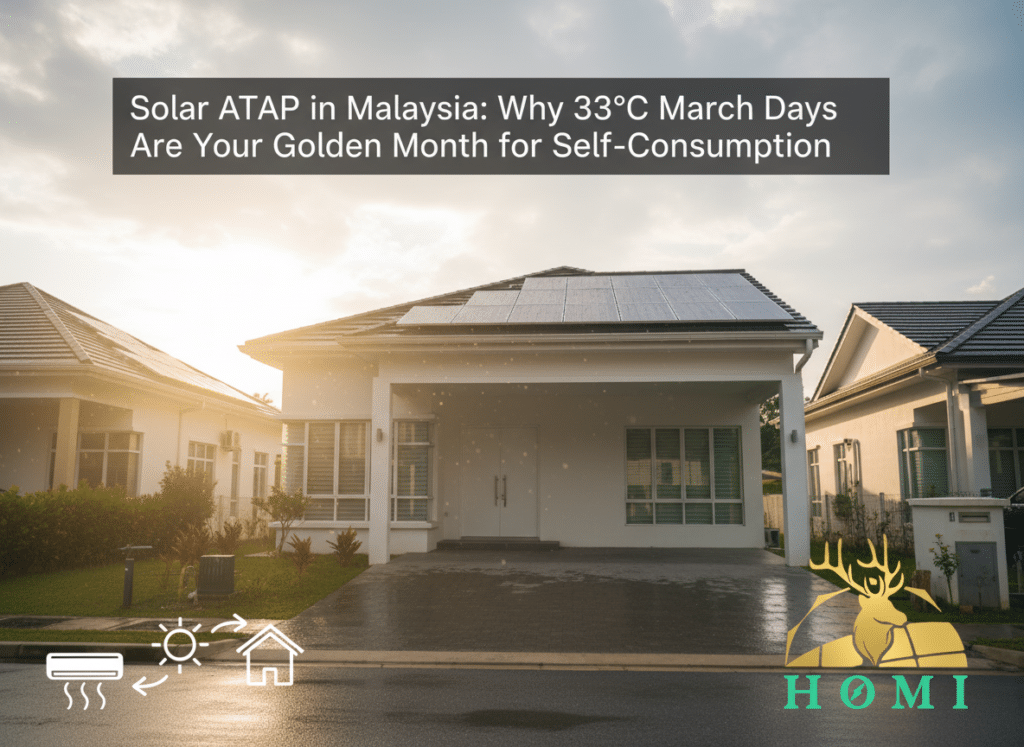
For landed homes with heavy air‑cond and fan usage, that “hot, sticky, yet still bright” mix is exactly what turns March into a golden month for self‑consumption Solar ATAP systems that are sized around daytime cooling.
If you live in a landed house with a high electricity bill, this article shows why March weather is your most honest “stress test” for Solar ATAP, why self‑consumption matters more than ever, and how HOMI uses real weather and irradiation data instead of wishful “always blue sky” assumptions.
1. March in Malaysia: Hot, Humid and Surprisingly Solar-Friendly
Based on long‑term climate data, Malaysia’s March weather usually looks like this:
- Daytime maximum temperature around 33°C, with nights dipping to roughly 22–24°C.
- Very high heat and humidity that make the air feel warmer and heavier than the number suggests.
- About 17 days with some rainfall in the month, and more than 200 mm of rain in many west‑coast areas.
- Still around seven hours of bright sunshine per day on average, even with the frequent showers.
- Your air‑cond and fans work much harder in the late morning and afternoon, not just at night.
- Your indoor comfort depends on continuous cooling, especially in living rooms and bedrooms.
- Your TNB bill reflects more daytime kWh, not only the usual evening peak.
2. Solar ATAP 2026: Built for Self-Consumption First, Export Second
Solar ATAP, launched in 2026 to replace NEM, is designed around a simple idea: use your own solar power first, then export any excess to earn bill credits.
Key points for landed homeowners:
- Solar ATAP uses a single bi‑directional meter; you self‑consume what your system generates in real time.
- Any surplus is exported to the grid and earns monthly credits against the Energy Charge on your TNB bill.
- Credits do not roll over beyond the billing period and are not paid out in cash, so unused export value simply disappears.
That is why self‑consumption is the star: a well‑sized Solar ATAP system is one that feeds your air‑conds and fans directly during hot months like March instead of oversupplying the grid and losing part of the value.
3. Why “Hot, Wet and Bright” March Is the Golden Month for Self-Consumption Solar
At first glance, March feels like the worst of both worlds: blazing hot and uncomfortably humid, yet also rainy and grey at times. For rooftop solar, it is actually a sweet spot.
Load and solar generation line up:
- Air‑cond in living rooms, bedrooms and maybe a home office run longer in late morning and afternoon.
- Ceiling and stand fans spin non‑stop in common areas to keep the air moving.
- Solar production peaks between roughly 11am and 4pm, overlapping with your highest indoor cooling demand.
Instead of exporting most of your midday solar, a self‑consumption‑focused setup lets those kWh flow directly into compressors, blowers and fans. For many landed homes, that is the fastest and cleanest way to slim down the Energy Charge portion of a high TNB bill.
- If your daytime loads are heavy in March, they will likely be meaningful for much of the year.
- If your March bill is painful, it is a strong signal that your home is a good candidate for Solar ATAP self‑consumption.
- Using March as a baseline prevents you from oversizing a system that looks good only on paper.
4. Simple Savings Calculator: How Much March-Type Solar Could Offset Your Air-Cond?
Solar for Air-Cond & Fans – Simple March Savings Snapshot
Use your real numbers to see how a self‑consumption Solar ATAP system aligned with a hot March month might cut the Energy Charge on your high TNB bill.
Assumptions: 1 kWp ≈ 4.5 kWh/day average output; 60–80% of solar is self‑consumed in a hot, high‑usage month like March for a well‑sized system; savings shown focus on Energy Charge reduction only, not the entire TNB bill.
5. How HOMI Uses Real Weather and Irradiation Data – Not “Always Sunny” Fantasy
Many generic solar quotes quietly assume perfect sunshine every day of the year. HOMI does the opposite for Malaysian landed homes: we deliberately include hot, humid, rainy months like March in our modelling.
What goes into HOMI’s Solar ATAP generation forecast:
- Location‑specific climate and solar irradiation data, including how many hours of bright sun you get in a typical March.
- Expected annual generation per installed kWp (often around 1,200–1,500 kWh/kWp/year for well‑sited residential systems).
- The seasonal pattern of your AC and fan usage, including how often you cool multiple rooms in the middle of the day.
For a high‑bill landed home, this results in a more honest graph: not a flat line of “maximum output” but a realistic curve showing how much your system should produce in a hot, sticky March versus milder months—and how that interacts with Solar ATAP’s self‑consumption‑first structure.
6. From March Weather to a Real Solar ATAP Plan: What HOMI Delivers
When you share your TNB bills and basic roof information with HOMI, we turn that “33°C and very humid” March feeling into concrete numbers and a clear self‑consumption plan.
- A 3–6 (or 12) month analysis of your kWh usage, highlighting how much happens during daytime.
- A roof and shading review, with realistic annual kWh/kWp generation estimates for your location.
- Two to three candidate system sizes tuned for self‑consumption, not just maximum export.
- A March‑style high‑heat scenario to show how much Energy Charge your air‑cond and fans could shift to solar.
FAQ: March Weather, Solar for Air-Cond and Solar ATAP Self-Consumption
Isn’t March too rainy to be a “golden month” for solar?
March is indeed wet in many parts of Malaysia, but it still offers around seven hours of sunshine per day on average. The combination of high temperature, very high humidity and frequent sun breaks means your AC and fans are working harder while your rooftop still sees strong midday light. For self‑consumption Solar ATAP systems sized correctly, this overlap is more important than having 100% cloud‑free days.
Why focus on self-consumption instead of maximising export under Solar ATAP?
Under Solar ATAP, you use your solar power first and only export what you cannot consume in real time. Exported energy earns bill credits against your Energy Charge, but these credits do not roll over indefinitely and are not paid out in cash. That makes every kWh you self‑consume—especially for heavy loads like air‑cond during hot months like March—more valuable than kWh that are exported and risk partial value loss when credits reset.
How does HOMI use weather data when sizing my Solar ATAP system?
HOMI uses real climate and solar irradiation data for your area, including typical March conditions such as 33°C daytime highs, high humidity, roughly 17 rainy days and about seven sunshine hours per day. We combine that with your actual TNB usage profile to estimate annual kWh per installed kWp and to see how many of those kWh you are likely to self‑consume, especially for air‑cond and fans. This helps us propose a system size that works in real Malaysian weather—not only in a perfect “always sunny” scenario.