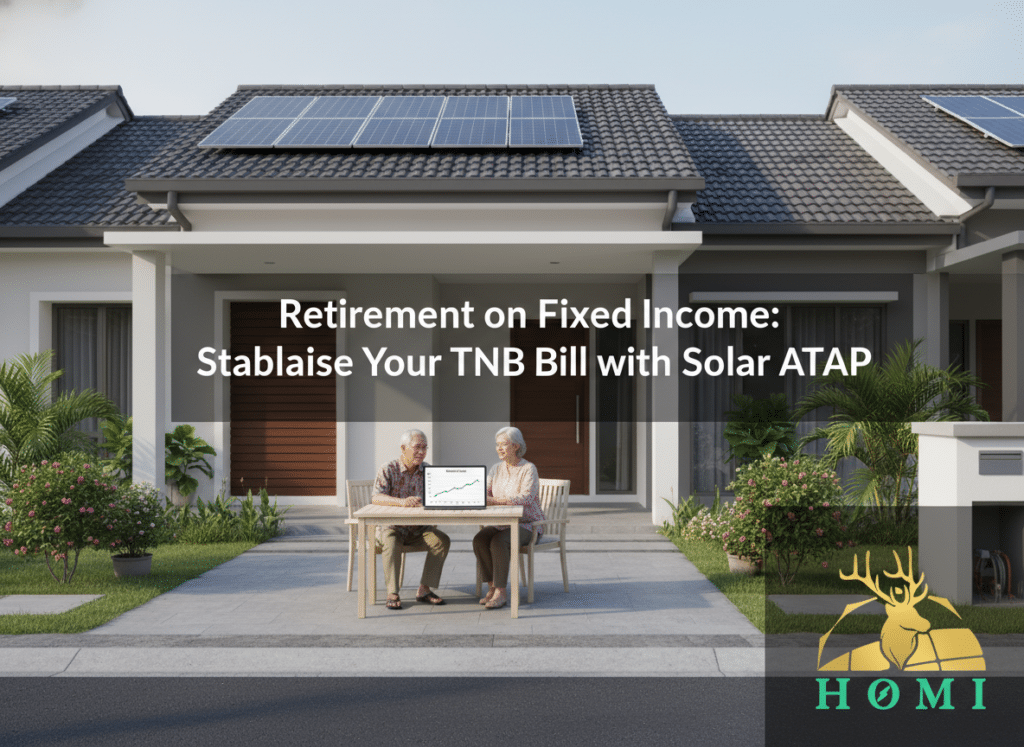
Solar ATAP Malaysia for Retirees: How to Stabilise Your TNB Bill on a Fixed Income (Without Overspending on Solar)
If most of your monthly income now comes from EPF withdrawals or a fixed pension, every RM 20–RM 50 swing in your electricity bill matters. With the new Automatic Fuel Adjustment (AFA) system and Solar ATAP rules, future tariffs will move more often—up or down—based on fuel costs and policy. [web:172][web:180]
This article is not about “making money” from solar. It is about using a right-sized Solar ATAP system to make your TNB bill more predictable, so you can plan your retirement budget calmly.
1. Why Your TNB Bill Feels Less Predictable in Retirement
From 2024 onwards, Malaysia replaced the old ICPT mechanism with an Automatic Fuel Adjustment (AFA) system that updates every few months. [web:172][web:180] The AFA rate is added or subtracted on top of the base tariff, depending on gas and coal prices.
- Your TNB bill can change even if your usage is similar, because the AFA rebate or surcharge changes. [web:172][web:180]
- There is no guarantee future AFA will always be a “discount”; it can become a positive charge if fuel prices spike. [web:172][web:180][web:182]
- On a fixed income, such changes can make monthly planning stressful.
At the same time, the new Solar ATAP policy pushes solar owners towards self-consumption first, with export credits given only for surplus energy and now only offsetting the energy portion of your TNB bill. [web:33][web:44][web:147]
2. Solar ATAP for Retirees: Think “Bill Smoothing”, Not “High-Risk Investment”
Under Solar ATAP, your solar generation is used in this order: [web:147]
- Generation: Your panels produce power during the day.
- Usage: Your home uses this power first—fans, air-cond, fridge, lights. [web:147]
- Export: Only surplus is exported to TNB.
- Credit: You receive energy-only credits on your monthly bill. These credits do not roll over beyond the billing month. [web:33][web:44][web:147]
For retirees, the main goal is not to chase maximum ROI like a stock trader. The goal is to:
- Cover a stable portion of your daytime base load (fridge, daytime AC, lighting).
- Reduce your exposure to AFA and future tariff hikes on that portion. [web:172][web:180][web:147]
- Do it without overspending on a system you cannot fully use (to avoid wasted export). [web:33][web:44]
3. Example: How “Partial Coverage” Calms Your Bill
| Without Solar ATAP | With Right-Sized Solar ATAP | |
|---|---|---|
| Monthly Usage | 900 kWh (Retired couple, day at home) | 900 kWh (same lifestyle) |
| Daytime Usage Covered by Solar | 0 kWh | ~400 kWh self-consumed (fridge, fans, some AC) |
| Units Exposed to AFA & Tariff Changes | Full 900 kWh | Only ~500 kWh (night + cloudy hours) |
| Bill Volatility | High: Every AFA change hits whole bill. [web:172][web:180] | Lower: Part of bill “locked in” by solar production. [web:147] |
| Risk of Wasted Credits | Not applicable | Low if system is sized to your real daytime load. [web:33][web:44][web:147] |
Notice that we are not trying to hit RM 0 bill. We are trying to make the bill smaller and more stable, so it fits comfortably within your retirement budget.
Simple TNB Bill Smoothing Calculator
Estimate how much of your bill you could “stabilise” with a right-sized Solar ATAP system.
4. Why Retirees Must Avoid Oversizing Under Solar ATAP
Because ATAP export credits expire each month and only offset the energy charge, oversizing hurts retirees twice: [web:33][web:44][web:147]
- You pay more upfront for a bigger system.
- A portion of your daytime surplus may never reduce your bill once your energy charge is already fully offset—those credits simply expire.
Retirees typically:
- Are at home during the day (good for self-consumption).
- Have relatively predictable routines.
- Do not plan to buy many new heavy appliances (like more AC or EV) in future.
This makes retirees perfect candidates for a carefully sized “enough, not too much” system that matches daytime consumption but does not overshoot it by a large margin.
5. How HOMI Designs a “Fixed-Income Friendly” Solar ATAP System
Step 1: Understand Your Retirement Lifestyle
Before talking about panel size, HOMI consultants ask:
- What time do you usually wake up and sleep?
- How many hours of AC or fan do you use in the day?
- Do grandchildren visit often? Any medical equipment at home?
Step 2: Analyse 12–24 Months of TNB Bills
We read your TNB history to see:
- Average monthly kWh and seasonal peaks. [web:174]
- How much of your usage happens in the day vs night (roughly inferred). [web:147]
- Any sudden changes that might affect future usage.
Step 3: Simulate ATAP Self-Consumption, Not Just “kW”
Using Solar ATAP’s self-consumption logic (solar used first, then export, no rollover), HOMI simulates different system sizes and shows you:
- How many kWh per month would realistically be self-consumed. [web:147]
- How many kWh risk being exported but not fully used as credits. [web:33][web:44]
- How your bill behaves over 10 years with different AFA and tariff scenarios. [web:172][web:180][web:147]
Step 4: Recommend a System That Matches Your Comfort Level
We then propose a system where:
- The estimated monthly savings fit your budget goals.
- The payback period is reasonable for your age and risk appetite.
- The system can be maintained with minimal hassle.
The focus is on peace of mind, not aggressive, high-risk returns.
FAQ: Solar ATAP for Retirees
Is Solar ATAP too risky for retirees?
Solar ATAP does not have to be a high-risk “investment play”. When sized correctly for self-consumption, it behaves more like a long-term cost-control tool, reducing how much of your TNB bill is exposed to future tariff and AFA changes. [web:33][web:44][web:147]
What if I cannot stay in my house for 25 years?
A right-sized system can still pay for itself within 6–9 years depending on your usage. [web:185][web:147] After that, any extra years you live there are a bonus. A functioning solar system may also improve the resale attractiveness of your home.
Can I start small and expand later?
Yes. HOMI can design an expandable layout (and suitable inverter) so you start with a modest system that fits your current comfort level, then add more capacity if your needs or confidence grow later—subject to Solar ATAP limits. [web:33][web:44]