Solar ATAP Malaysia for SMEs: How 100% Maximum Demand + GITA Cuts Your 2026 TNB Bill Risk
For commercial users, the Automatic Fuel Adjustment (AFA) rebate for February 2026 is set at -2.77 sen/kWh, down from -4.99 sen/kWh in January 2026. That means every kWh you buy from TNB now enjoys a smaller discount—even if your production and consumption are exactly the same. [web:172]
Combine this with long-term fuel and tariff uncertainty, and SME owners face a simple reality: electricity is a structural cost risk. Solar ATAP’s 100% Maximum Demand allowance for commercial systems, paired with Malaysia’s Green Investment Tax Allowance (GITA), is one of the strongest tools you have in 2026 to defend your P&L and cash flow. [web:176][web:195]
1. What February’s Smaller AFA Rebate Really Means for SMEs
Under the AFA mechanism, the Energy Commission (ST) can adjust tariffs monthly within ±3 sen/kWh based on fuel costs. [web:172][web:190] In February 2026, the AFA rebate is only -2.77 sen/kWh, versus -4.99 sen/kWh in January, shrinking your per‑kWh discount. [web:172]
- Smaller rebates today, with room for surcharges in future if fuel prices climb. [web:172][web:190][web:194]
- Real delivered cost at medium/large commercial tariffs that can easily sit above 50 sen/kWh once generation, capacity and network charges are combined. [web:172][web:174]
- Electricity cost volatility that is hard to pass on to customers in competitive markets.
In other words, relying 100% on grid energy leaves your business exposed to tariff and AFA cycles you cannot control.
2. Solar ATAP: Why 100% Maximum Demand Is a Big Deal for SMEs
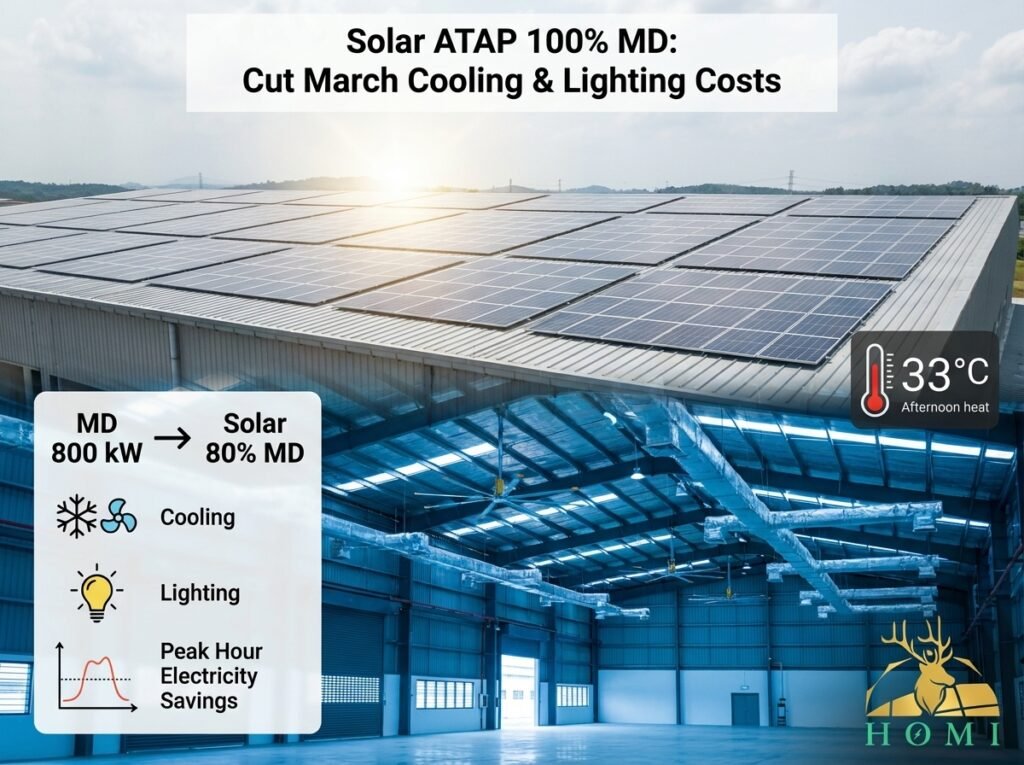
Solar ATAP allows commercial and industrial consumers to install rooftop solar systems up to 100% of their Maximum Demand (MD), capped at 1 MW per account. [web:176][web:33] This is significantly more flexible than earlier net-metering schemes and is designed to let businesses aggressively match daytime load with on-site generation.
| Pre-ATAP Era | Solar ATAP (From 2026) | |
|---|---|---|
| Design Limit vs Load | Solar size often restricted to a fraction of demand. | Up to 100% of MD (subject to technical checks), capped at 1 MW. [web:176][web:33] |
| Energy Strategy | Offset a portion of daytime kWh. | Real option to substantially cover working-hours load with solar. [web:166][web:176] |
| Tariff Exposure | Majority of kWh fully exposed to AFA and future hikes. | Large share of kWh “locked in” via rooftop generation once system is paid off. [web:166][web:176] |
Because most SMEs and factories have strong 9am–6pm activity, they are naturally good matches for Solar ATAP’s self‑consumption‑first design: your machines, chillers, compressors and lighting can consume solar as it is generated, reducing dependence on grid energy that is increasingly linked to volatile fuel costs. [web:33][web:44][web:147]
3. Where GITA Comes In: Turning Capex into Tax Savings
Malaysia’s Green Investment Tax Allowance (GITA) is designed precisely for investments in approved green technology assets such as solar PV. [web:195] For qualifying projects, GITA can grant a tax allowance of up to 100% of qualifying capital expenditure, which can be set off against up to 70% of statutory income, with unused allowance carried forward for several years. [web:193][web:195]
- Reduce the effective cost of your solar installation through tax savings. [web:193][web:195]
- Improve cash flow in the first few profitable years after installation, when tax payable is still high.
- Lift after‑tax project IRR without needing speculative export revenue, since benefits come from avoided TNB spend plus tax relief.
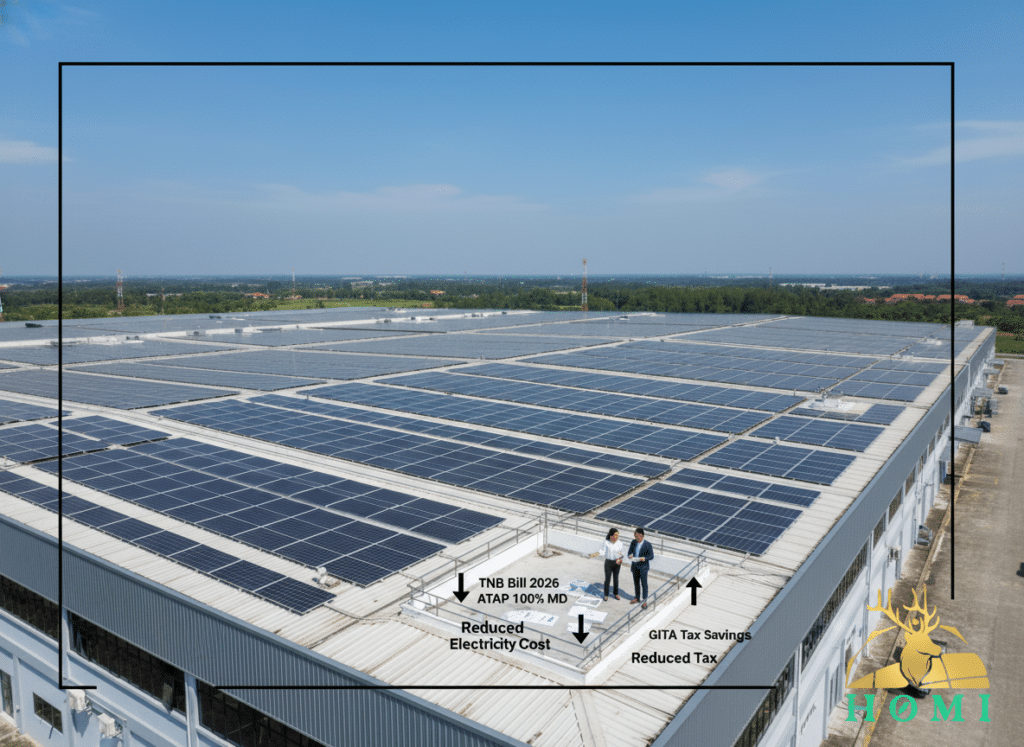
When you combine Solar ATAP’s 100% MD cap with GITA’s 100% allowance on qualifying capex, you get a structure where a large slice of your daytime energy can be self-generated, while a significant portion of the project cost is effectively subsidised via tax. [web:176][web:193][web:195]
4. Simple SME Calculator: Solar Savings + GITA Tax Impact
SME Solar & GITA Impact Estimator (Illustrative)
Use this to get a rough sense of how rooftop solar and GITA together might affect your annual numbers.
Note: This is a simplified illustration and not tax advice. Always confirm with your tax consultant and MGTC/IRB guidelines. [web:195]
5. How HOMI Supports SMEs: From Load Analysis to GITA Paperwork
Step 1: Load & TNB Bill Analysis
HOMI starts by analysing your last 12–36 months of TNB bills, tariff category and Maximum Demand profile to see:
- Base load vs variable load through the day and week.
- Seasonal peaks, shift patterns and production schedules.
- How much of your demand can realistically be covered by Solar ATAP without hurting operations. [web:33][web:174]
Step 2: Solar ATAP System Design up to 100% MD
Using ATAP’s technical limits (up to 100% of MD, up to 1 MW), we design a system tailored to your roof, single/three‑phase infrastructure and budget. [web:176][web:33]
- We simulate self-consumption vs export by time‑of‑day.
- We check how much AFA and tariff exposure your solar can neutralise. [web:172][web:190]
Step 3: GITA-Ready Documentation
GITA applications require that assets and projects meet MGTC’s green technology criteria and documentation standards. [web:195]
- We prepare the technical documentation for your solar PV project (design, specs, performance). [web:193]
- We coordinate with your tax and accounting team to align numbers for the GITA claim.
Step 4: Board-Ready Business Case
HOMI packages everything into a clear board or owner presentation:
- Capex, expected kWh yield and Solar ATAP assumptions. [web:166][web:176]
- TNB bill reduction scenarios under different AFA levels. [web:172][web:190]
- GITA tax impact on payback and IRR. [web:193][web:195]
The goal: help you decide with confidence, not guesswork.
FAQ: Solar ATAP 100% MD & GITA for SMEs
Can every SME really install up to 100% of Maximum Demand under Solar ATAP?
Solar ATAP guidelines state that non‑domestic consumers can install solar PV systems up to 100% of their Maximum Demand, subject to a 1 MW cap and technical studies where necessary. Grid constraints or site conditions may still limit practical size, which is why a proper engineering assessment is important. [web:176][web:33]
How does GITA actually reduce my solar project cost?
GITA provides up to 100% tax allowance on qualifying green technology capex, which can be used to offset up to 70% of your statutory income, with unused amounts carried forward for several years. In effect, part of your solar investment is paid back through reduced tax, improving your project’s net payback. [web:193][web:195]
Why move now instead of waiting for tariffs to go higher?
AFA rates can tighten or turn into surcharges as fuel costs and policy shift, raising your delivered kWh cost. [web:172][web:190][web:194] At the same time, GITA and related incentives are policy tools that may not last forever. Securing Solar ATAP capacity and tax incentives earlier locks in more years of savings and cost stability for your SME.