Solar ATAP Malaysia Valentine’s Guide: How One Landed House Covered Daytime Air-Cond with Solar and Cut Its TNB Bill
In Greater Kuala Lumpur, February daytime temperatures often climb to around 30–32°C with high humidity, making “Valentine’s at home” almost always a full‑blast air‑cond experience. [web:198][web:199][web:202] For many landed homes, those extra daytime cooling hours show up as a painful spike in the next TNB bill.
In this article, we share an anonymised HOMI case from the Klang Valley: a landed family that sized their Solar ATAP system so that, on typical hot days, the 11am–4pm air‑cond and home load are almost entirely covered by rooftop solar.
1. The “Valentine’s at Home” Problem for Landed Houses
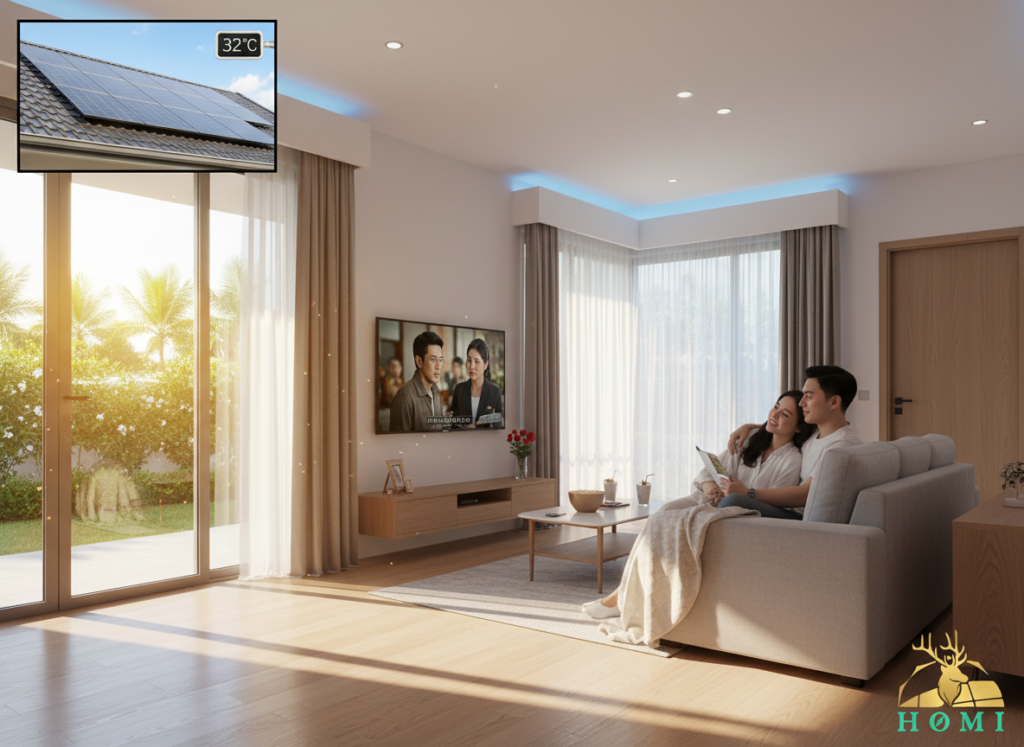
February in Kuala Lumpur and surrounding regions is hot and sticky. Daytime highs reach about 32°C on average, with high humidity that makes it feel warmer than the thermometer suggests. [web:198][web:199][web:202] When couples and families stay in to stream dramas or movies, they often run multiple air‑cond units for hours through midday and afternoon.
- Double-storey terrace or semi‑D, 2–3 bedrooms with split-unit air‑cond.
- Valentine’s weekend: both partners at home from late morning to late evening.
- Living room + master bedroom air‑cond running between 11am–4pm.
- TV, Wi‑Fi, fridge, and some kitchen usage in the background.
Without solar, this cluster of loads pushes daytime kWh into higher tariff tiers, especially for homes already above 600–700 kWh per month. [web:174]
2. Case Study: How One HOMI Client Covered Daytime Cooling with Solar
For this HOMI client (landed home in the Klang Valley), the goal was clear: “We want to enjoy daytime air‑cond on weekends and holidays without worrying about the TNB bill”. HOMI used its Precision Sizing method, built around Solar ATAP’s self-consumption‑first design, to match rooftop solar output to the home’s typical 11am–4pm load. [web:44][web:77]
House Profile
- Location: Greater KL, landed terrace home.
- Pre‑solar bill: ~RM 380–420/month (800–900 kWh). [web:174]
- Main daytime loads: 2 air‑cond units, fridge, fans, TV, router.
System Design Snapshot
- Solar ATAP system size: ~6–7 kWp (north–south roof mix).
- Designed for high self‑consumption, not maximum export. [web:44][web:77]
- Focused explicitly on covering 11am–4pm “comfort hours”.
| Before Solar ATAP | With HOMI Solar ATAP | |
|---|---|---|
| 11am–4pm Air‑Cond + Home Load | Mostly supplied by TNB grid. | ~80–100% supplied by solar on typical sunny days High Coverage |
| Monthly TNB kWh | 800–900 kWh | Reduced significantly; daytime portion largely offset by self-consumption. [web:44][web:77] |
| Bill Anxiety on Hot Weekends | High (“Can we really on two air‑conds?”) | Lower (“Daytime cooling mostly covered by our own roof.”) |
The key is not a “magic number of kW” but a design that uses your TNB data and lifestyle to align solar output with the hours your family actually wants to stay cool.
3. Simple Calculator: How Much of Your Daytime Air‑Cond Could Solar Cover?
Daytime Cooling Coverage Estimator
Use this to roughly estimate how much of your daytime air‑cond bill a solar system could cover, assuming a well‑designed Solar ATAP system.
Note: This is a simplified illustration. HOMI uses real TNB data, local weather and roof orientation to simulate your actual coverage more accurately. [web:44][web:77]
4. HOMI’s Precision Sizing: From “Turn on Air‑Cond Freely” to “TNB Bill Under Control”
Step 1: Read Your TNB Bills and Lifestyle
HOMI reviews 12–24 months of your TNB bills and asks practical questions:
- How many hours do you run air‑cond in the day on weekends and holidays?
- How often do you WFH, and which rooms need cooling?
- Do you expect higher usage in hotter months like February and March? [web:198][web:199][web:202]
Step 2: Simulate Solar ATAP Self‑Consumption
Using Solar ATAP’s “use your own power first” rule, HOMI simulates how much of your 11am–4pm load could be fed by solar in different system sizes. [web:44][web:77]
- We estimate air‑cond and base load kWh during peak sun hours.
- We model expected solar generation for your roof, taking local climate into account. [web:198][web:199][web:202]
Step 3: Choose the “Comfort‑First, Zero‑Waste” Size
Instead of pushing you to the maximum kW your roof can fit, HOMI recommends a size where:
- Most of your desired daytime cooling is covered on sunny days.
- Export is kept reasonable to avoid relying on credits that do not roll over.
- Your overall TNB bill profile (not just Valentine’s Day) still makes financial sense. [web:44][web:77]
FAQ: Solar ATAP, Air‑Cond & TNB Bill
Can Solar ATAP really cover 100% of my daytime air‑cond usage?
On typical sunny days, a well‑sized Solar ATAP system can cover a large portion—and in some cases nearly 100%—of your 11am–4pm air‑cond and base load in a landed house. Actual coverage depends on your kW usage, roof size, system orientation and local weather. [web:44][web:77][web:198]
Will my TNB bill drop to RM 0 if I install solar?
Not usually. Solar ATAP is designed for self‑consumption with monthly energy credits that do not roll over, so right‑sized systems focus on cutting the expensive daytime portion of your bill rather than eliminating it entirely. You will still pay some fixed and night‑time charges, but overall monthly costs can drop significantly. [web:44][web:77]
Is Solar ATAP worth it if I only use a lot of air‑cond on weekends?
Yes, provided we design from your full TNB history. Many families show strong weekend and holiday peaks. HOMI’s Precision Sizing considers both weekday and weekend patterns so that your system still makes sense across the whole year, not just on Valentine’s Day. [web:44][web:77]