
Solar ATAP + TNB TOU: One-Month March Home EV Charging Experiment to See How Much You Can Save vs DC Fast Charging in Malaysia
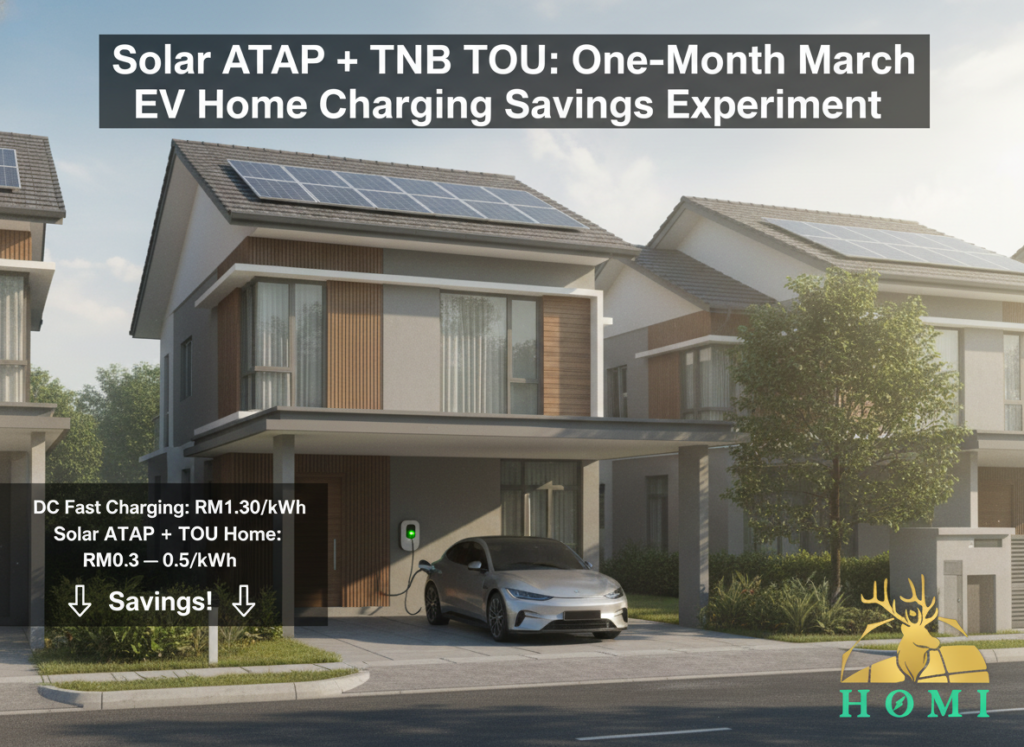
Instead of paying RM1.20–RM2.20 per kWh at public DC fast chargers, an EV owner with home solar and TOU can blend “solar-slow” charging in the day with cheaper off-peak grid charging at night.
This article lays out a simple weekday + weekend March experiment for EV owners and shows, with simplified numbers, how much charging cost you could save by combining Solar ATAP and TOU at home versus relying mostly on public DC fast charging or Normal tariff home charging.
1. The March EV Charging Experiment: KL / Selangor / JB / Melaka
For many Malaysian EV owners, a typical month looks like this:
- Weekdays: commute, errands and occasional meetings (charging mainly after work).
- Weekends: more flexible time at home, car parked in the porch for longer stretches in the day.
- Occasional road trips that might require DC fast charging on highways.
Our “March experiment” focuses on what you can do at home in a sunny month, not replacing all DC fast charging, but dramatically cutting how much you need to buy at high per‑kWh prices.
2. Cost Baselines: Public DC vs Home Normal Tariff vs Home TOU
Before we add solar, it helps to understand the basic cost per kWh from different charging paths in Malaysia:
| Charging Method | Typical Cost per kWh (RM) | Notes |
|---|---|---|
| Public DC Fast Charging | ≈ 1.20 – 2.20 | Many sites around RM1.20–1.80; some premium/highways higher. Tesla Superchargers often around RM1.13–1.25 for Tesla only. |
| Home AC Charging – Normal Tariff (high usage block) | ≈ 0.57 | For households with higher monthly usage, the top residential block is around 57 sen/kWh. |
| Home AC Charging – TOU Off-Peak | ≈ 0.34 – 0.57 | For high-usage TOU homes (>1,500 kWh), off-peak Energy Charge can drop to roughly 34.43 sen/kWh; for lower tiers, off-peak can be even cheaper. |
Even before Solar ATAP, home AC charging is often 2–3x cheaper per kWh than public DC. TOU can push that further down if you charge mostly in the off‑peak window.
3. Adding Solar ATAP: Daytime “Solar-Slow” + Night-time TOU Top-Up
Solar ATAP is Malaysia’s 2026 rooftop scheme built around self‑consumption and monthly Energy Charge credits, with no rollover beyond the billing cycle.
For EV owners, this opens up a powerful routine:
- Weekdays (after work): Park at home, set your charger to start or continue charging during the late-morning / early-afternoon window the next day (using solar output), and finish any remaining kWh during TOU off‑peak overnight.
- Weekends: Plug in for a long, low‑power “solar-slow” charge through midday, topping up remaining kWh in TOU off‑peak if needed.
- Public DC: Reserve DC fast charging mainly for long highway trips or emergencies.
Solar ATAP exports only give Energy Charge credits and reset monthly, so using your daytime solar directly in the EV instead of exporting can be far more valuable than relying on credits that may partially expire.
4. Simple One-Month EV Charging Savings Calculator (March Scenario)
March EV Charging Savings – DC vs Solar ATAP + TOU
Use this simple calculator to estimate how much you could save in one month by moving part of your charging from public DC to a Solar ATAP + TOU home setup.
Assumptions: simplified view comparing pure public DC charging vs a blended mix of Solar ATAP daytime and TOU off-peak home charging. Solar “cost” is treated as very low but not literally free to reflect system investment. Actual results depend on your vehicle efficiency, driving pattern, TNB bill structure and solar system size.
5. Example: 200 kWh/Month EV – Public DC vs Solar ATAP + TOU Home Charging
To make this more concrete, imagine a KL or JB EV owner who uses 200 kWh per month for charging (roughly 1,000–1,200 km for many EVs):
- Scenario A – Mostly Public DC: 200 kWh × RM1.30/kWh ≈ RM260 monthly charging cost.
- Scenario B – 40% Solar Daytime, 40% TOU Off-Peak, 20% DC:
- 80 kWh from Solar ATAP daytime at an effective 5 sen/kWh ≈ RM4.
- 80 kWh from TOU off‑peak at 34 sen/kWh ≈ RM27.
- 40 kWh still at DC at 1.30/kWh ≈ RM52.
That blended pattern comes to around RM83 for the month—less than one‑third of the pure DC case. The exact numbers will differ, but the direction is clear: the more March sunshine and off‑peak night hours you can harness at home, the less you need to pay premium DC prices.
6. How HOMI Designs Solar ATAP Systems with EV Charging and Main Incoming Capacity in Mind
For EV owners, solar is not just about roof area and panels; it is also about wiring, main incoming capacity and EV charger behaviour.
- Your main incoming supply (single- or three-phase) and existing load profile to avoid overloading.
- EV charger type (7 kW, 11 kW, 22 kW) and typical charging schedule (weekday evenings, weekend midday, etc.).
- Solar system size needed to realistically cover daytime household loads plus a meaningful share of EV charging in sunny hours.
- Whether a TNB TOU tariff makes sense given your overall monthly kWh and how much you can shift into off‑peak, including EV charging.
FAQ: EV Home Charging with Solar ATAP and TNB TOU
How much cheaper is home EV charging with Solar ATAP + TOU compared to public DC?
Public DC fast charging in Malaysia often ranges around RM1.20–RM2.20 per kWh, while home AC charging on a high residential tariff block can be roughly 0.57 RM/kWh, and TOU off-peak Energy Charge can drop to about 0.34 RM/kWh for high-usage homes. When Solar ATAP is added, a portion of your daytime kWh can effectively come from your roof at a very low marginal cost. For many EV owners, this combination can cut average charging cost per kWh to less than one-third of pure DC fast charging, depending on how much energy is moved to solar daytime and off-peak hours.
Does Solar ATAP make my EV charging “free”?
Solar ATAP does not make energy literally free because there is still the upfront cost of the PV system, and export credits only offset the Energy Charge portion of your bill on a monthly basis. However, by using your own midday generation directly for EV charging and household loads, you reduce how much electricity you buy from the grid, lowering your effective cost per kWh over the system lifetime. Any surplus exported energy that cannot be used to offset Energy Charge in a given month brings no additional cash benefit, which is why sizing and charging behaviour matter.
What does HOMI need from me to design an EV-ready Solar ATAP system?
To design an EV-ready Solar ATAP system, HOMI typically needs your recent TNB bills, basic details of your EV (battery size, typical monthly distance), your charger rating, your location (e.g. KL, Selangor, Johor Bahru, Melaka) and a rough weekly routine (weekday commute, weekend usage). With this, we can estimate monthly EV kWh needs, how much can realistically be moved to daytime solar and TOU off-peak, and what system size and wiring setup is safe for your main incoming supply.