

One Size Does Not Fit All”: Your Home Type Determines Your Solar Plan
In Malaysia, installing solar energy is no longer a luxury reserved for bungalow owners. With technological advancements and the NEM program, residents of terrace houses and even condominiums are exploring green energy. However, different building structures present vastly different challenges.
Your solar solution must be “site-specific.” Here is the adaptability analysis for Malaysia’s three main home types:
1. Bungalow / Detached House
Profile: The ideal candidate. Challenges: Roof design can be complex; high electricity consumption requires a properly sized system. Solutions:
-
High Flexibility: With a detached and typically large roof, the installation team has maximum flexibility in design.
-
Multi-Faceted Installation: Even with complex, multi-gabled roofs, installers can utilize the faces with the best orientation (e.g., North and South, or East and West) to maximize all-day generation.
-
Matching High Consumption: Bungalows often have the highest electricity bills. Installing a large system (e.g., 10kWp or more) not only achieves self-sufficiency but also generates significant bill credits via the NEM program.
2. Terrace / Link House
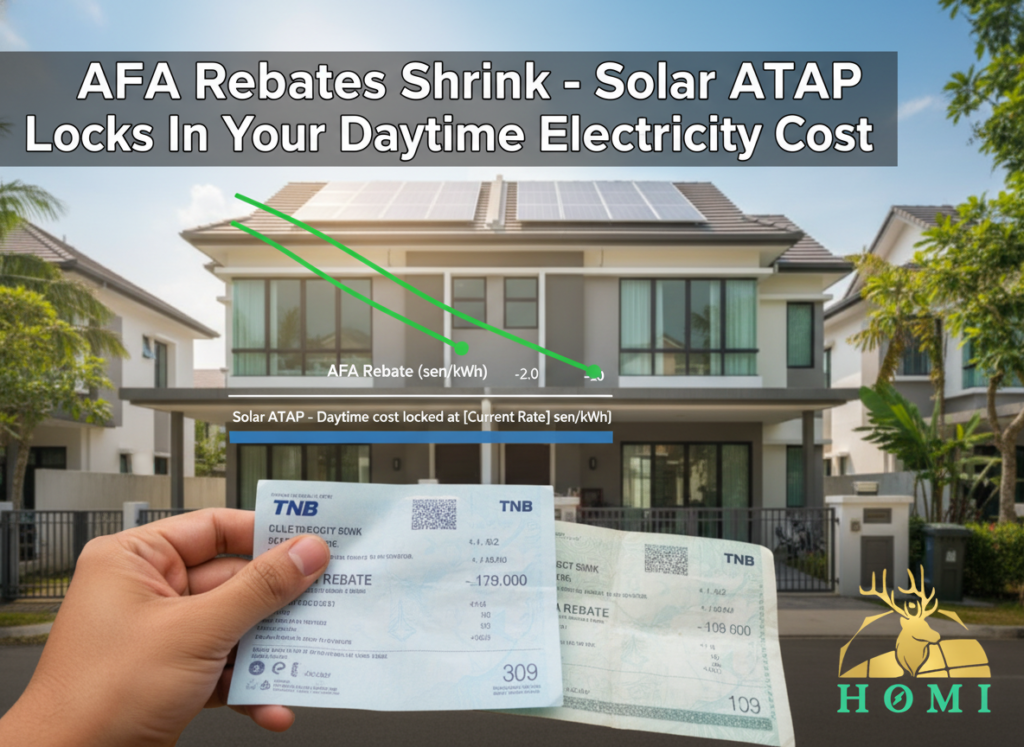
Profile: The most common housing type in Malaysia, with huge potential. Challenges: Limited roof space; potential overshadowing from neighbors. Solutions:
-
Space Maximization: Due to the limited roof area (especially for intermediate units), the use of high-efficiency solar panels is a priority. This allows for a higher system capacity to be installed within the same limited space.
-
Professional Shading Analysis: A professional shading analysis is crucial. If an adjacent neighbor’s house is taller or there are nearby high-rises, it could cast shadows during certain parts of the day, impacting energy production.
-
Optimized Layout: A professional installer will precisely measure the usable space, avoiding obstacles like skylights or water tanks, to design the optimal panel layout.
3. Condominium / Apartment
Profile: The most complex, but not impossible. Challenges: Jurisdiction (Ownership) and space limitations. Solutions:
This is the biggest point of confusion. It is almost impossible for an individual resident to install solar on a condo roof. Here’s why:
-
Ownership (Jurisdiction): The condo roof is “Common Property,” managed by the Joint Management Body (JMB) or Management Corporation (MC). No individual has the right to occupy this space for personal use.
-
Space: The limited roof space must be shared fairly among all residents, which is not operationally feasible.
What is the REAL solution? — Empowering the JMB / MC!
For condo residents, the most effective method is “collective action”:
-
Powering Common Areas: Push your JMB or MC to pass a resolution to install a large-scale solar system on the roof, dedicated to paying the electricity bills for common areas—such as elevators, lobby air-conditioning, corridor lighting, and pool pumps.
-
Lowering Maintenance Fees: The common area electricity bill is one of the largest expenses in a maintenance budget. By drastically cutting this cost with solar, the JMB / MC gains the ability to reduce the maintenance fees for all residents.
-
Professional Assessment: Invite a professional solar company (like Homi) to provide a free site assessment and ROI analysis for the JMB/MC, proving the financial viability with hard data.
Summary: Adaptability Checklist
Here is a quick summary for each housing type:
-
Bungalow / Detached House:
-
Challenge: Can have complex roof designs and high energy consumption.
-
Solution: High flexibility. Can utilize multiple roof faces for a large system to match high electricity bills.
-
-
Terrace / Link House:
-
Challenge: Limited roof space (especially intermediate units) and potential shading.
-
Solution: Must prioritize “high-efficiency” panels, optimize the layout, and require a professional shading analysis.
-
-
Condominium / Apartment:
-
Challenge: The roof is “common property”; individuals have no right to install.
-
Solution: Not feasible for individuals. The correct approach is to empower the JMB/MC to install solar for common areas (lifts, pools) to reduce maintenance fees for everyone.
-
Conclusion: No matter your home type, the first step is always a professional consultation. A qualified installer will conduct a site visit, assess your roof condition, shading, and energy usage habits, and tailor the best solar solution for you.