
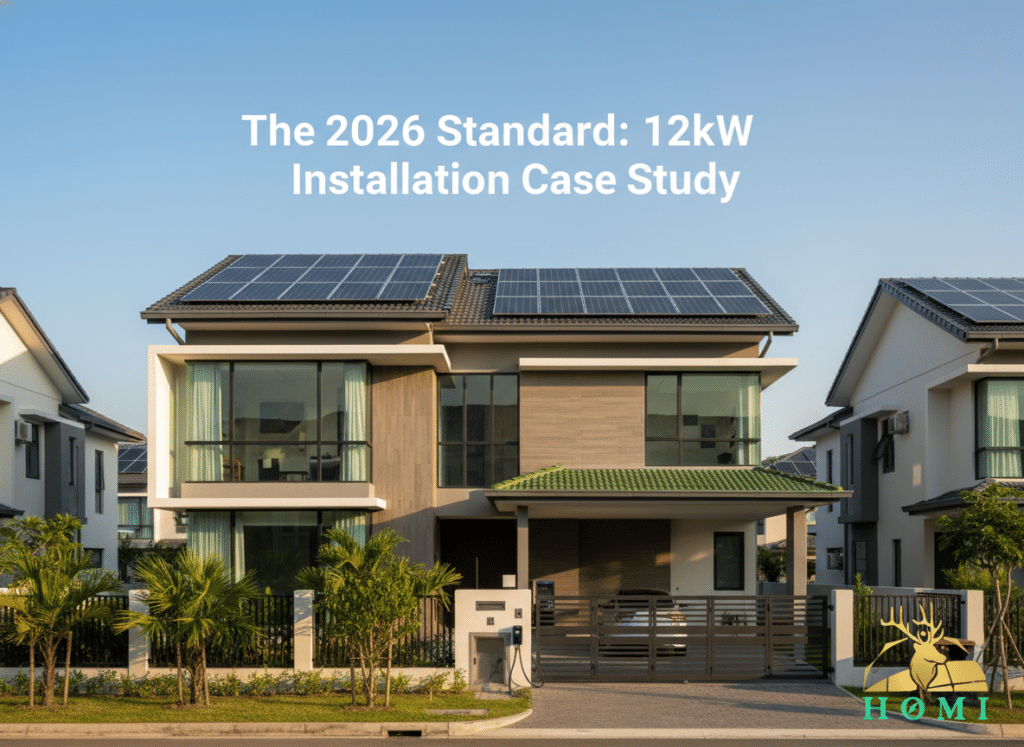
In the era of Solar ATAP, “good enough” installation quality is no longer sufficient. With the 2026 policy shift ending credit rollovers for new applicants, system efficiency and reliability are paramount. This week, we take you inside a recent 12kWp residential installation in Subang Jaya to show you exactly what the “HOMI Standard” looks like.
📍 Project Snapshot: USJ Heights, Selangor
Status: Commissioned January 2026
The Challenge: High Consumption, Zero Tolerance for Leaks
The homeowner, Mr. Tan, runs a semi-D household with 5 air-conditioners and a newly purchased EV. His average TNB bill was hovering around RM 1,100 monthly. His biggest concern wasn’t just the cost—it was the integrity of his roof. “I’ve heard horror stories of contractors cracking tiles and causing leaks 3 months later,” he told us.
1. The “Zero-Leak” Waterproofing Protocol
At HOMI, we don’t just drill and pray. For this project, we implemented our standard 3-layer protection protocol, which is critical for Malaysia’s heavy monsoon seasons:
- Non-Penetrative Clamps: Where possible, we use interlocking clips that grip the tile edge rather than drilling through it.
- Double Flashing: For necessary anchor points, we use industrial-grade aluminium flashing combined with bitumen sealant.
- Chemical Anchor Seal: Every screw penetration is injected with a weather-resistant chemical sealant that expands to fill micro-gaps.
2. 2026 Compliant Cabling & Safety
With the new Bomba guidelines updated in 2025, cable safety is non-negotiable. We utilized IEC 60332 fire-resistant DC cables housed in heavy-duty GI (Galvanized Iron) conduits. Unlike cheaper PVC pipes that become brittle under UV exposure, our GI conduits ensure the cabling remains safe for 20+ years.
3. Data Transparency: The App Interface
Under Solar ATAP, you cannot roll over credits indefinitely. This means you need to know exactly when you are generating power to optimize usage (e.g., charging your EV at noon). Mr. Tan’s system includes a premium monitoring app that shows:
- Real-time Generation: See exactly how many kW are being produced right now.
- Consumption vs. Export: (With optional CT meter) Visualize how much energy you use vs. how much you sell to TNB.
- Health Status: Instant alerts if any single panel underperforms.
End-to-End Service: We Handle the Paperwork
A 12kW system requires approval from TNB, SEDA, and sometimes local councils. HOMI’s service is truly end-to-end. We handled the entire Solar ATAP application, meter change coordination, and testing commissioning. Mr. Tan simply turned the switch on.
Get a free 3D roof design & savings estimate.
FAQ about Residential Solar
Is a 12kW system suitable for a terrace house?
Typically, a standard terrace house (20×70) fits a 4kW to 7kW system. A 12kW system usually requires the larger roof area of a Semi-D or Bungalow, and a 3-phase power supply is mandatory for systems above 6kW (single phase limit).
How does Solar ATAP differ from NEM for homeowners?
Starting Jan 1, 2026, Solar ATAP replaces NEM. The key difference is that export credits typically reset monthly (no 12-month rollover), encouraging users to size systems accurately for self-consumption rather than oversizing for export.
Do you offer warranty on the waterproofing?
Yes. HOMI provides a specific workmanship warranty that covers roof integrity against leaks caused by installation, separate from the 25-year performance warranty on the panels themselves.