The Misconception: Solar = No Blackouts?
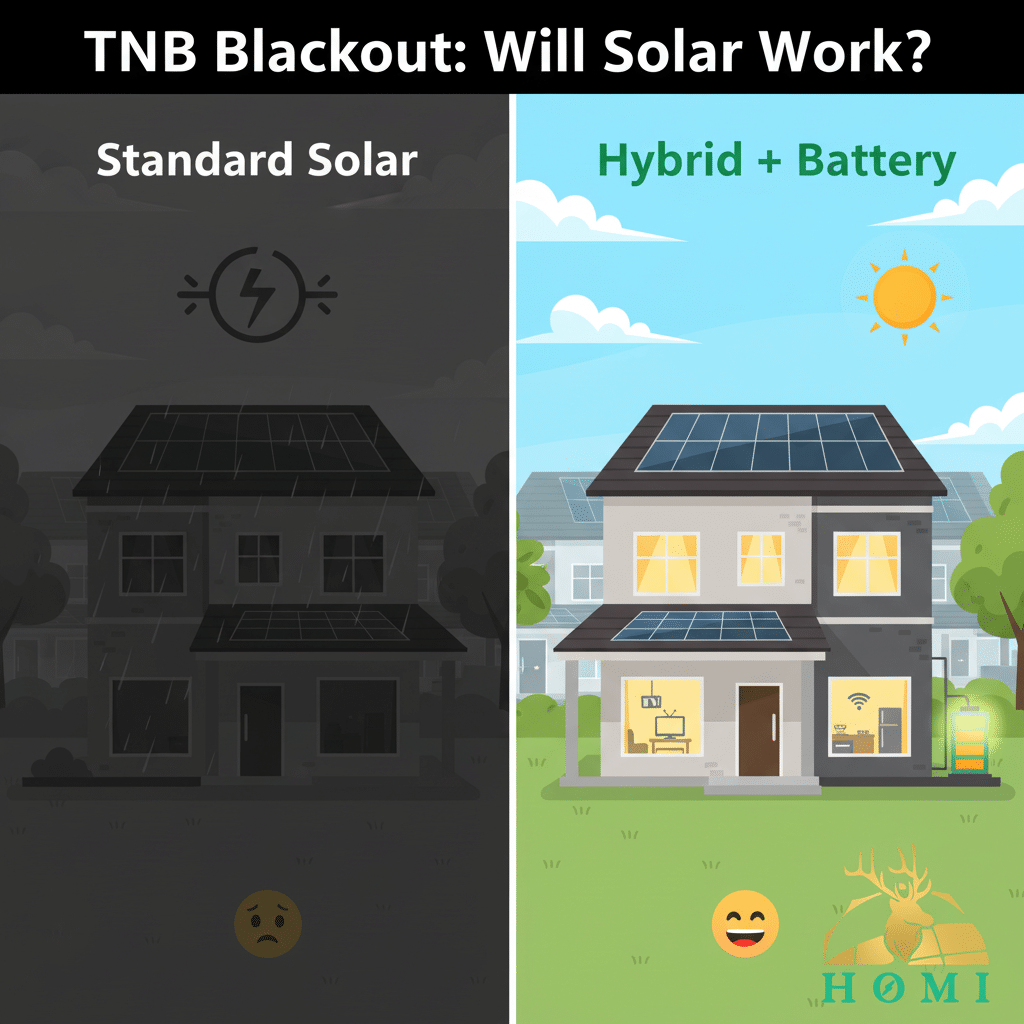
Imagine this: It’s a sunny afternoon, and your neighborhood suddenly experiences a TNB power outage. You might think, “It’s okay, I have solar, my house should still have power.”
Reality might disappoint you—your house will likely go dark just like your neighbors’.
Why does this happen? And what equipment do you need if you want power during a blackout?
1. Why standard solar systems “go on strike” during a blackout
The vast majority of homes in Malaysia install a “Grid-Tied PV System.” This system is legally required to have a critical safety mechanism called “Anti-Islanding Protection.”
-
Safety First: When the TNB grid goes down, technicians might be dispatched to fix the lines. If your solar system continues to generate and push power back into the grid (creating a live “island”), it could electrocute the workers who are trying to restore power.
-
Automatic Shutdown: To prevent this, all compliant grid-tied inverters will automatically shut down the instant they detect a grid failure (usually within milliseconds).
2. The Solution: Hybrid Inverter + Battery
If you want your solar system to act as a “backup generator” during a TNB outage, you need to upgrade to a “Hybrid Solar System.”
It consists of two core components:
-
Hybrid Inverter: Capable of working both “on-grid” and “off-grid.”
-
Battery Storage: To store energy for use when the grid is down.
3. How does it work?
When a hybrid system detects a TNB blackout, it will:
-
Physically disconnect from the TNB grid (ensuring no backfeed, keeping workers safe).
-
Automatically switch to battery/solar mode.
-
Power ONLY “Critical Loads”: This is crucial. Typically, you won’t power your entire house on batteries (it’s too expensive). Instead, a separate circuit is dedicated to critical appliances, such as:
-
Refrigerator (to prevent food spoilage)
-
Modem/WiFi router (to stay connected)
-
Essential lights and fans
-
Autogate
-
4. Do I need a Hybrid System?
It depends on your need for “energy security”:
-
If blackouts are rare and short in your area, a standard grid-tied system is likely enough and offers the best ROI.
-
If you experience frequent outages, or have equipment that absolutely cannot lose power (e.g., medical devices, servers, expensive koi pond pumps), then investing in a hybrid system and battery is a worthwhile “insurance policy.”
Conclusion: Standard solar systems are for saving money (via NEM), while Hybrid + Battery systems are for saving money plus peace of mind. Before installing, be clear with your installer: is your goal just to reduce bills, or do you also need emergency backup power?