
Why Consider Adding a Battery?
When deciding whether to add a battery, we must first understand its core functions. For homes or small businesses (especially those with existing solar systems), batteries primarily solve two problems:
-
Energy Independence & Backup: During a grid outage, a battery can act as a backup power source, ensuring critical devices keep running.
-
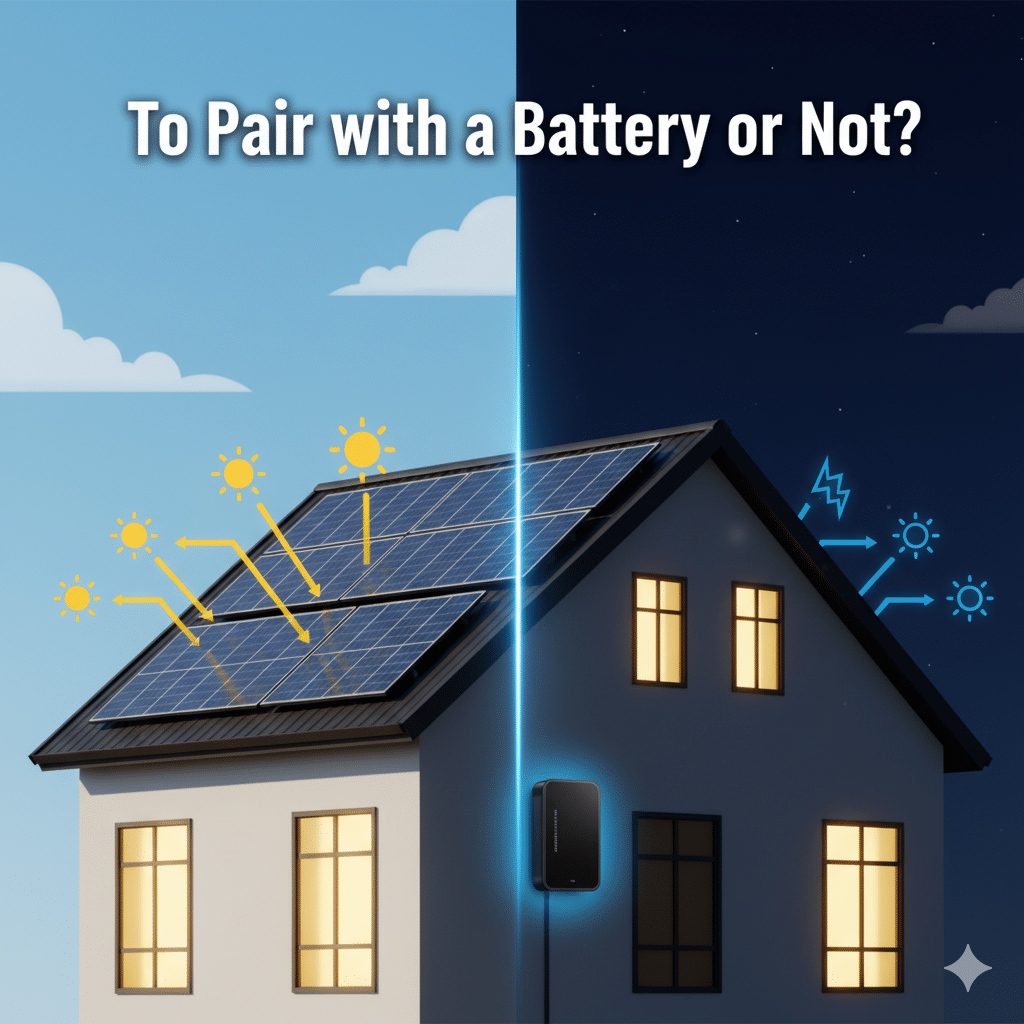
Energy Time-Shifting & Arbitrage: Storing excess energy (e.g., from solar) generated during the day for use at night, or taking advantage of Time-of-Use (TOU) rates by charging when electricity is cheap (off-peak) and discharging when it’s expensive (peak).
Four Key Factors in Your Decision
Adding a battery is a significant investment. Whether it’s right for you depends on your specific needs.
Factor 1: Blackout Protection
This is the most critical, needs-based reason.
-
Good Fit:
-
You live in an area with frequent power outages or an unstable grid.
-
You have critical loads (like medical equipment, servers, water pumps, or essential security systems) that cannot afford to lose power, even for a moment.
-
You are pursuing maximum “energy security.”
-
-
Not a Fit:
-
Your grid is extremely reliable; outages are very rare.
-
A short-term power outage is a minor inconvenience, not a significant disruption.
-
Factor 2: Peak Shaving & Arbitrage (Time-of-Use)
If your utility bill shows “Time-of-Use” (TOU) rates, the economic benefit of a battery becomes clear.
-
Good Fit:
-
Your peak electricity rate is significantly higher than your off-peak rate (e.g., peak is 2x the off-peak price or more).
-
The battery can charge from the grid during off-peak hours (like late at night) and discharge to power your home during peak hours (like the evening), allowing you to “buy low, sell high.”
-
-
Not a Fit:
-
You are on a flat-rate electricity plan where the price is the same 24/7. In this case, installing a battery purely for arbitrage is not cost-effective.
-
Factor 3: Energy Usage Habits
This factor is most relevant for users who already have a solar PV system.
-
Good Fit:
-
Your peak electricity consumption is in the evening or early morning (e.g., returning from work, cooking dinner, running the A/C).
-
Your solar production peaks during the day. A battery perfectly bridges this time gap, storing excess daytime solar power for you to use at night, maximizing your solar self-consumption.
-
-
Not a Fit:
-
Your energy usage is highest during the day (e.g., you work from home, or it’s a 9-to-5 office).
-
Your consumption curve closely matches your solar production curve, meaning you use most of the solar power as it’s generated.
-
Factor 4: Budget & Return on Investment (ROI)
Batteries are expensive and will significantly increase the initial cost of your (solar) system.
-
Good Fit:
-
You have a sufficient upfront budget and are prioritizing long-term energy independence and (potential) long-term savings over the fastest possible payback period.
-
-
Not a Fit:
-
Your budget is limited, and your current priority is the fastest possible ROI on the solar panels themselves.
-
Without TOU rates or frequent outages, adding a battery will significantly extend the payback period for your entire system.
-
Summary Checklist: Is It Right for Me?
| Good Fit 👍 | Not a Fit 👎 |
| ✅ Frequent blackouts; have critical loads | ❌ Extremely stable power grid |
| ✅ Have “Time-of-Use” (TOU) rates with a large price gap | ❌ On a “Flat Rate” electricity plan |
| ✅ Peak energy use is at night (after solar stops) | ❌ Peak energy use is during the day (matches solar) |
| ✅ Sufficient budget; prioritize energy independence | ❌ Limited budget; prioritize fastest ROI |
Conclusion: Adding a battery is a major investment. If your primary needs are managing frequent blackouts, capitalizing on TOU rates, or solving the “nighttime use” problem, a battery is a smart choice. However, if your grid is stable, your rates are flat, and you use most of your power during the day, you might be better off (for now) investing that money in more solar panels.