
Solar Panels Eat “Light,” Not “Heat”
Whenever dark clouds gather or heavy rain falls, many homeowners instinctively check their inverters, worried that the system has gone on “strike.”
This is a common misconception. Many believe solar panels need scorching heat and direct sunlight to work. In fact, Photovoltaic (PV) technology relies on Light, not Heat.
As long as there is light—even weak light—your panels are generating electricity.
Performance Across Different Weathers
Let’s look at how your system performs in three typical scenarios:
1. Cloudy Days — The Power of Diffused Light
When clouds block the sun, you can still see your surroundings, right? That is “Diffused Light.”
-
-
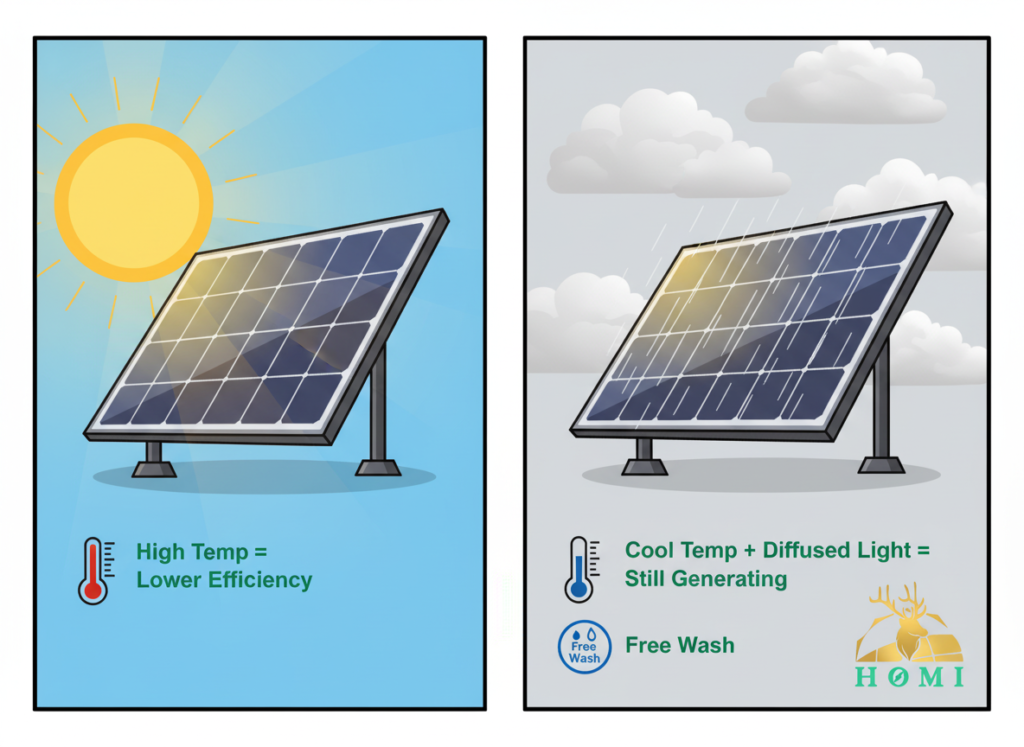
Performance: Modern Tier-1 solar panels (like those used by Homi) are highly sensitive to low light. On cloudy days, sunlight scatters through the clouds. Your system typically maintains 10% to 25% of its capacity.
-
Analogy: It’s like reading a book under a tree shade. There’s no direct sun, but there’s still plenty of light to read.
-

2. Rainy Days — Free Cleaning Time
During heavy storms when the sky turns dark, generation does drop significantly.
-
Performance: Output might drop to 5% – 10% of peak capacity.
-
Hidden Bonus: Don’t be sad! Rain is a solar panel’s best friend. It washes away dust, bird droppings, and pollen for free. After a good rain, your panels are spotless, and efficiency often spikes the next sunny day!
3. “Cool” Sunny Days — The Sweet Spot
Here is a counter-intuitive fact: Solar panels actually hate heat. Electronic efficiency drops as temperature rises. Therefore, the most productive moments in Malaysia aren’t the scorching midnoons (when panels are too hot), but rather the moments right after rain, when the air is cool and the sun comes back out.
Why You Shouldn’t Worry About the “Monsoon Season”
When designing a system, Homi’s professional engineers don’t calculate based on “perfect days.” We use Average Annual Irradiance data from the past 20 years in Malaysia.
Our ROI calculations already account for losses during the rainy season and cloudy days. Even if it rains a lot this month, your total generation over the full year will still meet the targets.
Conclusion: Generation might be lower on rainy days, but it is never “zero.” Plus, the cleaning and cooling effects of rain are crucial for long-term system health. So, when it rains, enjoy the cool weather—your roof is still quietly making money for you using “Diffused Light.”