


Solar inverter trips at midday in Malaysia: what to record before calling for help
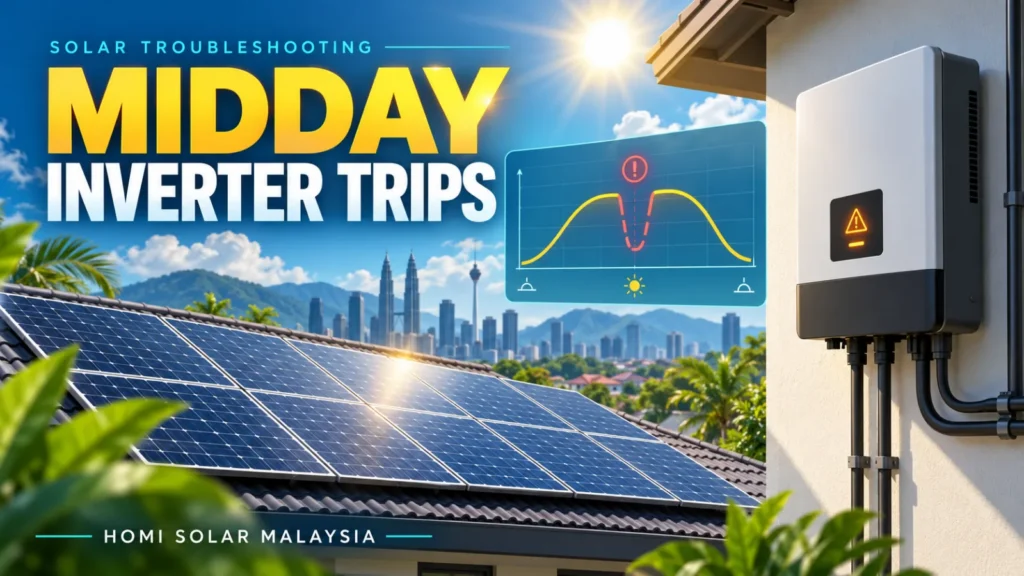
A solar inverter that disconnects or restarts around midday needs evidence, not a guessed diagnosis. A gap in the monitoring graph can come from a grid-voltage or frequency protection event, high equipment temperature, zero-export control, a communication outage or another site-specific condition. A smooth flat production top can simply be inverter clipping rather than a trip. These patterns may look similar in a daily chart, but the next action is different.
Homi Solar Malaysia recommends preserving the event before anyone resets equipment or changes settings. The current Energy Commission guideline checked on 16 October 2026 requires solar PV design, equipment, testing, operation and maintenance to follow applicable requirements and utility technical documents. It also places design certification, electrical work, testing and commissioning within qualified or competent-person responsibilities. This article therefore explains safe observation only: do not open the inverter, bypass protection, alter voltage or frequency limits, or repeatedly cycle isolators.
First decide whether the inverter stopped—or only the app stopped updating
Start with what can be observed without touching live equipment. Note whether the premises still had normal grid supply, whether the inverter display or indicator showed an exact code, and whether the monitoring portal stopped at the same minute. A blank app chart while the inverter remains in normal operation suggests a communications or portal issue; a stored protection code and an automatic reconnect are different evidence. Keep the original screenshot with its timestamp and timezone.
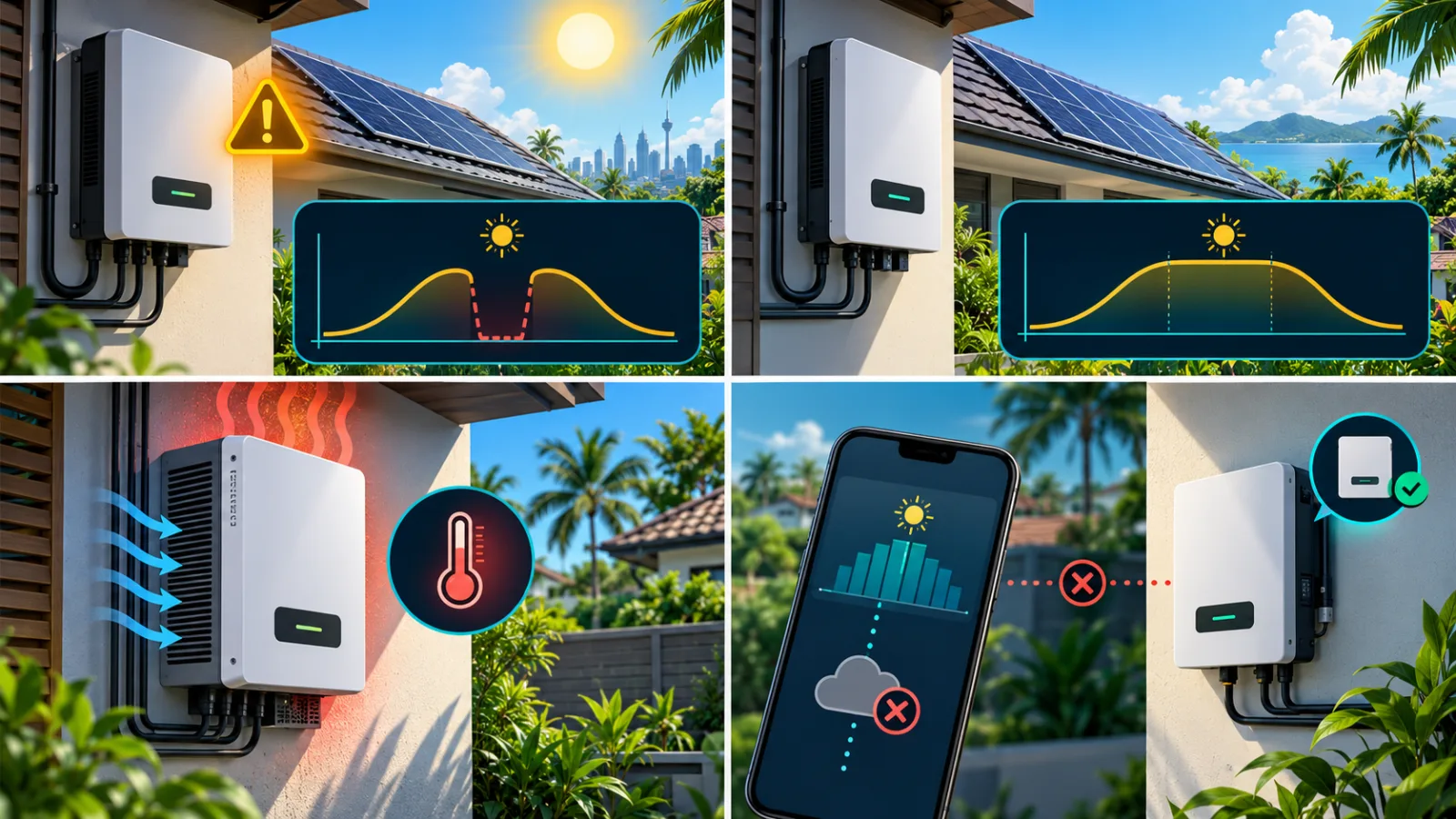
Comparison table: four patterns that should not be mixed together
| Observed pattern | Useful evidence | What it may indicate | Safe next step |
|---|---|---|---|
| Output falls to zero, an exact grid-voltage or frequency code appears, then the inverter reconnects | Alarm text/code, timestamp, inverter-reported values, grid supply status and recurrence | A protection event that needs correlation with approved settings and site or network measurements | Preserve the log and ask the responsible qualified party to review it; do not widen protection limits |
| Production has a smooth flat top without a disconnect alarm | AC output curve, DC/AC ratings, duration and weather assumptions | Possible inverter clipping or another operating limit—not necessarily a trip | Compare with the system design and the DC/AC ratio guide |
| A temperature or derating message appears during a hot period | Exact code, installation clearance, ventilation condition and time pattern | A thermal condition or derating that is distinct from a grid-protection event | Request a safe installation review; do not open or cool live equipment with water |
| The app stops updating but local indicators show normal operation | Last portal update, local status, router/connectivity status and later data recovery | A monitoring or communications outage | Check the non-electrical communications path and preserve the gap before escalating |
Worked example: a three-event log
Hypothetical educational example only: this is not measured HOMI project data, a remote diagnosis, an accepted protection threshold or proof of a TNB network fault. The values are deliberately shown as evidence to be reviewed, not as settings to copy.
| Local time | Owner records | What is still unknown |
|---|---|---|
| 11:58 | Production rising; no visible alarm | Actual conditions at the point of common coupling |
| 12:07 | Output zero; inverter log says “grid voltage high”; building grid supply remains on | Whether the inverter reading is accurate, how long the event lasted and whether approved protection settings were reached |
| 12:13 | Inverter reconnects automatically; similar event appears on two clear days | Whether the cause is site wiring, local voltage rise, network conditions, settings, equipment or a combination |
This log is more useful than saying “the inverter failed at noon”. The reviewer can correlate the exact event with inverter history, on-site measurements, cable design, phase conditions, protection records and utility requirements. The owner should not infer a threshold from one screenshot or change a setting to keep the inverter online.
A five-minute evidence checklist
- Exact event: photograph or export the complete alarm text and code, not a paraphrase.
- Time: record local date and time in Malaysia and note whether the device clock is correct.
- Grid status: note whether lights and non-solar loads remained powered.
- Production view: save the day curve before data is overwritten, including the minutes before and after the gap.
- Reported values: preserve inverter-displayed AC voltage, frequency and temperature only if available; do not treat them as calibrated site measurements.
- Pattern: note weather, approximate time, affected phases if known and whether the event repeats on clear days.
- Changes: list any recent approved maintenance, firmware or electrical work; do not make a new change while collecting evidence.
- Privacy: keep bills, account numbers, customer identities and private site data out of public comments and AI tools.
Why grid conditions belong in the review
TNB’s current connection guideline describes a 50 Hz AC system, publishes power-quality requirements and notes that voltage and frequency may fluctuate for short periods. It also states that protection arrangements and settings at the connection point must follow TNB requirements. That does not mean every midday event is a TNB fault. It means a credible investigation must compare recorded inverter events with approved protection settings and measurements at the correct connection point, rather than simply replacing the inverter or disabling protection.
When to stop and call a qualified person
Escalate promptly if the event repeats, the inverter shows a protection or insulation fault, breakers trip, there is burning smell, heat damage, water ingress, unusual sound or any exposed/damaged cable. Keep away from the equipment if there is an immediate hazard and follow the installed emergency and contractor instructions. Do not remove covers, bypass isolators or keep resetting a fault. The Energy Commission guideline assigns installation safety and maintenance responsibilities and requires qualified parties for regulated work.
Regional boundary and HOMI contact
The Energy Commission source used here is the June 2026 self-consumption guideline for Peninsular Malaysia. Sabah and Sarawak may follow different utility and authority routes. System type, programme, inverter model, approved settings and point of connection also matter. This guide does not guarantee a diagnosis, repair, uptime, approval or savings.
Homi Solar Malaysia can review a clean evidence pack and coordinate a site-specific technical assessment. See the current solar service route or contact HOMI. Share private bills and device records through an agreed private channel, never in a public comment.
Frequently asked questions
Does a midday production gap prove that grid voltage is too high?
No. It is one possible pattern, but the exact alarm, timestamps, approved settings and measurements at the correct connection point must be reviewed. Heat, communications, controls and equipment conditions can create different-looking gaps.
Should I raise the inverter voltage limit to stop the trips?
No. Protection settings are a safety and connection matter. Do not change them as a DIY fix; ask the responsible qualified party to compare the event with approved settings and current utility requirements.
Is a flat midday curve the same as an inverter trip?
No. A smooth flat top without a disconnect alarm may be clipping or another operating limit. A trip usually creates a gap, event record or reconnect sequence. Preserve both the curve and the alarm history.
What is the most useful information to send HOMI?
Send the exact alarm code, local timestamp, full-day production screenshot, whether grid supply stayed on, recurrence pattern and any recent approved work. Keep account numbers and personal information in a private channel.
Official sources checked
- Energy Commission Malaysia: Self-Consumption Solar PV Guidelines, June 2026
- TNB: Connection Guidelines
- TNB: Distributed Energy Resources Integration
This article reflects official information checked on 16 October 2026 and is general guidance. Programme rules, tariff treatment, approval and actual savings remain subject to the latest PETRA, SEDA, Energy Commission and TNB requirements plus the property bill, roof and usage pattern.
Want HOMI to review your TNB bill?
Send your usage pattern and HOMI can estimate whether Solar ATAP makes sense for your home or business.
Arrange an Inverter Event Review