


Who manages your solar account?

Before accepting a solar handover, establish who can view data, who can change equipment settings and how support access ends. Keep an owner-controlled recovery route and ask for separate named roles where the actual platform supports them. A shared password is a poor substitute for an agreed access record.
Homi Solar Malaysia prepared this guide for household owners and business facility teams. It focuses on account responsibilities, not network configuration or electrical procedures. It does not claim that a particular inverter is insecure, that every app has the same features or that a checklist makes a system attack-proof.
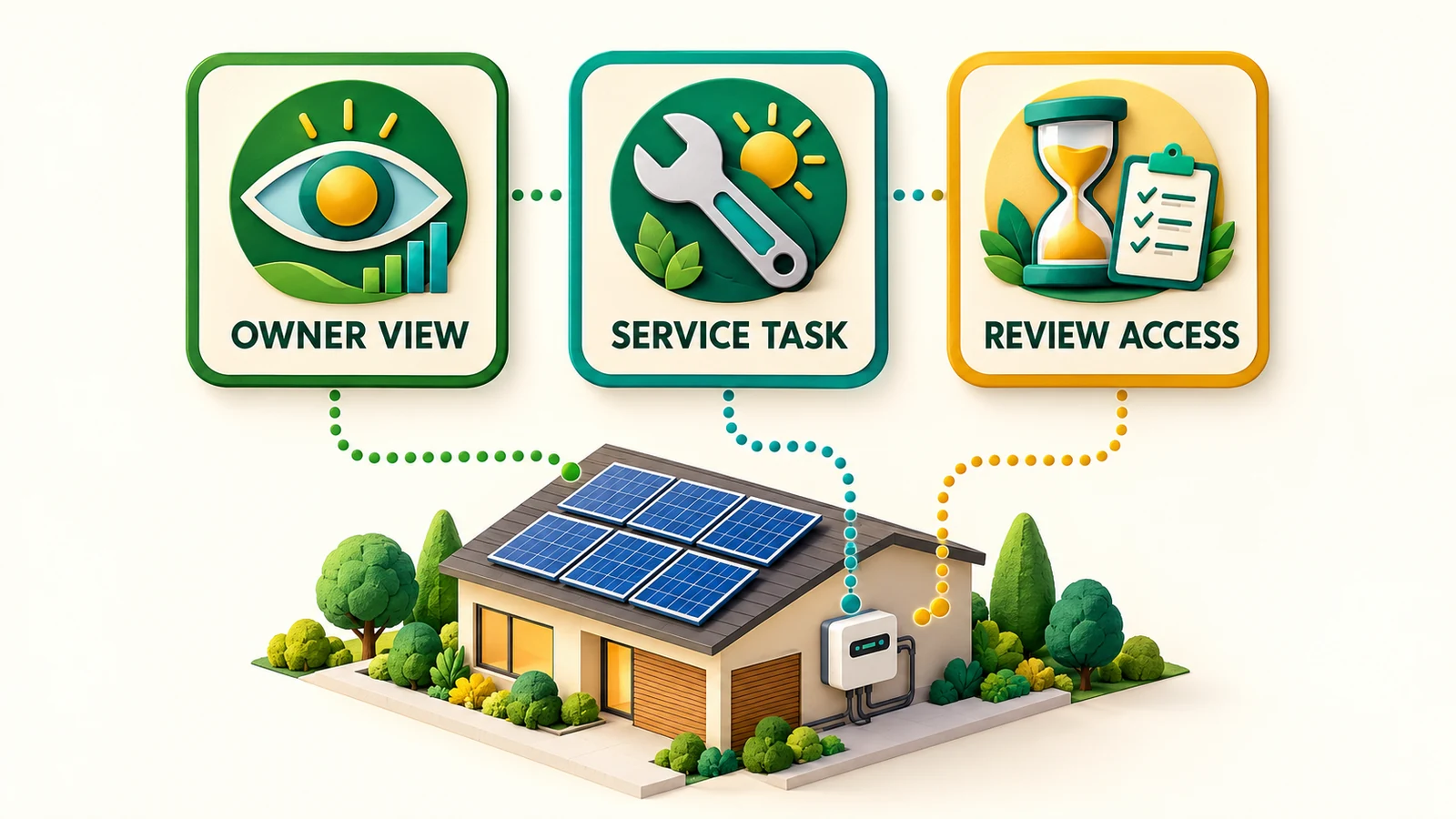
Compare the access roles
NIST IR 8498, final December 2024, distinguishes monitoring, installation and maintenance responsibilities. Its role-based approach limits access to the task. The table adapts that principle into HOMI questions for a Malaysian handover; the labels below are illustrative, not a promise about your app.
| Role | Purpose to confirm | Question for handover |
|---|---|---|
| Owner | View generation, receive alerts and manage an agreed recovery route | Which functions belong to my named account? |
| Qualified service team | Perform authorised diagnostics, maintenance or configuration | Who has this role, for which site and which tasks? |
| Temporary support | Investigate a defined issue within agreed permissions | When will access be reviewed or removed, and by whom? |
Do not confuse the monitoring app, the inverter’s local interface and a manufacturer’s service portal. Ask the supplier to identify each access route relevant to your equipment. Viewing a generation chart does not prove that the same login can change protection settings, and changing the app password should not be assumed to close every other route.
Confirm account ownership
Ask which email address receives account-recovery requests and who controls it. For a business, record the responsible company role and a documented handover process when staff change. For a home, avoid leaving recovery dependent on a former installer’s personal account. Confirm the provider’s actual transfer process before any contractor change.
NIST recommends changing default credentials and using unique credentials, with multi-factor authentication where supported. Ask the provider to demonstrate the relevant owner controls through its official process. Keep passwords and recovery codes private; an access inventory should record responsibilities and review dates rather than the secret values.
Agree how remote help works
A support visit can start with permission to inspect an alert rather than permission to change every setting. Ask what the team intends to do, what permission is required and how the outcome will be recorded. Where a platform lacks temporary roles, ask for its supported alternative and the review steps after support. Do not invent an expiry feature that the equipment does not have.
Illustrative scenario: an owner reports missing daily data. The team first reviews the alert using the agreed support route. If further privileges are needed, it explains the specific task before access changes. Afterwards, the owner receives a short action record and confirms the remaining access list. This is a proposed workflow, not a HOMI customer incident or proof that all systems work this way.
Include updates and records
The UK consumer IoT code of practice treats secure software updates and a stated support period as good-practice considerations. Ask who checks the inverter, communication gateway and app updates, which official channel supplies them, and what happens when support ends. App updates and equipment firmware are separate questions for the supplier.
NIST also discusses event logging and protection of communications. Ask what access or change history is available and who can review it. For a commercial site, involve the existing IT and electrical teams before changing connectivity. This article provides no port-forwarding, firmware-flashing or protection-setting instructions.
Five handover checks
- Identify the owner account and its verified recovery channel.
- List named support organisations and their agreed permissions.
- Confirm non-default unique credentials and available MFA.
- Record the update owner, official source and support period.
- Agree an access review after support or a contractor change.
These are HOMI planning suggestions, not a statutory form. Keep the non-secret access record with your solar handover documents. If the app is offline, use our monitoring versus generation guide to prepare questions without opening electrical equipment.
Malaysia scope and next step
The US DOE solar cybersecurity page explains the relevance of connected monitoring and control. NIST and UK sources here provide technical background, not Malaysian legal or product certification requirements. The ST SELCO index, checked 29 October 2026, lists June 2026 guidance for Peninsular Malaysia issued 24 July 2026. Sabah and Sarawak require separate checks with the relevant authorities and electricity providers.
Solar ATAP rules, tariffs, approval and savings depend on current PETRA, SEDA, ST and TNB requirements and the actual bill, roof and usage. Account hygiene does not guarantee savings, approval or uninterrupted generation. Ask Homi Solar Malaysia about handover questions, or contact the human team to agree a private document channel. Keep bills, passwords, recovery codes and customer data out of public comments and public AI tools.
Frequently asked questions
Does the owner need installer privileges?
Ask for owner monitoring and recovery access appropriate to your platform. Electrical configuration should remain with the qualified team; ownership does not require every technical privilege.
Will changing one password remove every connection?
Do not assume it will. Ask the verified provider how to review linked users, active sessions and any separate device or service access on that platform.
Should I disconnect the internet for safety?
Agree a plan with the qualified team first. Connectivity may support alerts, diagnostics and updates; an unexplained disconnection is not a complete security plan.
What can I send when asking for help?
Start with a fault description and a redacted screenshot through an agreed private channel. Never post passwords, recovery codes, full bills or customer data in public comments or AI tools.
Sources checked 29 October 2026
- NIST — Cybersecurity for Smart Inverters: Guidelines for Residential and Light Commercial Solar Energy Systems
- UK Department for Digital, Culture, Media and Sport — Code of Practice for Consumer IoT Security
- US Department of Energy — Solar Cybersecurity
- Suruhanjaya Tenaga — Self-Consumption (SELCO) official index
This article reflects official information checked on 29 October 2026 and is general guidance. Programme rules, tariff treatment, approval and actual savings remain subject to the latest PETRA, SEDA, Energy Commission and TNB requirements plus the property bill, roof and usage pattern.
Want HOMI to review your TNB bill?
Send your usage pattern and HOMI can estimate whether Solar ATAP makes sense for your home or business.
Discuss Solar Account Handover