


Two solar ratios: what do they mean?
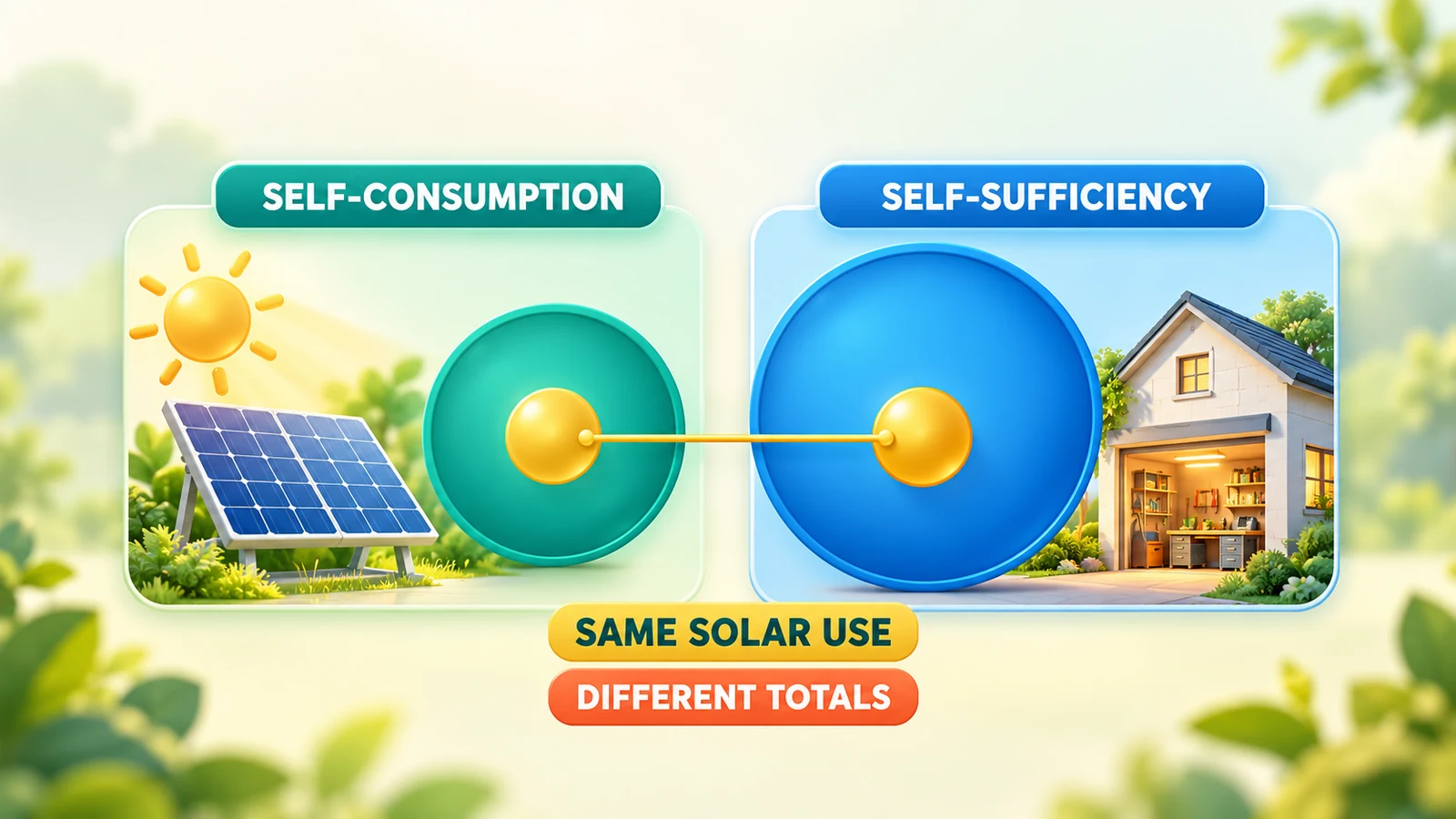
Solar self-consumption asks how much of the solar you generate is used on site. Self-sufficiency asks how much of your total electricity demand is supplied by that solar. The numerator can be the same while the denominator changes. A high first percentage therefore does not prove a high second percentage.
Homi Solar Malaysia prepared this guide for homeowners and business facility teams comparing proposals or monitoring summaries. We use energy in kWh over one consistent period, with no battery, other generator or changing storage balance. This keeps the arithmetic visible without claiming a forecast, tariff result or actual project performance.
Start with three energy totals
The IEA PVPS self-consumption methodology distinguishes these concepts. The SMA Sunny Design glossary also separates the share of generation used locally from the share of demand covered. Here, let G mean AC solar generation, U mean solar used directly on site, and L mean total site electricity demand, all in kWh for the same period.
- Self-consumption ratio = U ÷ G × 100%. It asks where the generated solar went.
- Self-sufficiency ratio = U ÷ L × 100%. It asks where the site’s electricity came from.
These ratios need non-zero denominators. Total demand is not simply the grid-import figure: it also includes solar used on site. Do not divide a month’s generation by a different month’s bill and label the result as either ratio.
Worked example: different answers
Hypothetical teaching example only: the following two invented one-day cases are not HOMI measurements, a system-size recommendation or a completed simulation. Both sites use 100 kWh. We assume an AC energy boundary with no storage or other supply. Export is an accounting remainder here, not permission to export under any Malaysian programme.
| Invented case | Solar G | Used U | Demand L | U/G | U/L | Import / export |
|---|---|---|---|---|---|---|
| A | 40 kWh | 30 kWh | 100 kWh | 75% | 30% | 70 / 10 kWh |
| B | 80 kWh | 40 kWh | 100 kWh | 50% | 40% | 60 / 40 kWh |
Case A uses 30 of its 40 solar kWh locally, so its self-consumption is 75%. Yet solar supplies only 30 of the site’s 100 kWh, so self-sufficiency is 30%. In case B, useful solar rises to 40 kWh even though self-consumption falls to 50%. The percentages answer different questions; neither case is automatically the better purchase.
For this simplified balance, grid import is L minus U and export is G minus U. The table does not reveal hourly peaks, weather, equipment cost, curtailment or bill treatment. Annual net generation cannot establish when electricity is actually available, and a daily energy ratio does not establish blackout capability.
Check the dashboard boundary
Before comparing two percentages, ask whether both reports cover the same dates, timezone and AC measurement points. Confirm whether the display shows instantaneous power in kW or accumulated energy in kWh. A live midday percentage and a full-month energy ratio are different observations.
Storage needs a separate balance. Battery charging, energy delivered back to loads, conversion losses, grid charging and the opening and closing state of charge can change the accounting. A platform may count charging toward self-consumption while measuring delivered supply separately. Ask for its definitions before using the no-battery equations above. Do not count both charging and later discharge as two units of useful solar supply.
Use the ratios to ask better questions
A proposal should show generation, useful local solar and demand alongside the percentages. Ask for representative working days, weekends and shutdowns using consistent data. If a higher ratio comes from a smaller array, find out whether the site receives fewer useful solar kWh. If it comes from moving loads, check that the schedule remains practical and safe.
Keep bill modelling separate. Energy rates, export treatment, demand-related charges, fixed items and project costs are not captured by either ratio. A claim of 75% self-consumption is not a claim of 75% bill savings. Review our generation, import and export guide for the underlying readings, then use these two denominators to interpret the percentages.
Five checks before comparing
- Write down the exact dates, timezone and energy boundary.
- Record G, U and L in kWh, not only the two percentages.
- Identify estimated values, missing readings and exclusions.
- Separate battery flows, losses and changes in stored energy.
- Compare the engineering and bill case before choosing a size.
Malaysia scope and next step
The older IEA methodology is used for stable definitions, not current Malaysian policy. The ST SELCO index, checked 30 October 2026, lists June 2026 Peninsular Malaysia guidance issued 24 July 2026. A technical self-consumption ratio is not the same thing as eligibility for the SELCO programme. Sabah and Sarawak need separate checks with their authorities and electricity providers.
Solar ATAP rules, tariff treatment, approval and savings depend on current PETRA, SEDA, ST and TNB requirements plus the actual bill, roof and usage. Ask Homi Solar Malaysia to clarify the assumptions, or contact the human team about a private review. Do not upload private bills or customer records into public comments or public AI tools.
Frequently asked questions
Does 100% self-consumption mean I can leave the grid?
No. It means all measured solar generation was used locally within the stated boundary and period. That generation may still cover only a small share of total demand. Grid independence and backup require separate engineering.
Is a lower self-consumption ratio always worse?
No. Compare useful solar energy in kWh, total demand and the full project case. A larger array can supply more useful energy even while the percentage used locally falls.
Can I divide monthly generation by my grid import?
That is not either ratio in this guide. Grid import excludes solar used on site. Use consistent generation, local-use and total-demand data for the same period and boundary.
What should I send for a review?
Start with a non-sensitive summary of the period, system configuration and data definitions. Agree a private channel with the human team before sending bills or interval records; keep customer data out of public comments and AI tools.
Sources checked 30 October 2026
- IEA PVPS — A methodology for the Analysis of PV Self-Consumption Policies
- SMA Solar Technology AG — Sunny Design Glossary
- Suruhanjaya Tenaga — Self-Consumption (SELCO) official index
SMA current-status definitions: power, battery charging and delivered supply.
This article reflects official information checked on 30 October 2026 and is general guidance. Programme rules, tariff treatment, approval and actual savings remain subject to the latest PETRA, SEDA, Energy Commission and TNB requirements plus the property bill, roof and usage pattern.
Want HOMI to review your TNB bill?
Send your usage pattern and HOMI can estimate whether Solar ATAP makes sense for your home or business.
Discuss Solar Account Handover