


Solar generation versus TNB import and export: why the kWh readings differ

Your solar inverter’s generation total and the TNB meter’s import or export total describe different energy flows. They are not expected to be identical. Solar used inside the premises does not all pass out to the grid. Homi Solar Malaysia suggests checking the measurement boundary and exact dates before treating a difference as missing production or a faulty meter.
This guide helps Malaysian owners compare energy records. It does not calculate a bill, diagnose a meter or replace a utility enquiry. Sources were checked on 20 October 2026. The Solar ATAP contract separately defines import, export and PV metering; its billing month runs between successive readings. [1]
Compare what each number actually measures
| Record | Question it answers | Comparison to avoid |
|---|---|---|
| Solar generation, kWh | How much solar energy was recorded at the stated production boundary? | Assuming every generated unit was exported |
| Grid import, kWh | How much energy entered from the utility? | Treating it as all household energy use |
| Grid export, kWh | How much energy left for the grid? | Treating it as the entire solar yield |
| Household consumption, kWh | How much energy the loads used across the chosen boundary | Adding app channels without checking how they were derived |
The first three distinctions reflect the contract’s separate measurement roles; the final row is an energy-accounting interpretation. An inverter app may need additional metering to describe other flows. Fronius’s named Smart Meter manual illustrates that meter position matters. It is a product example, not proof of the equipment at your site. [1][3]
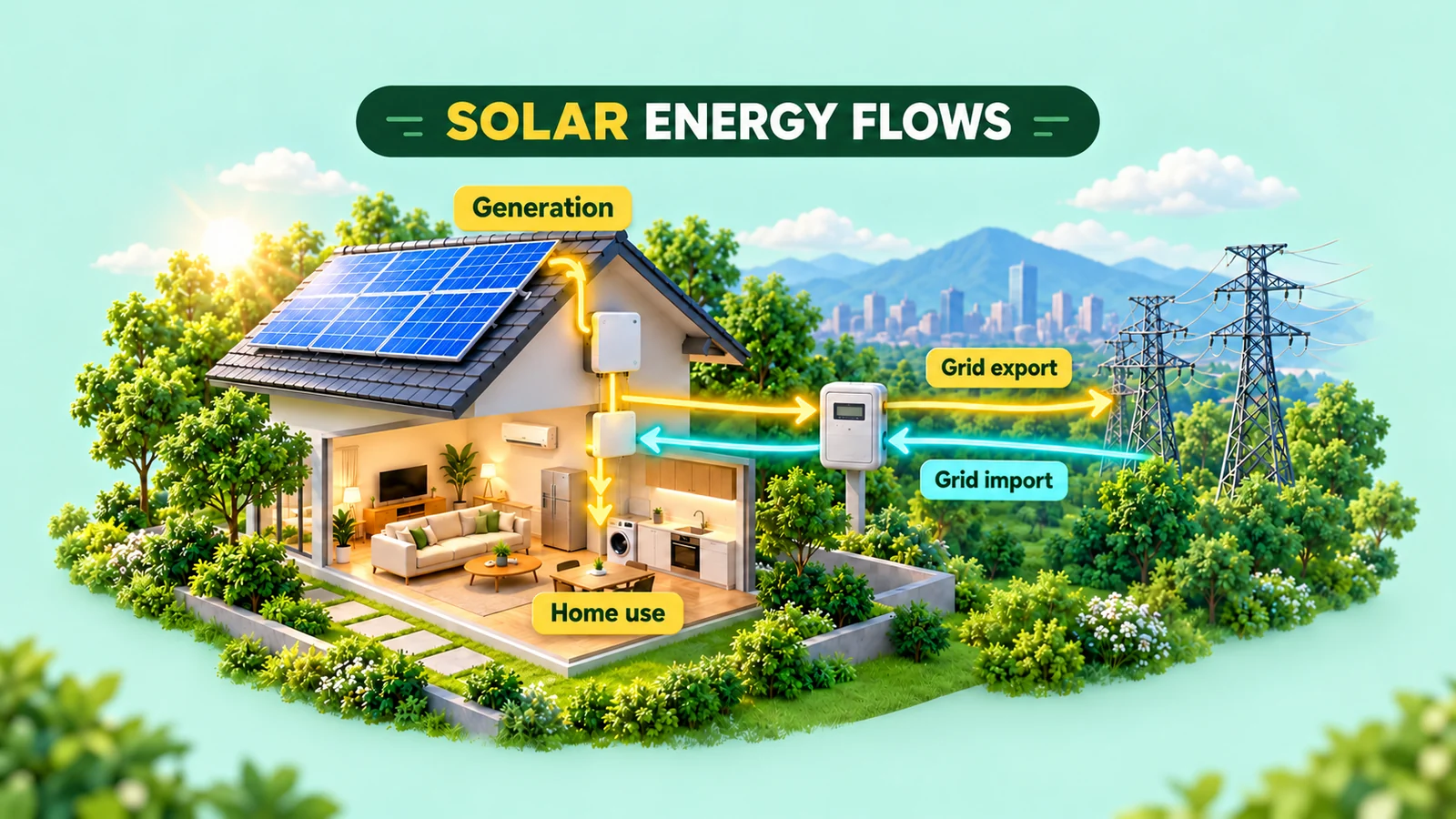
Worked example: 900 kWh generated does not mean 900 kWh exported
Hypothetical educational example, not measured HOMI project data. Assume one identical reporting period, no battery, no other generator, consistent AC measurement boundaries and no material losses. Suppose generation is 900 kWh, export is 350 kWh and import is 600 kWh.
- Direct solar self-use: 900 − 350 = 550 kWh.
- Total household energy: 550 + 600 = 1,150 kWh.
- Balance check: 900 + 600 = 1,150 + 350 = 1,500 kWh.
In that model, the 550 kWh difference between generation and export was used inside the home. Import is still possible at other times, such as when generation is unavailable. These are period energy totals, not simultaneous kW values. They do not show how loads were spread across phases or prove electrical safety.
Do not turn the 550 kWh into an RM saving by inserting an assumed tariff. Physical energy accounting and commercial bill settlement are separate questions. Exported energy, eligible credit and the final payable amount require the actual programme and bill to be reviewed. No export rate, rebate, guaranteed saving or return is assumed here.
Align the dates before subtracting anything
Write the start and end date, time and timezone beside each total. A calendar-month app view and a utility reading period can cover different days. A lifetime register also cannot be compared directly with a monthly total. For a cumulative register, the period quantity is its end reading minus its start reading, using the same register and units.
For example, two illustrative cumulative import readings of 12,400 and 13,000 kWh give 600 kWh for that interval. The 13,000 kWh end reading alone is not that month’s import. Retain the register label and any stated multiplier; ask the utility to interpret an unclear register rather than guessing its code.
Keep battery and monitoring boundaries visible
The simple balance above must be expanded if there is storage, another generator or an AC/DC boundary difference. A battery can shift energy between periods and introduce losses; a change in its stored energy also belongs in a full balance. Do not add battery discharge to solar production as though it were a new source. Ask the installer to identify each channel and draw the site-specific accounting boundary.
Record whether the app has complete data for the chosen interval, whether equipment was replaced, and whether a displayed total was reset. These are review questions, not a diagnosis. A discrepancy alone does not establish a faulty meter, stolen energy or an installation defect. Do not open a meter enclosure, break a seal, move sensors or change electrical settings to make numbers agree.
A practical reconciliation checklist
- Name the question: generation, self-use, import, export or bill amount.
- List the data source, channel name and units; separate kW snapshots from kWh totals.
- Align the exact interval and record cumulative start/end readings where relevant.
- Confirm batteries, other generators and meter positions with the installer.
- Mark gaps and changed equipment; keep the original records privately.
- Ask the installer about monitoring channels and TNB about utility readings or billing, using the same period in both enquiries.
Malaysia boundaries and the next step
SEDA describes Solar ATAP in the Peninsular Malaysia context. [2] Sabah and Sarawak require separate checks with their applicable authorities and utilities. An existing NEM or SelCo installation must be reviewed under its actual arrangement; do not apply this article as a new contract or export permission.
Solar ATAP rules, tariff treatment, approvals and savings depend on the latest PETRA, SEDA, Energy Commission and TNB requirements and your actual bill, roof and usage. See our solar services, TNB bill preparation guide and offline monitoring guide.
Contact the human team at Homi Solar Malaysia to discuss your energy records. Start with the question and general channel labels. Keep private bills, account numbers, addresses and customer data outside public comments and AI chats; agree a suitable private channel before sharing documents.
Frequently asked questions
Should my inverter generation equal the TNB export reading?
No. In the simple no-battery case, some solar supplies the home before the remainder reaches the grid. Compare the same period and AC measurement boundary before investigating a difference.
Can I use generation minus export to calculate my bill?
That subtraction estimates direct solar self-use only within the stated simplified model. It is not a bill formula. Your applicable scheme, billing period and current utility treatment need a separate review.
Does this example still work with a battery?
Not unchanged. Ask for a balance that includes battery charging, discharge, losses and change in stored energy, using consistent AC or DC measurement boundaries. Do not count discharged energy as new solar production.
What should I send when the readings still look wrong?
Start with the channel names, units, exact date range and a description of the mismatch. Share any requested bills or identifiers only through a suitable private channel agreed with the installer or utility.
Sources and versions
- Solar ATAP Contract: terms and conditions of supply — SEDA Malaysia / TNB. Official linked contract; SEDA listing updated 1 April 2026; definitions 6, 7, 12, 14 and 21. Checked 20 October 2026.
- Solar Accelerated Transition Action Programme (Solar ATAP) — SEDA Malaysia. Live programme page checked 20 October 2026; guideline listing dated 30 December 2025. Checked 20 October 2026.
- Fronius Smart Meter 63A-1 operating instructions — Fronius. HTML manual 42,0426,0294, checked 20 October 2026; no edition date displayed. Checked 20 October 2026.
This article reflects official information checked on 20 October 2026 and is general guidance. Programme rules, tariff treatment, approval and actual savings remain subject to the latest PETRA, SEDA, Energy Commission and TNB requirements plus the property bill, roof and usage pattern.
Want HOMI to review your TNB bill?
Send your usage pattern and HOMI can estimate whether Solar ATAP makes sense for your home or business.
Discuss Solar Energy Records