


Solar backup: is it a UPS?
A solar battery backup function is not automatically an uninterruptible power supply (UPS). A system may restore power to selected circuits after a short interruption. That can still allow a computer or communications device to restart. Battery energy, available output and continuity during changeover are separate requirements.
Homi Solar Malaysia prepared this guide for homeowners and small-business teams planning solar with storage. The question here is whether equipment can tolerate the transition, rather than how large a battery to buy. Manufacturer examples below explain the distinction; they are not a HOMI product offer, partnership, local approval list or performance promise.
Start with the interruption
The Fronius Primo GEN24 manual, in its PV Point/PV Point Comfort explanation, describes a brief interruption when moving from grid-connected operation to backup. It states that this backup function cannot be used as a UPS, with computers as an example. That is a documented restriction for the described arrangement, not a statement that every solar-storage product has the same switching behaviour.
Ask the designer to distinguish the time before backup becomes available from the time a particular device can remain operating without input power. Obtain that device’s requirements from its manufacturer or supplier. A word such as seamless, or a large kWh figure, cannot replace the exact equipment specification and agreed acceptance checks.
Read the mode behind the number
Schneider Electric’s APC FAQ defines transfer time as a transition between UPS states. Its figures are tied to named product families and sensitivity settings. The comparison below records those examples only; it does not rank brands or establish a universal solar-versus-UPS transfer time.
| Documented case | Official observation | Question for your proposal |
|---|---|---|
| Primo GEN24 PV Point/PV Point Comfort section | A brief interruption is described; this backup function is not a UPS. | What is the exact changeover behaviour of the offered system? |
| APC named line-interactive families | High sensitivity: 2–4 ms; medium: 6–8 ms; low: 8–10 ms. | Which exact model, sensitivity and operating state do the figures cover? |
| APC named double-online-conversion families | No transfer time for input AC failure during online operation. | Does that statement apply to the selected operating mode and event? |
The FAQ’s line-interactive families are SMC, SCL, SMX, SMT and SMTL; its double-online-conversion list is SRT, SRTL, SRYL, SURT and SURTD. Lower sensitivity increases the stated transfer time. Its online-operation statement should not be extended to bypass, other modes or every switching event without the relevant manual. These are official product observations, not HOMI measurements or a guarantee for a Malaysian installation.
Check the complete supply chain
For a home office, list the computer, router, display and any other device that must remain useful. A computer staying on while its network device restarts may not meet the intended outcome. For a shop, define the essential transaction and communications equipment with the responsible supplier. Treat medical, life-safety and other critical systems as a separate specialist requirement.
If a UPS is proposed alongside solar backup, ask both suppliers to confirm the exact arrangement. Record the allowed input conditions, operating mode, output loading, battery condition and required runtime. Do not assume that placing two backup products together establishes compatibility. Leave electrical design and any circuit changes to qualified local professionals; do not connect equipment to feed a house circuit or improvise a changeover test.
Keep power and duration separate
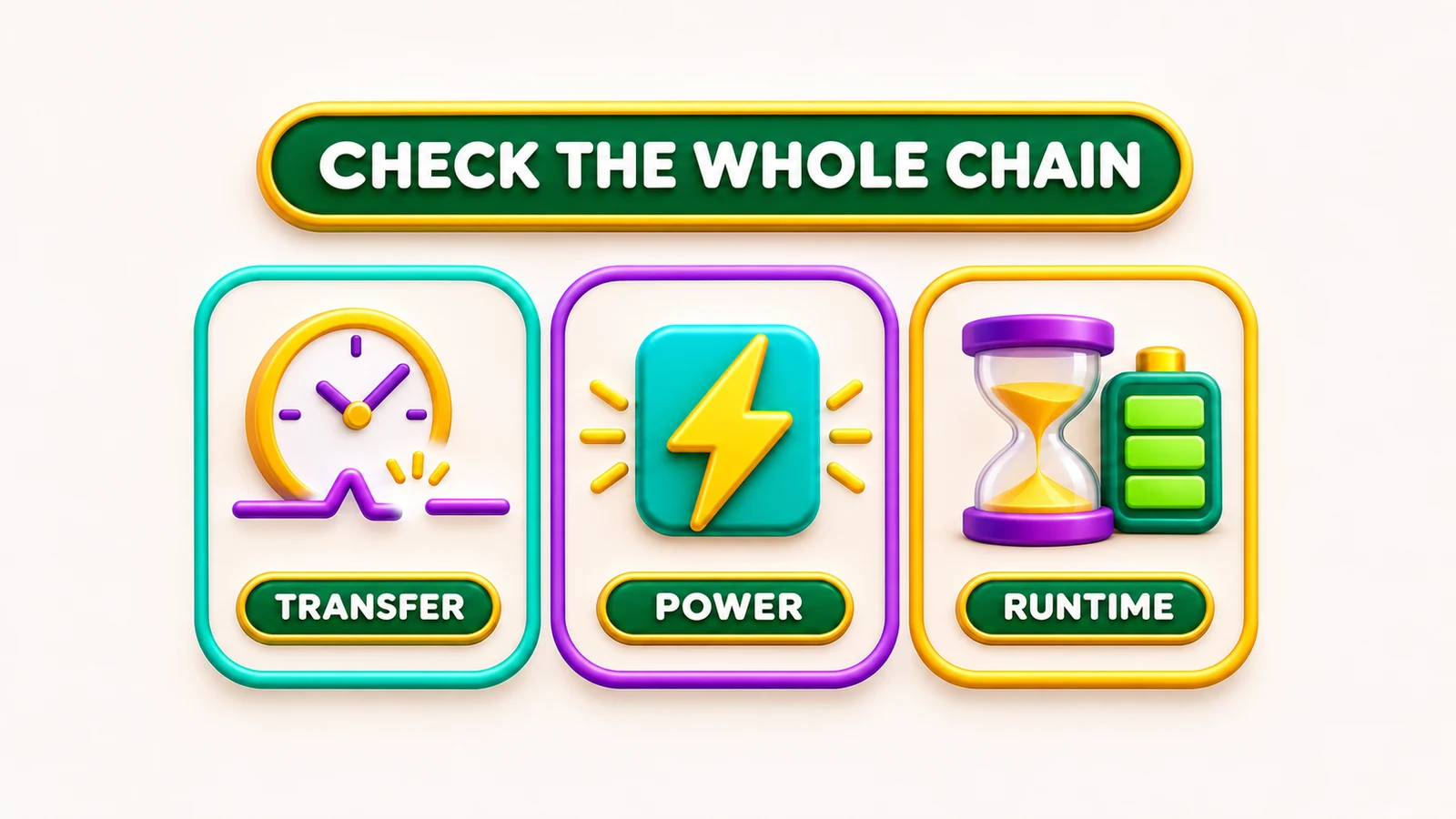
A transfer-time figure does not establish supported continuous load, starting demand or battery duration. The Fronius manual separately warns that some appliances may not operate correctly because of high starting currents. Ask for the proposed system’s output limits and a supported-circuit list, as well as the transition information.
Plan for both loss and return of grid power. Ask what happens when stored energy is depleted, an overload occurs, or a proposed operating mode changes. Have the qualified team agree a safe demonstration and record its conditions and results. A single successful demonstration documents that test; it does not guarantee every future disturbance.
Five items for the brief
- Name the devices and functions that must continue.
- Request their acceptable interruption and supply conditions.
- Record exact inverter, battery and UPS models plus modes.
- Separate transfer behaviour, output limits and runtime assumptions.
- Agree professional commissioning, handover records and support ownership.
Our usable-capacity and essential-load guide covers battery sizing. This guide adds the separate continuity question; neither article approves a design from a monthly bill alone.
Malaysia scope and next step
The overseas manuals and USA FAQ explain their stated products. They are not Malaysian wiring rules, local stock availability or certification of your equipment. The ST SELCO index, checked 3 November 2026, lists June 2026 guidance for Peninsular Malaysia issued 24 July 2026. It is jurisdiction context, not approval of a UPS or battery pairing; check Sabah and Sarawak with the relevant local authority and utility.
See Homi Solar Malaysia services or contact the human team with your continuity brief. Solar ATAP rules, tariffs, approvals and savings depend on current PETRA, SEDA, ST and TNB requirements plus the actual bill, roof and usage. Start with a non-sensitive equipment summary; agree a private channel before sending bills, network details or customer records. Keep those records out of public comments and AI tools.
Frequently asked questions
Does a bigger battery prevent a computer restart?
Not necessarily. Stored energy and interruption tolerance are different. Ask for the exact transfer behaviour and the equipment supplier’s continuity requirements.
Does every UPS have zero transfer time?
No. The cited APC FAQ distinguishes named line-interactive products and sensitivity settings from named double-online-conversion products operating online. Check the exact model, mode and event.
Can I simply add a UPS to any solar backup circuit?
Do not assume compatibility. Have the relevant suppliers and qualified designer review the exact input, output, operating mode, loading and runtime requirements before use.
How should HOMI start the discussion?
Provide a non-sensitive list of devices, their required functions and the acceptable interruption confirmed by their suppliers. Agree a private document channel with the human team; do not send bills or network credentials through public comments or AI.
Sources checked 3 November 2026
- Fronius International GmbH — Fronius Primo GEN24 operating instructions: PV Point/PV Point Comfort restrictions
- Schneider Electric USA — What is the transfer time of APC Smart-UPS and Symmetra Units?
- Suruhanjaya Tenaga — Self-Consumption (SELCO) official index
This article reflects official information checked on 3 November 2026 and is general guidance. Programme rules, tariff treatment, approval and actual savings remain subject to the latest PETRA, SEDA, Energy Commission and TNB requirements plus the property bill, roof and usage pattern.
Want HOMI to review your TNB bill?
Send your usage pattern and HOMI can estimate whether Solar ATAP makes sense for your home or business.
Discuss Backup Continuity