


EV charging: which kWh?
Compare the measurement point and the same time window before comparing EV charging kWh. A charging-circuit record, a vehicle’s estimated battery energy change and the property’s electricity import are different quantities. Homi Solar Malaysia recommends identifying each record before using it for solar planning or treating a difference as an equipment problem.
This guide is for Malaysian home and workplace discussions. It explains energy accounting, not a metering installation, billing dispute determination or vehicle diagnosis. A display labelled kWh does not, by itself, tell you where the energy was measured. Keep the device name, data definition and start and end times with each number.
Why the readings can differ
The DOE charging explanation describes conversion and battery-resistance losses and says charging efficiency varies with the equipment, battery condition and weather. It does not establish one loss percentage for every Malaysian vehicle. We use that qualitative explanation, not its numerical U.S. vehicle examples.
First ask whether a charger app reports energy at an AC input, energy delivered at another boundary, or a calculated quantity. Check the actual product documentation. Do not assume all app histories measure the same point. A vehicle percentage display is also not automatically a direct measurement of energy added to the battery.
Read the boundary first
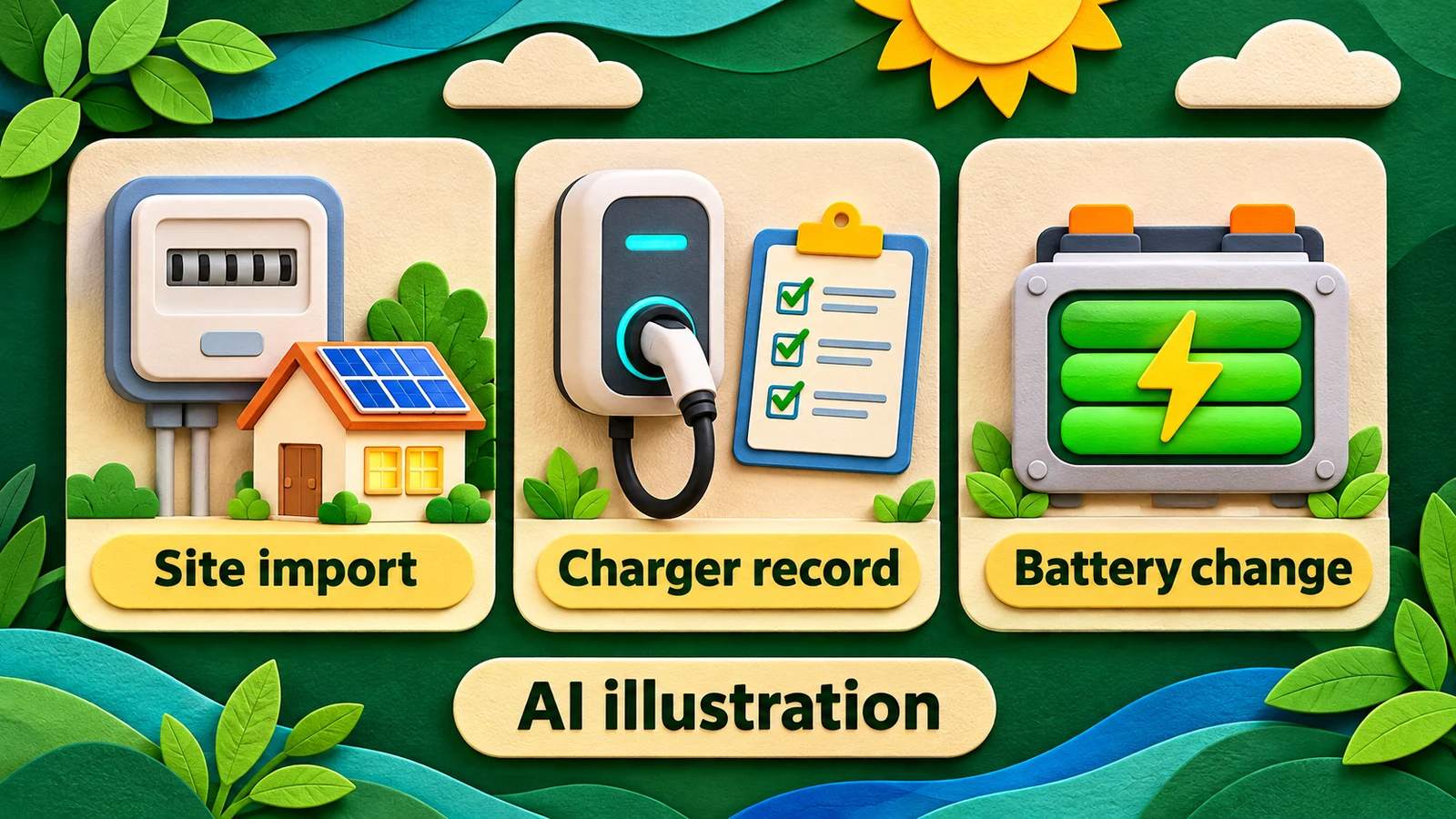
| Record | Question it can help answer | Check before comparing |
|---|---|---|
| Defined charging-circuit meter | How much energy crossed this recorded circuit boundary? | Which loads it includes and the exact interval. |
| Charger app session | What quantity did this product record for the session? | Manufacturer definition, units and session timestamps. |
| Vehicle battery change | How did stored or estimated battery energy change? | Measurement or estimate method; relevant usable capacity. |
| Whole-property import | How much electricity entered from the grid at the site? | Other loads, solar or storage and matching intervals. |
Source basis: DOE’s distinction between charging input and useful stored energy. The record questions are HOMI editorial guidance, not claims that a particular app or meter is calibrated for settlement. Whole-site accounting also requires the actual system arrangement.
A hypothetical comparison
Assume a defined, EV-only charging circuit records 20 kWh over one interval and an independently established battery-energy change is 17 kWh for that same interval. The arithmetic difference is 20 − 17 = 3 kWh. These are invented teaching numbers, not a HOMI project, expected performance or a pass mark.
The subtraction does not prove that all 3 kWh became heat in the charger. Check the measurement methods and what equipment or functions each boundary includes. If the 17 kWh came only from a percentage rise multiplied by an advertised battery size, call it an estimate. A whole-house import total from a different interval cannot replace the 20 kWh charging-circuit figure in this example.
Avoid counting losses twice
The EPA testing page says its MPGe values include charging losses using Level 2 AC charging, with cable and onboard-charger losses included. That is a U.S. test definition. It shows why a published consumption value must be read with its measurement basis before adding another loss allowance.
For solar planning, ask which energy figure the proposed calculation starts with and where the charging demand sits in the site energy balance. Keep the demand time profile alongside the kWh total. Do not subtract the same loss twice or assume that every EV dashboard, Malaysian label or charger app follows the EPA method. Our AC charging power guide addresses kW limits; it answers a separate question from this kWh comparison.
Record a useful comparison
- Name the device, source and measurement point for every number.
- Use the same start and end times, including the time zone.
- Separate measured values from estimates and copied label figures.
- Note other site loads, solar or storage relevant to the interval.
- Ask the supplier to explain an unexplained pattern before drawing a fault conclusion.
Use existing records; do not open electrical equipment or modify a circuit for this exercise. Bring a non-sensitive summary to the HOMI human team or review HOMI solar services. Agree a private channel before sharing bills, account numbers, vehicle identifiers or detailed premises records. Keep customer information outside public comments and AI tools.
Malaysia scope and sources
Sources were checked on 9 November 2026. DOE is U.S. technical education; the EPA page was updated on 1 July 2026 and concerns U.S. vehicle testing. Neither source announces a Malaysian tariff, rebate, approval rule or guaranteed saving. Confirm actual vehicle and charger documentation and the relevant local utility, including separate supply arrangements in Sabah and Sarawak. A qualified site review is needed for metering or electrical work.
Frequently asked questions
Does a kWh difference prove a charger fault?
No. First confirm the measurement points, time window and data definitions. Charging involves conversion and other losses, but a mismatch alone cannot locate or diagnose a fault. Ask the responsible supplier to review a documented concern.
Can I multiply the battery percentage rise by advertised capacity?
That is an estimate unless the vehicle documentation supports the method and relevant usable capacity. Record it as an estimate, not a verified battery-energy measurement or a calibrated charging-efficiency test.
Is my electricity bill the EV charging total?
A whole-property import record covers the site rather than one charging circuit. Other loads and on-site generation or storage affect the comparison. Use an appropriately defined charging record for the EV question; do not alter wiring to obtain one.
Should I add a fixed loss percentage to every published EV figure?
No. Check the figure’s definition first. EPA MPGe already includes charging losses under its U.S. test method. Other labels, dashboards and apps need their own documentation. This guide supplies no universal percentage.
Sources and version
- U.S. Department of Energy / FuelEconomy.gov — Where the Energy Goes: Electric Cars
- U.S. Environmental Protection Agency — Fuel Economy and EV Range Testing
This article reflects official information checked on 9 November 2026 and is general guidance. Programme rules, tariff treatment, approval and actual savings remain subject to the latest PETRA, SEDA, Energy Commission and TNB requirements plus the property bill, roof and usage pattern.
Want HOMI to review your TNB bill?
Send your usage pattern and HOMI can estimate whether Solar ATAP makes sense for your home or business.
Discuss EV Energy Records