


AC charging: what limits the power?

An AC wallbox rating is a maximum capability, not a promise of the power your car will receive. The vehicle, compatible supply, cable and active controls can each impose a lower limit. Buying a higher-rated unit alone may leave the charging rate unchanged.
Homi Solar Malaysia prepared this guide for Malaysian homeowners and workplace teams comparing EV charging with a solar plan. It explains the questions to ask before an equipment purchase. It is not an electrical design, a vehicle specification sheet or an installation instruction.
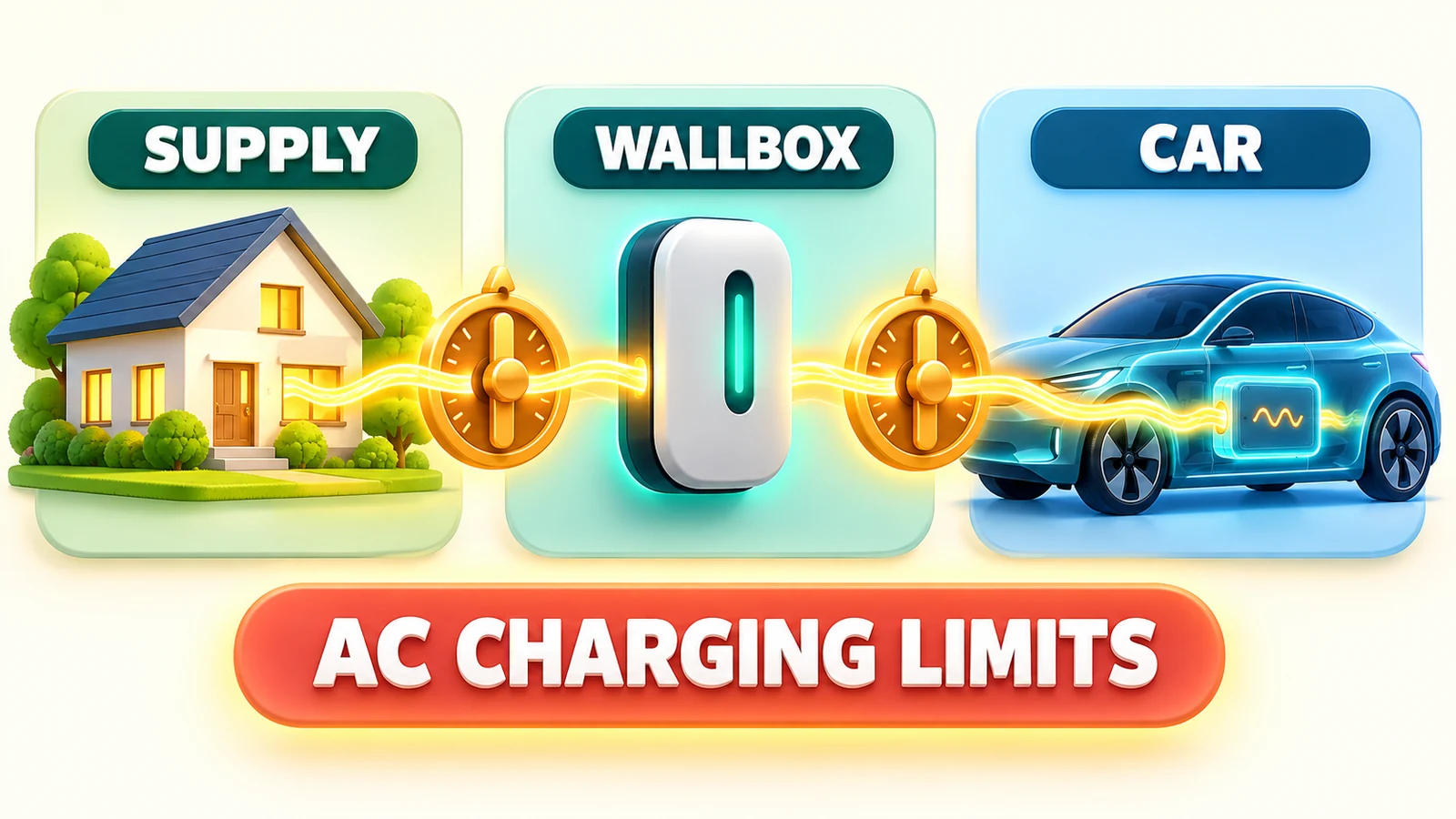
Follow the AC charging chain
The Australian Government glossary distinguishes the charging equipment’s rated capacity from actual capacity, which may be limited by the vehicle or network. Its charging-equipment guide explains that an onboard charger converts AC to DC for the battery.
For an AC session, check the exact car’s onboard AC acceptance limit. A headline DC fast-charging figure describes a different charging path and cannot establish that AC limit. Confirm the local-market model, variant and manual rather than assuming every car with the same badge behaves identically.
Compare three ceilings
Hypothetical planning examples only: these invented, rounded kW figures are not HOMI measurements, product recommendations or a forecast. Assume the supply phases, vehicle, cable and equipment are compatible. Each row shows an upper bound before other limits and losses, not an expected steady reading.
| Case | Wallbox rating | Car AC limit | Site allocation | Planning ceiling |
|---|---|---|---|---|
| A | 22 kW | 11 kW | 7 kW | At most 7 kW |
| B | 22 kW | 7 kW | 22 kW | At most 7 kW |
| C | 7 kW | 11 kW | 22 kW | At most 7 kW |
| D | 22 kW | 11 kW | 22 kW | At most 11 kW |
In A, more available site capacity could matter; in B, the vehicle remains the listed constraint. C shows an equipment constraint. D still cannot reach the wallbox’s 22 kW rating with the assumed 11 kW car. Simply taking the smallest headline number is not a complete design: phase compatibility, settings, cable ratings and the installation still require verification.
Check phases and active settings
Ask whether the quoted AC power depends on single-phase or three-phase operation, and whether the car supports that arrangement. A three-phase rating is not automatically available from a single-phase connection. Leave circuit assessment, protective devices, wiring and current limits to an appropriately qualified local electrical professional.
Record the car’s user-selected charging limit, wallbox commissioning limit and any site load-management setting. At workplaces, capacity may be shared with other vehicles or building loads. Do not raise current settings, bypass protection or use an improvised adapter to chase the advertised number.
Keep power and energy separate
kW describes power at a moment; kWh describes energy over a period. Power at the wallbox is also not automatically the energy stored in the battery. Conversion losses and vehicle systems can affect the balance. State of charge, battery temperature and the car’s control strategy can change the session.
For a rough teaching calculation, 30 kWh divided by a constant 7 kW is about 4.3 hours. That is ideal arithmetic before losses or changing power, not a charging-time commitment. Plan around the energy actually needed and the available parking window, then ask for a realistic assessment of the specific vehicle and site.
Where rooftop solar fits
Solar availability and AC acceptance are separate constraints. A charger capable of following solar surplus cannot force the vehicle to accept more than its AC capability. Cloud, other building loads and charging controls may reduce available power further. If departure is before sunrise, ask how any required grid contribution is handled rather than assuming the rooftop will cover the whole session.
Our solar surplus and load-balancing guide explains those control functions. This article instead focuses on the car and equipment power ceilings. Neither a charging rating nor a solar percentage proves a bill-saving outcome.
Five checks for a quotation
- Identify the exact local-market car and its AC specification.
- Confirm compatible phases and the installed cable arrangement.
- Have available supply capacity and other loads assessed.
- List vehicle, wallbox and shared-site control limits.
- State the energy needed and the usual parking window.
Malaysia scope and next step
The overseas sources support technical concepts only. They are not Malaysian wiring rules, connector approvals or local vehicle specifications. The ST official EVCS index, checked 2 November 2026, identifies the 2025 edition with a 17 March 2025 publication date. Confirm current site requirements with the relevant authority and electricity provider; Sabah and Sarawak require their own local checks.
Ask Homi Solar Malaysia about a combined solar and charging brief, or contact the human team for a private review. Solar ATAP rules, tariffs, approval and savings depend on current PETRA, SEDA, ST and TNB requirements and the actual bill, roof and usage. Keep private bills and vehicle/customer records out of public comments and public AI tools.
Frequently asked questions
Will a 22 kW wallbox make every EV charge at 22 kW?
No. The car must support that AC power and phase arrangement, and the site, cable and controls must allow it. Treat the wallbox figure as a ceiling.
Can I use the DC fast-charging rating to choose an AC wallbox?
No. Verify the separate onboard AC specification for your exact local-market vehicle. DC charging follows a different path.
Why does the reading change during a session?
Vehicle settings, battery state and temperature, other site loads and control limits can affect power. Record the context before asking the installer or vehicle support team to investigate.
What should I send HOMI first?
Start with the car model, AC specification, parking window and a non-sensitive site summary. Agree a private channel before sharing bills, vehicle identifiers or detailed records.
Sources checked 2 November 2026
- Australian Government — Definitions for electric vehicles
- Australian Government — Electric vehicle charging equipment
- Suruhanjaya Tenaga — Guidelines on Electric Vehicle Charging System (EVCS)
This article reflects official information checked on 2 November 2026 and is general guidance. Programme rules, tariff treatment, approval and actual savings remain subject to the latest PETRA, SEDA, Energy Commission and TNB requirements plus the property bill, roof and usage pattern.
Want HOMI to review your TNB bill?
Send your usage pattern and HOMI can estimate whether Solar ATAP makes sense for your home or business.
Discuss EV Charging Limits