


Solar EV charging in Malaysia: surplus control versus dynamic load balancing
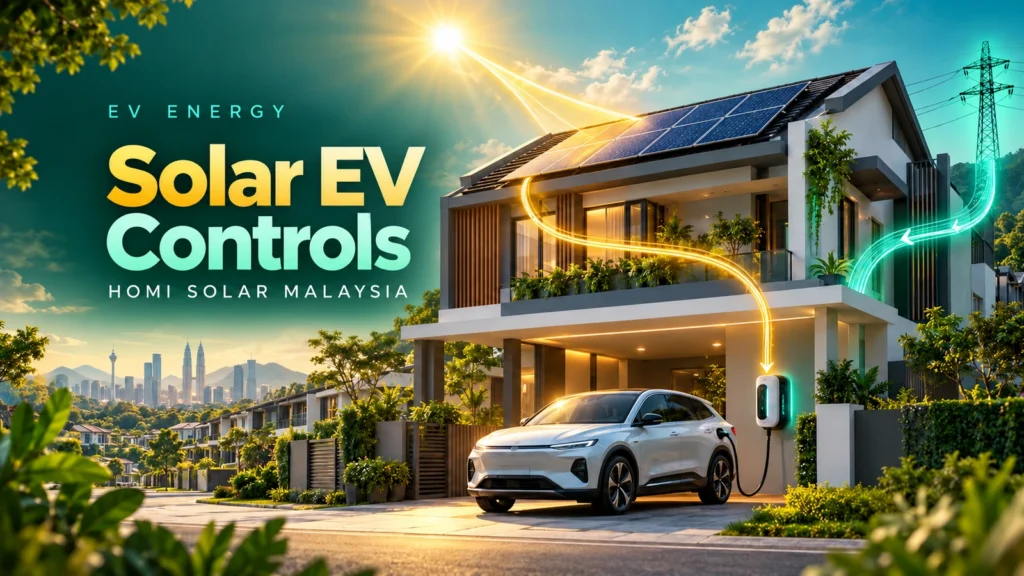
Solar-surplus charging decides how an EV uses available solar energy. Dynamic load balancing decides how much charging current the electrical supply can accommodate. A charger may offer both, but a solar or eco label does not prove either function is installed and commissioned for your home. Homi Solar Malaysia recommends comparing the control behaviour and site assessment alongside the charger power rating.
This guide is for Malaysian homeowners planning rooftop solar and a home EV charger. It explains the controls, rather than selecting cable sizes or protection settings. Source versions were checked on 19 October 2026; manufacturer examples describe their stated products and do not establish Malaysian approval or a HOMI product partnership.
Two controls answer two different questions
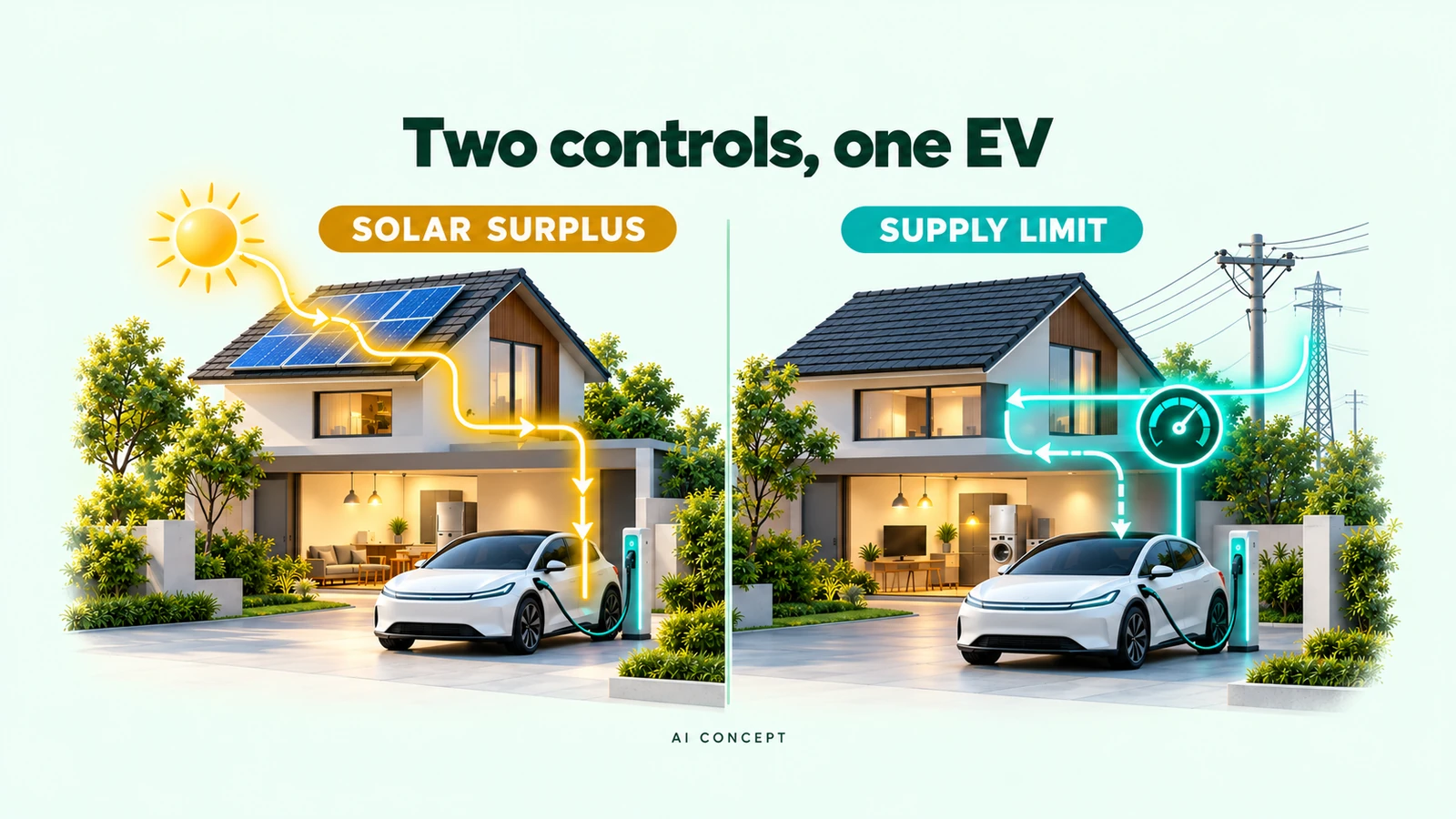
Surplus means the solar power available after the other loads and any agreed battery priorities at that moment. A surplus-aware charger can adjust or pause charging as that balance changes. The exact minimum charging power, phase switching, restart behaviour and permitted grid supplement depend on the charger, vehicle and configuration.
Dynamic load balancing uses measurements at the relevant connection to adjust the EV demand against configured current limits. Fronius documents a system that considers generation, consumption and available current on each phase. This is useful when household loads change, including when there is little solar. It still needs suitable metering, communication and professional configuration. [1]
| Question to compare | Solar-surplus control | Dynamic load balancing |
|---|---|---|
| Main objective | Follow available renewable surplus | Manage charging within configured electrical limits |
| What must be observed? | Net energy flow and other energy priorities | Supply loading and the relevant per-phase current |
| If the kettle or air conditioning starts | Less surplus may be available for the EV | The controller may reduce EV current to retain headroom |
| What it does not prove | That the installation has adequate electrical capacity | That charging uses no grid energy |
The comparison synthesises the Fronius operating principles and myenergi mode descriptions. It is not a universal feature list or a safety certification. [1][2]
Worked example: read the power balance before the app label
Hypothetical educational example, not measured HOMI project data. Assume one instant with 5 kW of AC solar output, 2 kW of other household demand and no home battery. Ignore losses and short control transients. The available surplus is 5 − 2 = 3 kW. An ideally following charger taking 3 kW would approximately balance import and export at that instant.
If the same EV instead takes 6 kW, total demand becomes 2 + 6 = 8 kW. With 5 kW from solar, the illustrative grid import is 8 − 5 = 3 kW. A load-balancing function may allow that import if it stays within the professionally configured limits; this does not make it solar-only charging. Conversely, a surplus-priority mode may reduce or pause charging when cloud or household demand changes. Actual steps and delays vary.
These kW figures describe power, not the energy delivered over a day. They cannot size a circuit or demonstrate phase safety, charging time, bill savings or investment return. An installation assessment must consider the actual supply, each phase, cables, protective devices and vehicle limits.
Do not buy a feature name without the metering plan
Ask where the measurement is taken and what the charger can actually see. A solar-production reading alone does not reveal all household demand. Fronius lists specific compatible components and communication conditions; other products have different arrangements. Existing battery and export controllers also need a coordinated design. [1]
Read the precise charging mode. The myenergi manual distinguishes ECO from ECO+: ECO can combine renewable and grid power, while ECO+ can pause when surplus is insufficient, subject to its settings. Boost functions can override the ordinary energy-priority behaviour. Those examples do not promise identical results from another brand or firmware. [2]
A practical installer checklist
- Record the EV model, charger model, single- or three-phase supply, usual parking hours and next-trip needs.
- Request the metering location, phase assessment and which device controls solar, battery and charger priority.
- Ask the installer to demonstrate what happens when a large household load starts and solar output falls.
- Request the documented response when metering or communications fail; do not assume charging always stops safely.
- Keep the design, inspection, test, handover and maintenance records, with owner-level operating instructions.
The Energy Commission’s 2025 EVCS guideline covers installation and safety matters including competent persons, inspection and preventive maintenance. Arrange the electrical work through the appropriate competent professionals; do not open equipment, relocate current sensors or change protective settings yourself. [3]
Malaysia boundaries and your next step
The Malaysian safety reference here is the ST guideline in a Peninsular Malaysia planning context. Sabah and Sarawak have their own applicable authority and utility requirements that must be checked separately. International product manuals explain technology; their foreign regulatory sections do not become Malaysian rules. No tariff, rebate, quota or approval entitlement is asserted.
Solar ATAP rules, tariff treatment, approvals and actual savings depend on the latest PETRA, SEDA, Energy Commission and TNB requirements and your bill, roof and usage pattern. See our solar service overview, future EV load planning guide and battery and essential-load guide for related planning.
Contact Homi Solar Malaysia for a human solar-and-EV planning discussion. Start with the general equipment types, daytime parking pattern and questions you want answered. Keep bills, account numbers, home addresses, customer records and login details out of public comments and AI chats; ask our team for an appropriate private channel if documents are needed.
Frequently asked questions
Does dynamic load balancing mean my EV uses only solar?
No. Its purpose is to manage charging within configured supply and circuit constraints. Solar-only or surplus-priority behaviour needs a separately supported mode, compatible metering and verified settings.
Will every charger labelled eco stop importing electricity?
No. Mode names are product-specific. Some modes supplement solar with grid energy, and boost or departure targets can change the behaviour. Ask for the exact manual and a live demonstration.
Can I raise the current limit when charging feels slow?
Ask the installer to review the design and measured loading. Do not raise protection or supply limits, move sensors, open the distribution board or alter wiring yourself.
Do I need a battery for solar-surplus EV charging?
A compatible system can follow available solar surplus without a home battery. If storage is present, document battery reserve and priority rules so charging does not conflict with your intended backup reserve.
Sources and version notes
- Wattpilot Flex operating instructions: PV surplus and Dynamic Load Balancing — Fronius. Document 42,0426,0546, live HTML checked 19 October 2026; update date not displayed. Checked 2026-10-19.
- zappi v2.1 user manual, revision 1.7 — myenergi. Rev 1.7, July 2023; sections 10 and 17. Checked 2026-10-19.
- Guidelines on Electric Vehicle Charging System (EVCS), GP/ST/No.54/2025 — Energy Commission Malaysia. 2025 edition; dated 24 February 2025; official listing 17 March 2025. Checked 2026-10-19.
This article reflects official information checked on 19 October 2026 and is general guidance. Programme rules, tariff treatment, approval and actual savings remain subject to the latest PETRA, SEDA, Energy Commission and TNB requirements plus the property bill, roof and usage pattern.
Want HOMI to review your TNB bill?
Send your usage pattern and HOMI can estimate whether Solar ATAP makes sense for your home or business.
Discuss Solar and EV Planning