
AFA Rebate Now Only -2.15 sen: How High-Usage Landed Homes in Malaysia Can Use Solar ATAP and Smarter Habits to Rescue Their TNB Bill
If your landed home regularly uses more than 1,500 kWh a month—and you are running multiple air-conditioners in 33°C weather—your effective cost per kWh is now much closer to the full 54.43 sen baseline, not the heavily discounted rates you saw at the end of 2025.
This article explains what the AFA trend means for high-bill families and outlines a three-step “self-rescue” plan: 1) use a self-consumption Solar ATAP system to lock in daytime cooling and essential loads, 2) adjust when you use electricity so more kWh fall into solar or cheaper bands, and 3) avoid oversizing your system so ATAP credits are not wasted at the end of each month.
1. AFA Is Shrinking: From -6.42 to -2.15 sen/kWh
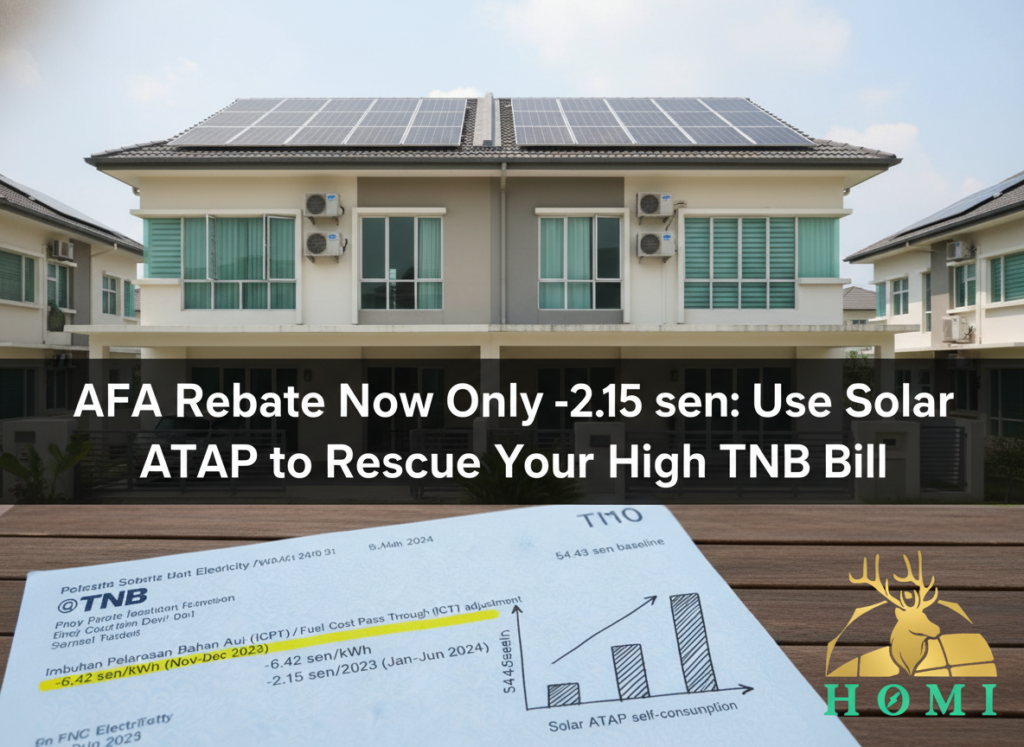
The Automatic Fuel Adjustment (AFA) mechanism tweaks your electricity price each month based on fuel and generation costs. Over the past few months, the rebate has clearly moved in the wrong direction for heavy users.
| Month | AFA Rate (sen/kWh) | What It Means for Your Bill |
|---|---|---|
| Dec 2025 | -6.42 sen/kWh | Very strong rebate; noticeable cushion for high-usage homes. |
| Jan 2026 | About -4.99 sen/kWh | Rebate still strong but clearly smaller than December. |
| Feb 2026 | About -2.77 sen/kWh | Discount continues to shrink; you feel more of the base cost. |
| Mar 2026 | -2.15 sen/kWh | Rebate is modest; high bills feel much heavier again. |
At the same time, the new tariff structure (from July 2025 onwards) sets your Energy Charge at 37.03 sen/kWh for usage above 1,500 kWh, plus 4.55 sen/kWh Capacity and 12.85 sen/kWh Network charges—bringing the combined “core” charge close to 54.43 sen/kWh before tax and AFA. When AFA shrinks, you are exposed to more of that 54.43 sen reality every month.
If your family is still relying on AFA rebates to keep the bill “under control”, you are playing defence with a cushion that gets thinner every quarter.
2. Why March’s 33°C Heat Makes High Bills Even Worse
In many parts of Malaysia, March brings long, hot afternoons with 33°C temperatures and high humidity. For landed homes, this means:
- Longer air-cond hours in living rooms and upstairs bedrooms.
- More fans, dehumidifiers and air purifiers running in the background.
- More time spent at home (especially on weekends and holidays), driving up daytime kWh.
The combination of a hotter month and a smaller AFA rebate means your high-usage bill can jump even if your lifestyle did not change much compared to late 2025. That is why “hoping for better rebates later” is not a strategy—especially for families already in the >1,500 kWh bracket.
3. Step 1 – Use Solar ATAP to Lock In Daytime Cooling and Essential Loads
Solar ATAP gives you a way to take part of your cost structure into your own hands.
How Solar ATAP helps high-usage landed homes:
- You self-consume rooftop solar first in real time, directly reducing grid kWh during the day.
- Any surplus becomes monthly bill credits that offset the Energy Charge only, within the same billing cycle.
- Credits do not roll over or convert to cash; oversizing purely for export is far less attractive than under old NEM rules.
For a home that regularly uses 1,500–2,000+ kWh per month, a right-sized Solar ATAP system can cover a significant share of daytime air-cond, fans, fridge, lighting and work-from-home usage. Instead of paying nearly 54.43 sen/kWh for those kWh, you are effectively “pre-paying” them via your solar investment, protecting yourself from both AFA shrinkage and future tariff moves.
The mindset shift is key: Solar ATAP is not a way to “play the export game” anymore—it is a way to secure your daytime cost per kWh for the next 20+ years.
4. Step 2 – Adjust When You Use Electricity (Even Without TOU)
Even if you stay on the standard domestic tariff, changing when you use electricity can materially improve how much value you get from Solar ATAP and AFA combined.
Practical shifts for high-usage families:
- Move flexible loads (washing, drying, dishwashing, some water heating) into solar hours (roughly 10am–4pm).
- Use timers or smart plugs to pre-cool key rooms during strong sun, then reduce air-cond load at night.
- Charge EVs or plug-in hybrids more during sunny afternoons when possible, instead of purely at midnight.
This way, more of your kWh come from your own roof at effectively “locked-in” cost, and fewer kWh are bought from TNB when AFA is weak. If you later combine this with a TOU plan, the same habit shift will also move kWh into cheaper off-peak bands at night.
5. Step 3 – Avoid Oversizing Your Solar and Wasting ATAP Credits
With AFA shrinking, it is tempting to “go big” on solar to escape the bill entirely. Under ATAP, that can backfire if your system is much larger than your real daytime usage.
- Midday export becomes very high on normal days and especially on holidays.
- Your Energy Charge might already be close to zero, but credits keep piling up on the bill.
- Because credits do not roll over, any unused value at month-end simply disappears.
The sweet spot for high-usage landed homes is a system that is large enough to cover most daytime cooling and essential loads on a typical 33°C day, but not so large that export regularly overshoots your monthly Energy Charge. That is where HOMI’s careful sizing based on real TNB bills comes in.
6. Simple AFA + Solar ATAP “Self-Rescue” Calculator
High-Usage Self-Rescue Snapshot – AFA vs Solar ATAP + Habits
Use this simplified calculator to estimate how much a Solar ATAP system and modest behaviour changes could reduce your reliance on expensive kWh in a month with a -2.15 sen AFA rebate.
Assumptions: Energy Charge for >1,500 kWh ≈ RM0.37/kWh; Capacity + Network ≈ RM0.174/kWh; baseline effective ≈ RM0.5443/kWh before AFA. Solar generation assumed at 4.5 kWh/kW/day, 30 days/month, with 60% of output overlapping daytime usage; AFA rebate fixed at -2.15 sen/kWh for illustration only. This is a simple snapshot, not a full TNB bill calculator.
7. How HOMI Uses Your Real TNB Bills and a “TNB Bill Calculator” Logic to Give Precise Estimates
Instead of guessing savings from a brochure, HOMI uses your actual bills and the 2026 tariff structure to simulate different combinations: with or without Solar ATAP, with current habits vs improved habits, and with different AFA levels.
- Reading 6–12 months of TNB bills to understand your kWh, AFA line and total RM trend under the new tariff.
- Estimating daytime vs night-time usage based on your household routine and smart meter data if available.
- Applying a “TNB bill calculator” style logic: splitting charges into Energy, Capacity, Network and AFA, then overlaying Solar ATAP self-consumption and monthly credits.
- Showing you, in RM, how much you can realistically save each month and how sensitive that is to future AFA movements and your own behaviour.
FAQ: AFA Shrinkage, High Bills and Solar ATAP “Self-Rescue”
Why do my bills feel so much heavier now that the AFA rebate is around -2.15 sen/kWh?
Because AFA is only one part of your tariff. The new structure from July 2025 introduced a combined base of Energy, Capacity and Network charges that already sits around 54.43 sen/kWh for high-usage homes before tax and AFA. When AFA was -6.42 sen/kWh, it masked a lot of that base cost. As the rebate has dropped step by step to around -2.15 sen/kWh, more of the underlying 54.43 sen/kWh reality is visible in your monthly bill, especially if your usage regularly exceeds 1,500 kWh.
How exactly does Solar ATAP reduce my average cost per kWh when AFA is small?
Solar ATAP reduces your average cost per kWh by replacing part of your daytime grid consumption with energy from your own roof. Every unit of self-consumed solar is one unit you do not buy at the combined Energy + Capacity + Network rate. Even when the AFA rebate is small, solar generation during 10am–4pm can cover a large portion of your cooling and household loads, which pulls down your monthly average cost per kWh. The key is to size the system so that most of this generation is actually used by your home before the end of the billing cycle, instead of being exported and subject to Solar ATAP’s monthly credit rules.
Why shouldn’t I just install the biggest Solar ATAP system allowed if I’m a high-usage customer?
Under Solar ATAP, domestic export credits are calculated at the Energy Charge rate and can only offset the Energy Charge portion of your TNB bill within the same billing month. They do not roll over or become cash. If you install a system that is much bigger than your realistic daytime usage, you may often export more than your Energy Charge can absorb, leading to unused credits that expire at month-end. For high-usage landed homes, it is usually more effective to right-size the system so that most of the solar generation is self-consumed or used as credits that are fully applied each month, while also improving your usage habits to align with solar hours.