


Solar ATAP in Malaysia: As AFA Rebates Shrink Again in March 2026, How Can High-Usage Landed Homes Lock In Daytime Electricity Costs?
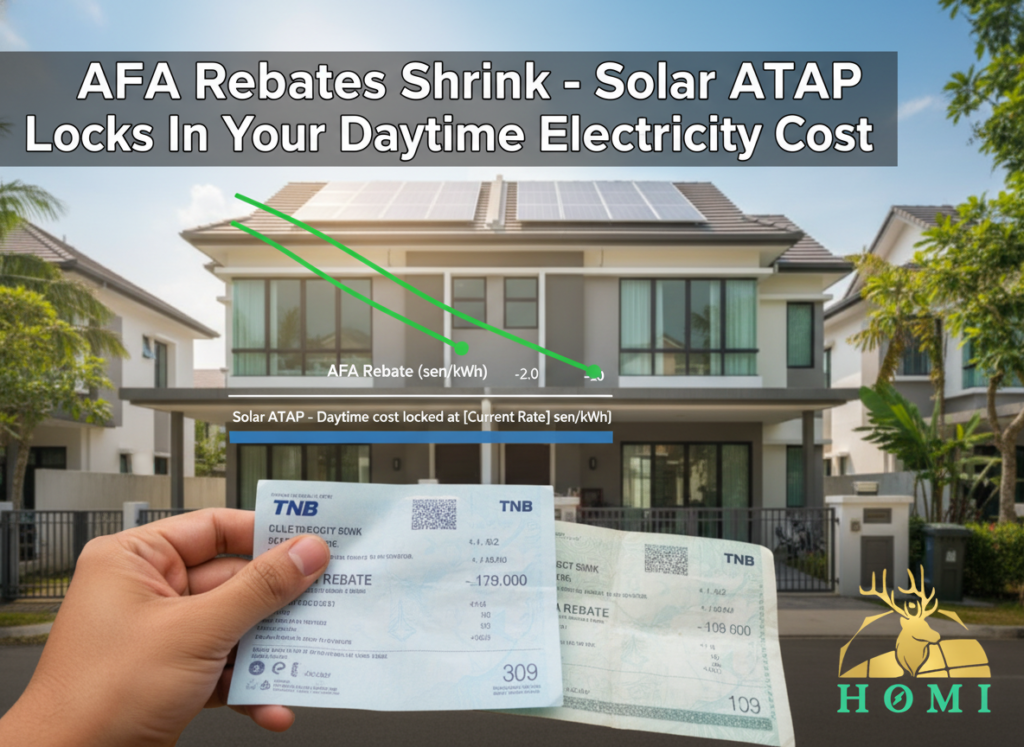
Solar ATAP in Malaysia: As AFA Rebates Shrink Again in March 2026, How Can High-Usage Landed Homes Lock In Daytime Electricity Costs?
Now the forecast AFA rebate for March 2026 has fallen closer to the -2 sen/kWh range, with earlier estimates around -5 sen/kWh already revised down, signalling a clear trend: the discount gets smaller, and high-usage homes feel the weight of every extra kWh.
For landed families regularly using 800–1,500 kWh or more per month—especially in hot, humid months with 33°C days and long air‑cond hours—depending on AFA rebates alone is becoming a risky strategy. This is where a self‑consumption focused Solar ATAP system can help “lock in” part of your daytime cost, as long as the system is sized precisely to avoid wasted credits.
1. What Is AFA and Why Is It Shrinking?
AFA (Automatic Fuel Adjustment) is the monthly mechanism that adjusts your TNB bill up or down based on changes in actual fuel and generation costs.
- When fuel prices are high, AFA can be a surcharge (positive sen/kWh) added to your base tariff.
- When fuel prices fall, AFA can be a rebate (negative sen/kWh), reducing your effective cost per kWh.
- AFA is capped in how much it can move per month and is updated regularly under the current tariff framework.
- December 2025 saw an AFA rebate of around -6.42 sen/kWh—very helpful for high-usage homes.
- Forward-looking estimates for early 2026 showed AFA moving up (less negative) month by month.
- By around March 2026, the rebate band is much closer to the -2 sen/kWh region, meaning every unit of electricity now gets a much smaller “discount” than just a few months earlier.
2. High Heat, High Humidity, High Bills: Why 33°C March Weather Hits Landed Homes Hard
March in many parts of Malaysia often brings daytime highs around 33°C with very high humidity and fewer rainy days than during the wetter monsoon periods. For landed homes, this means:
- Living rooms, upstairs bedrooms and home offices heat up quickly, even with good insulation.
- Air‑conditioners run longer and at lower setpoints in the afternoon and early evening.
- Fans, dehumidifiers and other comfort devices are often running almost non‑stop.
TNB’s new tariff structure from July 2025 onwards also means your bill now includes separate components for Energy, Capacity, Network and other charges. Even if AFA is giving a small rebate, the base Energy Charge and other components still add up, especially once monthly usage crosses higher blocks.
If your recent bills feel “heavier” despite still seeing an AFA rebate line, you are not imagining it: the rebate has shrunk, and hot‑weather usage is doing the rest.
3. Why Relying Only on AFA Rebates Is Increasingly Risky for High-Usage Homes
For high‑usage landed families (e.g. 800–1,500+ kWh per month), AFA used to feel like a reliable cushion. But AFA is designed to follow fuel cost trends, not to guarantee long‑term discounts.
Three reasons this is risky:
- AFA can shrink or even turn into a surcharge when fuel costs or exchange rates move the other way.
- The base tariff (around 45.40 sen/kWh) and structural charges remain, regardless of AFA’s short‑term ups and downs.
- Your cooling and comfort needs during 33°C months do not shrink just because the rebate does—you still need AC and fans running.
Depending entirely on AFA is like hoping petrol stays cheap forever: you have no control. Solar ATAP is one of the few tools that lets you directly reduce how many daytime kWh you buy from TNB in the first place.
4. Solar ATAP: Locking In Part of Your Daytime Cost (If You Right-Size It)
Solar ATAP, launched in 2026, is built around self‑consumption with monthly energy‑only credits and no rollover. That changes how high‑usage homes should think about rooftop solar.
Key rules that matter:
- You use your own solar first, reducing grid kWh during sunny hours.
- Any export becomes a monthly credit that offsets the Energy Charge portion of your bill only.
- Credits expire at the end of the billing month—no rollover, no cash payout, no offset for Capacity, Network or taxes.
For high‑usage landed homes, this points to a clear strategy:
- Size your Solar ATAP system so that most daytime generation is consumed by your own home (AC, fans, fridge, appliances).
- Avoid oversizing purely for export, because unused credits at month‑end are simply lost.
- Think of solar as a way to “lock in” a chunk of your daytime Energy Charge at a predictable long‑term cost, instead of chasing maximum export value.
Every kWh you self‑consume from your own roof is one less kWh exposed to future AFA shrinkage and base tariff adjustments.
5. Simple Calculator: How Much of Your Bill Depends on AFA vs What Solar Could Take Over
AFA vs Solar ATAP – One-Month Impact Snapshot
Use this simplified calculator to see how much “AFA help” you are currently getting, and how a Solar ATAP system could take over part of your daytime cost instead.
Assumptions: 1 kW ≈ 4.5 kWh/day average output; focus on Energy Charge; solar generation is used first to offset daytime usage up to your daytime demand; this is a simplified illustration, not a full TNB bill simulation.
6. How HOMI Uses Your Real TNB Bills and the 2026 Tariff Structure to Build a Long-Term Scenario
Because AFA moves monthly and Solar ATAP credits reset monthly, the only honest way to plan is over several years—not just one hot month.
- Analysing 12–24 months of TNB bills to see how your kWh, AFA line and total RM amount have changed through different seasons.
- Breaking your usage into daytime vs night-time to see how much solar can realistically cover under self‑consumption rules.
- Modelling a few Solar ATAP system sizes and showing, for each one, how many kWh are self‑consumed, how many are exported, and how many credits may be wasted under the no‑rollover rule.
- Running scenarios with different AFA levels (strong rebate, small rebate, neutral, surcharge) so you can see how much of your future bill is still exposed vs how much has been “locked in” by your solar.
FAQ: AFA Shrinkage, High TNB Bills and Solar ATAP Sizing
If AFA is still a rebate, why do my TNB bills feel heavier?
AFA is only one part of your bill. The base tariff and various structural components such as Energy, Capacity and Network charges still apply. When AFA shrinks from a strong rebate (for example around -6.42 sen/kWh) to a much smaller rebate (around -2 sen/kWh), each kWh receives less discount even if your usage stays the same. At the same time, hot weather and lifestyle changes can increase your kWh consumption, especially for air-conditioning and fans, which makes total bills feel heavier even though a rebate is still visible on the bill.
How does Solar ATAP help if credits do not roll over and only offset Energy Charge?
Solar ATAP helps by directly reducing the number of kWh you need to buy from the grid during sunny daytime hours. For high-usage landed homes, a right-sized system can cover a substantial share of daytime air-conditioning, fans and other loads, cutting the Energy Charge portion of the bill that is most exposed to future tariff changes. Exported energy does generate credits, but because credits do not roll over and only offset Energy Charge, the main benefit comes from self-consumption—using your own solar power as you go rather than relying on large, banked credits.
What does HOMI need to design a “right-sized” Solar ATAP system for my high-usage landed home?
HOMI typically needs your last 12–24 months of TNB bills, an idea of your daytime vs night-time usage (or smart meter data if available), information on air-conditioning patterns and major appliances, and basic roof details such as photos or a layout. Using this, we estimate realistic solar generation for your roof, how much of it you can self-consume, how much might be exported and how your bill would look under different AFA levels and Solar ATAP system sizes. The goal is a system that fits your lifestyle and locks in daytime costs without wasting credits.
Mahu HOMI menyemak bil TNB anda?
Hantar corak penggunaan anda dan HOMI boleh menganggar sama ada Solar ATAP sesuai untuk rumah atau perniagaan anda.
Tanya HOMI di WhatsApp