

Bifacial solar panels in Malaysia: check rear-side gain before comparing quotes

A bifacial solar panel can use light reaching both sides, but its bifaciality figure is not the extra percentage of electricity your Malaysian roof will produce. Before comparing quotes, ask how much rear-side light the proposed layout receives and whether the quoted annual energy already includes that contribution. A product specification and a site energy forecast answer different questions.
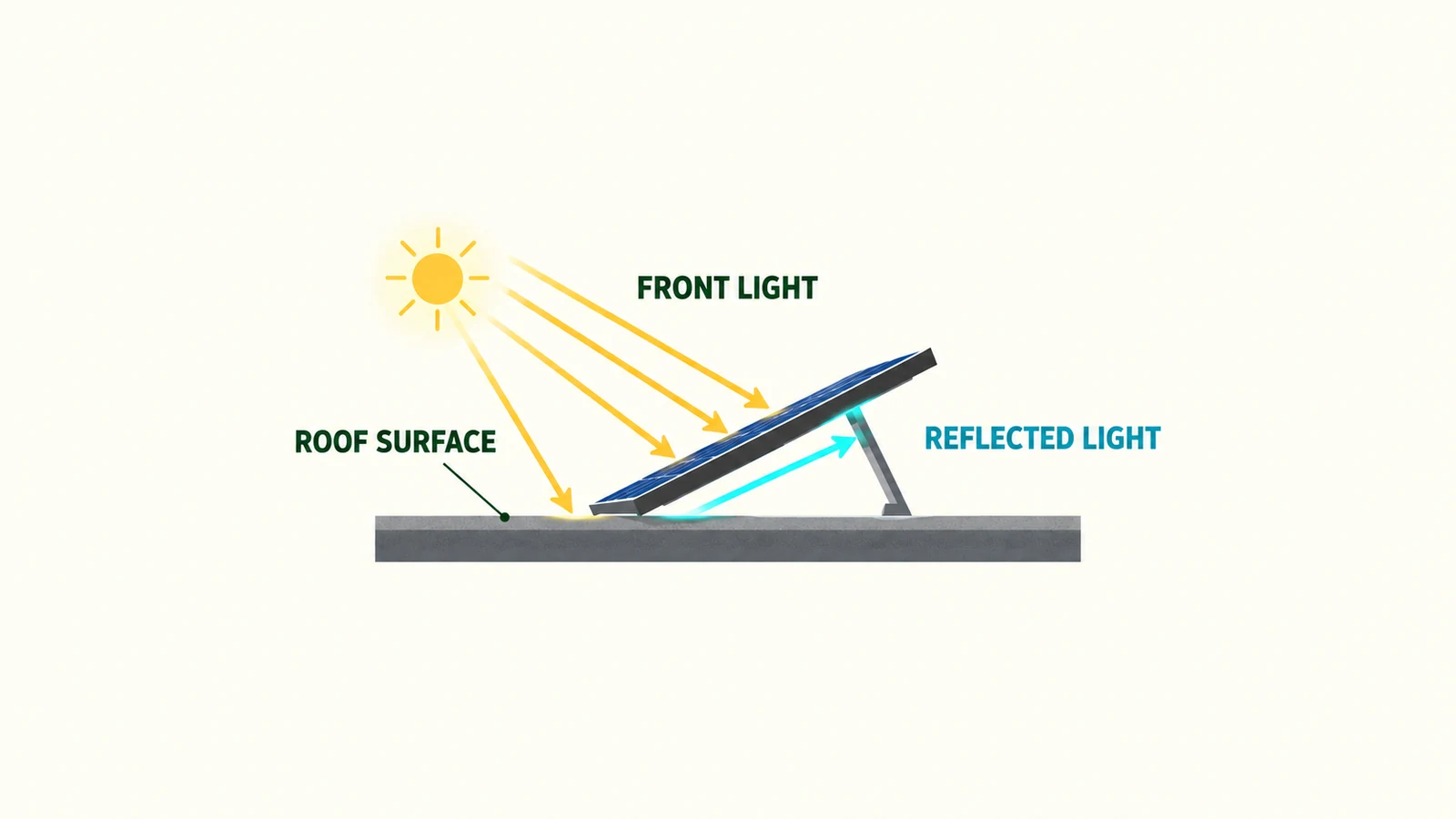
Homi Solar Malaysia has prepared this guide for homeowners and business owners reviewing proposals. The diagrams are AI educational concepts, not actual HOMI installations, engineering layouts or measured project results. We do not claim a standard rear-side gain for Malaysian roofs.
Separate the panel property from the site result
SAM’s module documentation defines bifaciality as rear-side efficiency relative to front-side efficiency. The model treats rear irradiance separately. A hypothetical bifaciality of 0.80 therefore does not mean 80% more annual electricity. Light still has to reach the rear; the specification does not create it.
Sandia’s modelling guidance identifies the surrounding surface and nearby objects, including racking, as relevant to rear irradiance. A neat photograph or a large product percentage is not enough to establish the expected energy from a particular roof. Asking for the assumptions is a normal proposal review step, not an accusation that the equipment is unsuitable.
What to compare in the proposal
| Item | What it tells you | Useful question |
|---|---|---|
| Module bifaciality | A relative module conversion property; source: SAM. | Which exact model and datasheet revision support it? |
| Rear-light assumptions | Depend on reflectance, spacing and clearance; source: SAM. | Which values represent this roof and layout? |
| Rear obstructions | Can change light distribution; source: Sandia. | Were rails, neighbouring rows and roof features represented? |
| Extra annual AC energy | A system comparison requiring a defined baseline. | What changes between the two cases, and is the gain already included? |
The questions and comparison method are HOMI editorial guidance, not additional laboratory specifications. Reflectance is often called albedo: it concerns light reflected by a surface. A roof colour description alone is not a verified modelling value. Do not assume a ground-mounted project’s result applies to panels close to an opaque roof.
A worked example, not a yield prediction
Hypothetical arithmetic only: suppose a proposal gives 1,000 kWh of AC energy for a stated period in a comparison case with no rear contribution, and 1,050 kWh after modelling rear contribution. The extra energy is 50 kWh. The relative increase is (1,050 − 1,000) ÷ 1,000 × 100 = 5%.
These invented inputs are not HOMI measurements, a completed simulation, an expected Malaysian gain or a savings promise. The comparison should keep front-rated DC capacity, weather period, orientation, inverter, other losses and measurement boundary consistent, with any changes disclosed. If 1,050 kWh is already the total forecast, adding another 5% would count the same assumed benefit twice.
Ask whether each number is DC energy at the array, AC energy after the inverter or electricity delivered at another meter. A rear-light calculation is not automatically the same as extra usable AC energy. The installer should explain the complete model rather than multiplying a monthly bill by a product percentage.
Five records to request before deciding
- The exact module model, front-rated capacity and applicable datasheet.
- The proposed roof layout, clearance and shading assumptions, supplied by the qualified designer.
- The reflectance value, its basis and how uncertainty was handled.
- The model name/version, weather period, energy boundary and comparison case.
- A written answer stating whether rear contribution is already included in the quoted total.
If the proposal changes several things at once, request a short change table. A higher total may reflect extra panels or a different inverter as well as rear light. Ask for a reasonable sensitivity comparison rather than one optimistic roof-reflectance value. This is a document review checklist; do not climb onto a roof, move modules, repaint surfaces or alter mounting height to pursue a theoretical gain. Structural, wind, waterproofing and electrical decisions need the appropriate professional assessment.
Malaysia scope and next step
The Energy Commission SELCO index, checked 23 October 2026, lists June 2026 guidance for Peninsular Malaysia. It is jurisdiction context, not approval of a bifacial product or a roof design. Sabah and Sarawak require separate current authority and utility checks. Solar ATAP rules, tariff treatment, approval and savings depend on the latest PETRA, SEDA, ST and TNB requirements and the actual bill, roof and usage pattern.
Read our solar yield forecast checklist and roof orientation guide for related questions. Explore Homi Solar Malaysia services or contact our team to review your proposal assumptions. Start with the model and your question; agree a suitable private channel before sharing documents. Keep unredacted bills, account numbers, addresses and customer data out of public comments and public AI tools.
Frequently asked questions
Does bifaciality of 80% mean 80% more electricity?
No. Bifaciality compares rear and front conversion efficiency; the site gain also depends on the light reaching the rear and the complete system.
Is the same gain valid for every roof?
No. Ask for the roof reflectance, layout, shading and modelling assumptions for the proposed site, rather than borrowing another installation’s percentage.
Should I add rear gain to the total quoted annual energy?
Only after the installer confirms what the total includes. If rear contribution is already included, adding it again would double-count it.
Should I change my roof or mounting height for more rear light?
Do not make changes from a generic illustration. Ask qualified professionals to assess the complete structural, waterproofing, wind and electrical design first.
Sources checked 23 October 2026
- National Laboratory of the Rockies / SAM: SAM Help: Module — Bifacial Specifications
- Sandia National Laboratories / PVPMC: Bifacial PV Performance Models
- Suruhanjaya Tenaga: Self-Consumption (SELCO) official guideline index
This article reflects official information checked on 23 October 2026 and is general guidance. Programme rules, tariff treatment, approval and actual savings remain subject to the latest PETRA, SEDA, Energy Commission and TNB requirements plus the property bill, roof and usage pattern.
Want HOMI to review your TNB bill?
Send your usage pattern and HOMI can estimate whether Solar ATAP makes sense for your home or business.
Discuss Bifacial Solar Assumptions