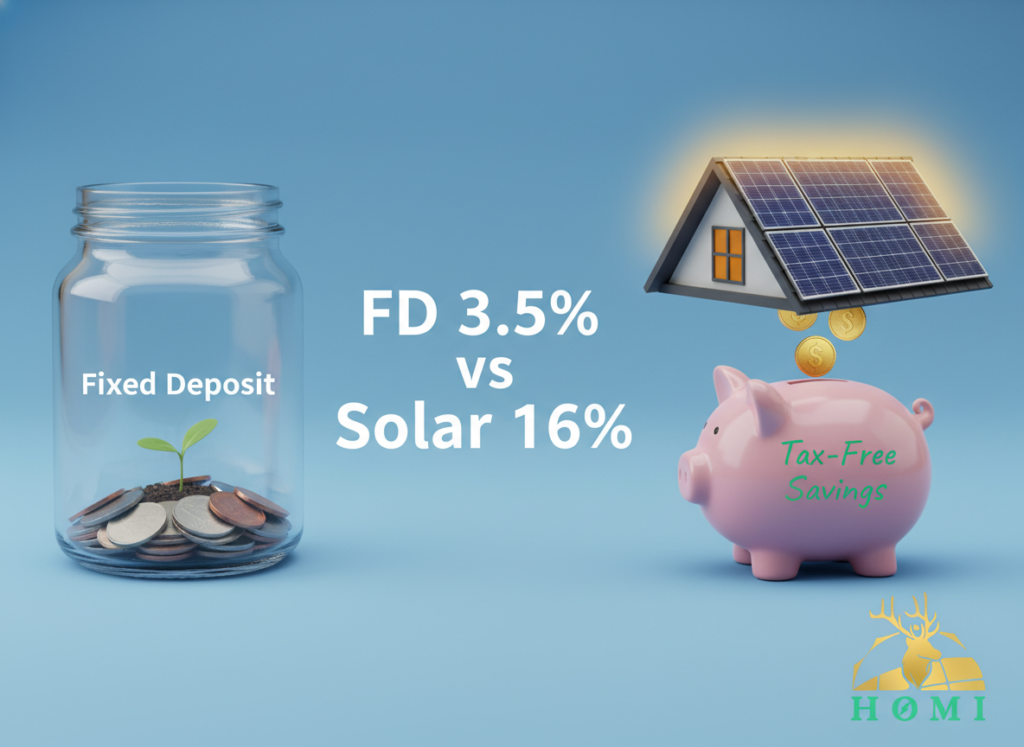
You’ve received your company bonus. Do you lock it in a Fixed Deposit (FD) for 3.5% interest, or is there a smarter, inflation-proof place to park your cash?
In 2026, electricity tariffs in Malaysia are rising to cover renewable energy grid costs [web:151][web:153]. While Solar ATAP has stricter export rules than the old NEM, the Cost Avoidance ROI is higher than ever because TNB rates have jumped.
The 5-Year Showdown: FD vs. Solar ATAP
Let’s invest RM 20,000 (approx. cost of a 6.6kWp system) and see where you stand in 2031.
🏛️ Fixed Deposit
Interest Rate: ~3.5% p.a. [web:150]
Risk: Very Low
Inflation Protection: Poor (Electricity inflation > 4%)
5-Year Profit:
(Total Value: RM 23,750)
☀️ Solar ATAP System
Yield Rate: ~15-18% p.a. (Bill Savings)
Risk: Low (Hardware Warranty 25yrs)
Inflation Protection: Excellent (Hedge against tariff hikes)
5-Year Savings:
(Payback achieved in ~4.5 years)
Why Solar ATAP 2026 is Still a Winner
Many worry about Solar ATAP’s “No Rollover” rule. Here is the truth: For a typical T20 household with air-conditioning, you consume 70-80% of what you generate instantly. You aren’t losing credits; you are simply not buying expensive power.
📈 The “Conservative” HOMI Promise
We don’t use “Best Case Scenario” numbers. We calculate your ROI based on Self-Consumption Only.
Even if you export ZERO units to TNB, your system pays for itself in under 6 years. Every unit exported is just a bonus.
💰 Quick ROI Checker
Enter your monthly TNB bill to see your potential yearly return.
Your bonus is hard-earned. Don’t let inflation eat it away in a low-yield account. Put it on your roof and let it work for you every single sunrise.
Get a “Conservative” Investment PlanFAQ: Investing in Solar
What if electricity tariffs drop?
Highly unlikely. With the global push for green energy and grid infrastructure upgrades (RP4), TNB base tariffs are projected to rise to ~45 sen/kWh by late 2026 [web:151]. Solar protects you from these hikes.
Does Solar ATAP have a quota?
Good news: Solar ATAP has NO quota limit [web:67][web:15]. Unlike NEM which ran out quickly, you can invest anytime. However, hardware prices fluctuate, so locking in now is smart.
Is the system an asset or liability?
It’s an asset. A solar-equipped home has a higher property valuation. Plus, with HOMI’s workmanship warranty, maintenance costs are minimal compared to the savings generated.
You’ve received your company bonus. Do you lock it in a Fixed Deposit (FD) for 3.5% interest, or is there a smarter, inflation-proof place to park your cash?
In 2026, electricity tariffs in Malaysia are rising to cover renewable energy grid costs [web:151][web:153]. While Solar ATAP has stricter export rules than the old NEM, the Cost Avoidance ROI is higher than ever because TNB rates have jumped.
The 5-Year Showdown: FD vs. Solar ATAP
Let’s invest RM 20,000 (approx. cost of a 6.6kWp system) and see where you stand in 2031.
🏛️ Fixed Deposit
Interest Rate: ~3.5% p.a. [web:150]
Risk: Very Low
Inflation Protection: Poor (Electricity inflation > 4%)
5-Year Profit:
(Total Value: RM 23,750)
☀️ Solar ATAP System
Yield Rate: ~15-18% p.a. (Bill Savings)
Risk: Low (Hardware Warranty 25yrs)
Inflation Protection: Excellent (Hedge against tariff hikes)
5-Year Savings:
(Payback achieved in ~4.5 years)
Why Solar ATAP 2026 is Still a Winner
Many worry about Solar ATAP’s “No Rollover” rule. Here is the truth: For a typical T20 household with air-conditioning, you consume 70-80% of what you generate instantly. You aren’t losing credits; you are simply not buying expensive power.
📈 The “Conservative” HOMI Promise
We don’t use “Best Case Scenario” numbers. We calculate your ROI based on Self-Consumption Only.
Even if you export ZERO units to TNB, your system pays for itself in under 6 years. Every unit exported is just a bonus.
💰 Quick ROI Checker
Enter your monthly TNB bill to see your potential yearly return.
Your bonus is hard-earned. Don’t let inflation eat it away in a low-yield account. Put it on your roof and let it work for you every single sunrise.
Get a “Conservative” Investment PlanFAQ: Investing in Solar
What if electricity tariffs drop?
Highly unlikely. With the global push for green energy and grid infrastructure upgrades (RP4), TNB base tariffs are projected to rise to ~45 sen/kWh by late 2026 [web:151]. Solar protects you from these hikes.
Does Solar ATAP have a quota?
Good news: Solar ATAP has NO quota limit [web:67][web:15]. Unlike NEM which ran out quickly, you can invest anytime. However, hardware prices fluctuate, so locking in now is smart.
Is the system an asset or liability?
It’s an asset. A solar-equipped home has a higher property valuation. Plus, with HOMI’s workmanship warranty, maintenance costs are minimal compared to the savings generated.