


Solar ATAP in Malaysia: Holiday-at-Home or Away? Practical Strategies to Avoid No-Rollover Credit Waste for Families and EV Owners
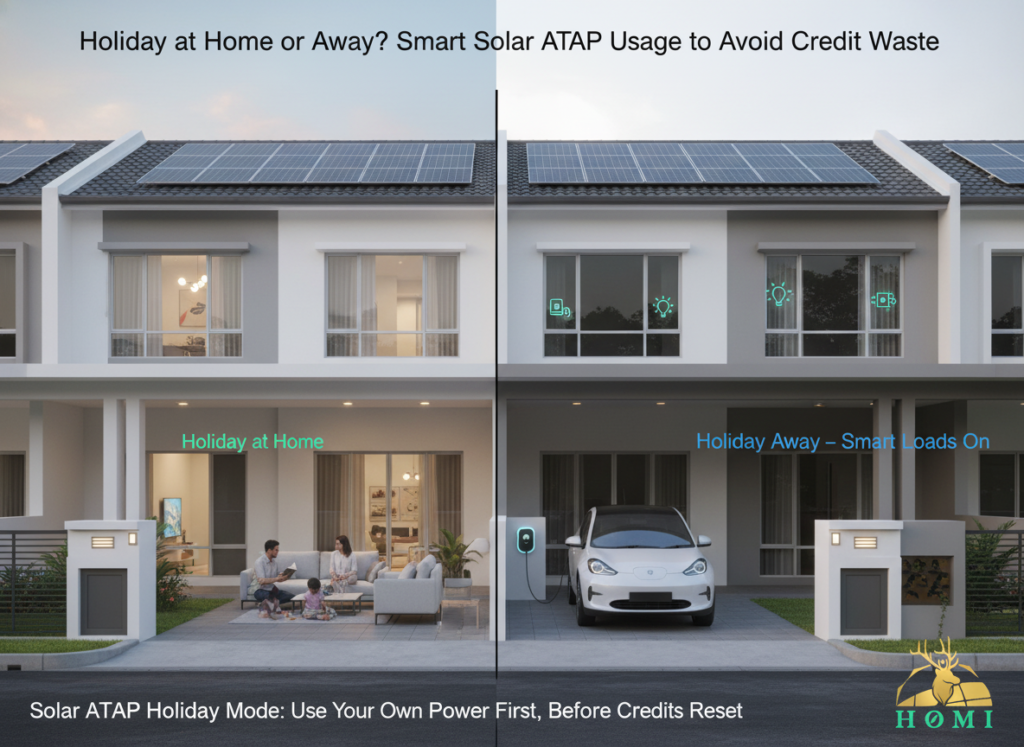
Solar ATAP in Malaysia: Holiday-at-Home or Away? Practical Strategies to Avoid No-Rollover Credit Waste for Families and EV Owners
For domestic users, Solar ATAP export credits can only offset the **Energy Charge** portion of the TNB bill and they **reset every month with no rollover, no cash payout and no offset for AFA, network or taxes**. [web:44][web:57][web:33][web:17] A quiet month with lots of export but low usage no longer subsidises future months, so days like Nuzul Al-Quran—where you might be home all day or out all day—are perfect examples of how to plan your “holiday mode” to avoid credit waste. [web:334][web:349]
This guide walks through two simple Nuzul Al-Quran scenarios for landed homes—(1) whole family at home with AC on, (2) whole family out with only the fridge on—and shows practical ways to use timing, dehumidifiers, circulation fans and EV slow charging to make the most of your Solar ATAP system.
1. Quick Refresher: Solar ATAP No-Rollover Rules for Homes
Solar ATAP keeps the basic idea of exporting surplus energy but tightens the rules compared with NEM 3.0. [web:44][web:57][web:33][web:77]
| Feature | NEM 3.0 | Solar ATAP (2026) |
|---|---|---|
| Export credit value | Up to 1:1 against full bill. [web:77] | Energy Charge only for domestic; SMP‑based for non‑domestic. [web:44][web:17] |
| Credit rollover | Carry forward up to 24 months. [web:147] | No rollover; unused credits expire every billing month. [web:44][web:57][web:33] |
| Offset scope | Energy + some non‑energy components (depending on scheme). | Domestic: Energy Charge only; no offset for AFA, network, SST etc. [web:44][web:33] |
In practice, this pushes homeowners to think less about “selling” solar and more about **using as much of their own generation as possible within the same month**, especially on high‑solar days.
2. Scenario 1 – Holiday-at-Home: AC On, Family Together
Scenario 1: Nuzul Al-Quran at Home
- Whole family at home for prayers, rest and family time.
- Living room + 1–2 bedrooms cooled in the afternoon.
- Fridge, fans, TV, devices and some cooking all running.
On this type of day, Solar ATAP naturally works in your favour: strong late‑morning and afternoon generation is soaked up by your own cooling and appliance loads without needing special tricks.
If you already own an EV, shifting part of your AC‑friendly daytime window to include a few hours of 7 kW home charging (for example, topping up 20%→60%) can further increase your self‑consumption, especially if you normally charge at night. [web:304][web:302]
3. Scenario 2 – Holiday Away: House Empty, Only the Fridge On
Scenario 2: Nuzul Al-Quran Outing Day
- Family leaves home after Subuh and only returns after Maghrib.
- Only fridge, routers and a few standby devices stay on.
- Solar still produces a strong curve between 10am–4pm, but almost no one is there to use it.
Under NEM, a “super export” day like this could bank credits for later; under Solar ATAP, those surplus credits are limited to Energy Charge and **vanish at month‑end if you cannot use them**. [web:44][web:57][web:33][web:17]
The solution is not to leave AC on in an empty house, but to plan safe, useful loads—like controlled dehumidification, timed circulation fans or EV slow charging—that run during your solar window without compromising comfort or safety.
4. Practical Holiday Mode Tools: Dehumidifier, Fans and EV Charging Schedules
Here are three practical tools for “empty house but sunny roof” days under Solar ATAP.
4.1 Dehumidifier & Circulation Fan Timers
- In Malaysia’s humid climate, running a quality dehumidifier for a few hours can improve indoor air quality and reduce mould risk.
- Set a plug‑in timer or smart plug to run a dehumidifier and/or a circulation fan in key spaces (e.g. living and master bedroom) from about 11am–3pm, when your PV output is high.
This converts some of your midday export into useful conditioning work, without overspending or cooling an empty space.
4.2 EV Slow Charging as a Solar “Battery”
- Home 7 kW AC chargers typically add around 30–36 kWh from 20%→80% on a 50–60 kWh pack in about 4–5.5 hours. [web:304][web:302]
- If your EV is parked at home on a holiday, scheduling a mid‑day charge (e.g. 11am–4pm) can absorb much of your solar generation directly into the battery instead of exporting it.
- Using a timer or smart charger app, you can align charging start/stop times with your usual solar peak window.
Even if solar cannot cover 100% of the kWh for that charge, each solar‑powered kWh is one less Energy Charge kWh you buy from TNB—or one less kWh you pay RM 1.20–1.80 for at a public DC charger later. [web:297][web:44]
4.3 Small but Smart Loads
- Schedule washing machines or dishwashers with delay timers to run mid‑day on holidays instead of late night.
- Use smart plugs to group “holiday mode” loads into a single scene you can activate the night before: dehumidifier, fan, maybe a low‑power air‑purifier.
These loads are modest, but combined with an EV or a few hours of dehumidification, they meaningfully reduce the volume of “free” kWh exported on an empty home day.
5. Interactive: Holiday Mode Solar ATAP Planner (Self-Consumption Estimator)
Holiday Mode Planner: How Much Solar Can You Use Instead of Export?
Estimate how much of your daytime solar you can intentionally consume on a holiday—whether you are staying home or going out.
- ✔ Add dehumidifier/fan hours to your extra load when away.
- ✔ If you have an EV, include a portion of mid‑day slow charging in extra load.
- ✔ Re‑run this whenever you adjust your “holiday mode” habits.
Assumptions: simple benchmark ≈ 4.5 kWh/day per kWp with about 65% of that generated in the 11am–4pm window, Solar ATAP credits offset Energy Charge only and expire monthly with no rollover or cash payout. [web:206][web:44][web:57][web:33]
6. How HOMI Delivers a “Holiday Mode Playbook” with Every Solar ATAP System
HOMI does not just install panels and walk away; we provide a **household‑level usage strategy** that fits Solar ATAP’s no‑rollover rules.
Step 1: Map Your Loads and Lifestyle
- We review 12–24 months of your TNB usage, plus your weekend and public holiday patterns (including Nuzul Al-Quran and school breaks). [web:33][web:77]
- We list key loads: AC, EV charger, dehumidifiers, fans, heaters, pumps, and identify which are flexible or schedulable.
Step 2: Design “Normal Mode” and “Holiday Mode” Profiles
- We simulate solar generation against your typical weekday profile and a few holiday variants (home vs away) to estimate self‑consumption percentages. [web:206][web:319]
- We then propose simple holiday routines: e.g. “If away, set dehumidifier + fans 11am–3pm; if EV at home, schedule 2–3 hours of mid‑day charge.”
Step 3: Hands-On Setup + Education
- During handover, we help you configure smart plugs, basic timers or EV charger schedules to implement your holiday playbook.
- We provide a one‑page **Holiday Mode Checklist** so every family member can follow it before travelling or before a public holiday.
The goal is simple: make it easy for Solar ATAP users—especially families and EV owners—to push their self‑consumption up on sunny, low‑occupancy days, instead of donating value to the grid when credits reset.
FAQ: Solar ATAP No-Rollover Credits, Holidays and EV Charging
What exactly happens to unused Solar ATAP credits at the end of the month?
For domestic users, Solar ATAP export credits are given at the Energy Charge rate and can only offset the Energy Charge portion of the bill within the same billing month. [web:44][web:57][web:33][web:17] Any remaining credits at month‑end are forfeited; they do not roll over, cannot be converted to cash and cannot be used to offset AFA, network charges or taxes.
Is it safe and sensible to use EV slow charging as a way to absorb solar during holidays?
Yes, as long as you follow your EV and charger manufacturer’s guidelines. Home 7 kW AC charging typically adds around 30–36 kWh when charging a 50–60 kWh battery from 20% to 80% over roughly 4–5.5 hours. [web:304][web:302] Scheduling part of this charging window during 11am–4pm on sunny days allows Solar ATAP generation to be stored in your EV battery rather than exported, reducing both Energy Charge and reliance on more expensive public fast charging later.
How does HOMI help new Solar ATAP users avoid credit waste in practice?
HOMI combines analysis of your TNB usage and household appliances with Solar ATAP’s no‑rollover credit rules to design simple, actionable usage patterns. [web:33][web:44][web:77] This includes recommended daytime setpoints, suggested dehumidifier and fan schedules, EV charging windows and smart‑plug or timer configurations for “holiday mode”, so you can easily increase self‑consumption without micromanaging your system every day.
Want HOMI to review your TNB bill?
Send your usage pattern and HOMI can estimate whether Solar ATAP makes sense for your home or business.
Ask HOMI on WhatsApp