
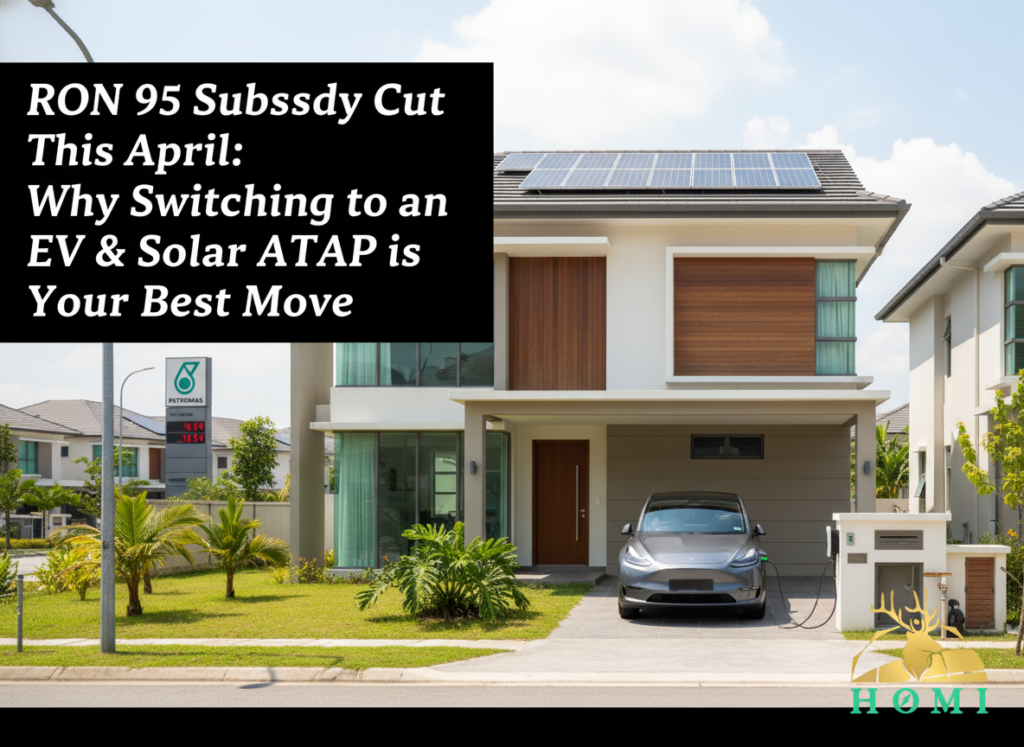
RON 95 Subsidy Cut This April: Why Switching to an EV & Solar ATAP is Your Best Move
For many Malaysian commuters, transport costs are no longer just about traffic. They are about monthly survival. As fuel subsidy changes put more pressure on household budgets, more landed homeowners are asking a smarter question: if driving is getting more expensive, should my next move be an EV powered by my own roof?
Why Fuel Cost Pressure Changes the EV Conversation
Many drivers used to compare EVs only against car price. That is no longer enough. When recurring fuel costs become more painful, the real comparison becomes monthly running cost. For commuters with regular daily mileage, charging at home can feel far more predictable than repeated trips to the petrol station.
Why Solar Makes an EV Even More Powerful
An EV already changes how you pay for mobility. Adding solar changes where that energy comes from. Instead of depending fully on grid electricity, you can use daytime solar production to support home charging. This is especially attractive for households that already consume a lot of power during the day or have flexible charging habits.
Use Daytime Charging to Avoid Wasted Solar
One of the smartest strategies for EV owners is to charge during strong daytime generation whenever possible. Your car becomes a useful energy sink that helps consume extra solar output instead of letting your system produce more than your lifestyle can use. That is why sizing matters so much. A system should be designed around both home demand and vehicle charging patterns.
Why HOMI’s EV-Aware Sizing Matters
Not every solar installer understands commuting behaviour, charger habits, and how EV usage affects household load. HOMI plans around the full picture. We estimate your driving needs, daytime charging potential, roof space, and family consumption profile so the final system is practical, compliant, and built to reduce waste instead of just looking big on paper.
Petrol vs EV + Solar Savings Estimator
Use this simple tool to compare your monthly commuting spend.
A Better Next Step Than Guesswork
If fuel costs are becoming harder to absorb, switching to an EV alone may help. But pairing that EV with a properly designed solar system can make the long-term economics much more attractive. The key is not buying the biggest setup. It is building one that matches your real commuting and household usage.
FAQ
Can solar really help with EV charging at home?
Yes. A well-sized home solar system can support part of your EV charging needs, especially if you can charge during daylight hours.
Why is sizing important for EV owners?
Because your solar system should reflect both household usage and vehicle charging demand. Oversizing can create waste, while undersizing may not support your daily energy pattern well.
What makes HOMI different for EV-related solar planning?
HOMI looks beyond rooftop panel count. We plan around mileage, charging habits, daytime usage, and realistic household demand so your setup is more useful in daily life.