Solar ATAP · Malaysia
TNB Bill Data
Solar ATAP Malaysia: Why Oversizing Your Home Solar System Can Waste TNB Bill Savings (And How HOMI Sizes It Right)
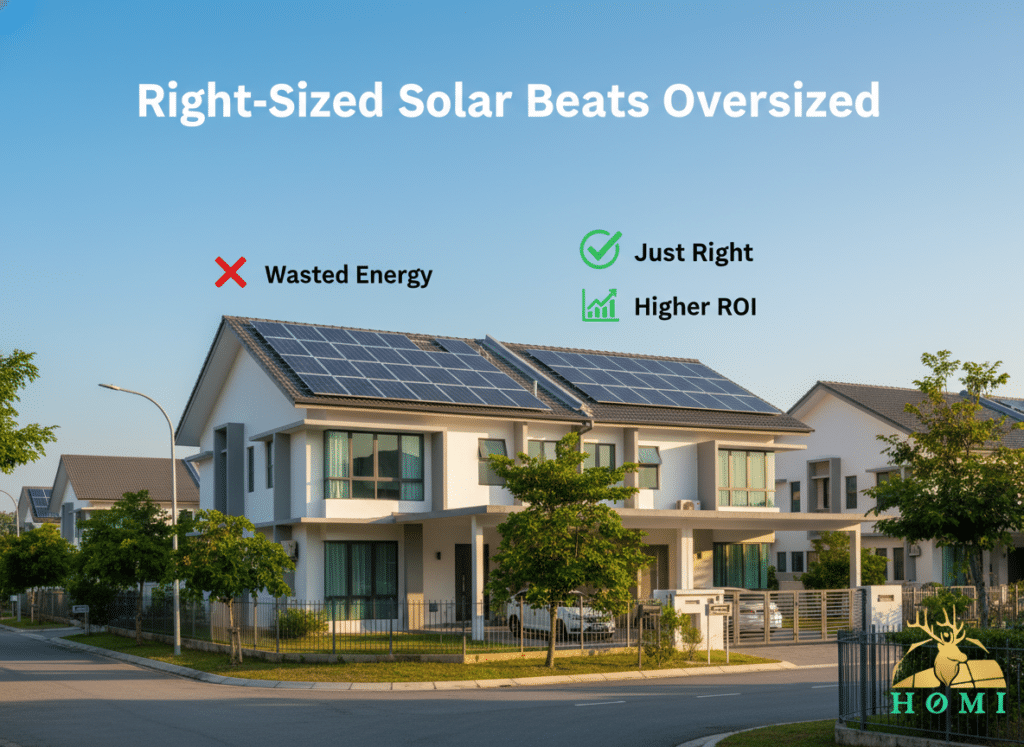
In a landed home in the Klang Valley, a homeowner proudly installed a 10 kWp system because “the sales guy said just fill the whole roof”. Under Solar ATAP, he later realised that nearly 30% of his monthly solar generation could not be used or fully monetised because his daytime usage was too low and export credits now expire each billing cycle instead of rolling over like old NEM schemes. [web:8][web:33]
Under Solar ATAP, Malaysia has moved decisively to a “self-consumption first” model. Credits are given only for surplus export and they now expire at the end of each billing cycle with more limited offset scope on your TNB bill, especially for residential users. [web:8][web:33][web:147] Oversizing, which used to be merely “less optimal”, can now directly destroy your ROI when 20–30% of your exports have zero value.
Case Study: A 10 kW System That Was Too Big
House Profile
- Double-storey terrace in PJ
- Family of 4, both parents working office hours
- Daytime usage mainly fridge, fans, a few ACs
- Average pre-solar TNB bill: RM 420 / month
The 10 kW Decision
- Installer pushed “bigger is better” package
- Estimated monthly generation: ~1,300–1,400 kWh
- Actual daytime self-use: ~900–1,000 kWh only
- ~30% of energy consistently exported at low value or forfeited under ATAP rules
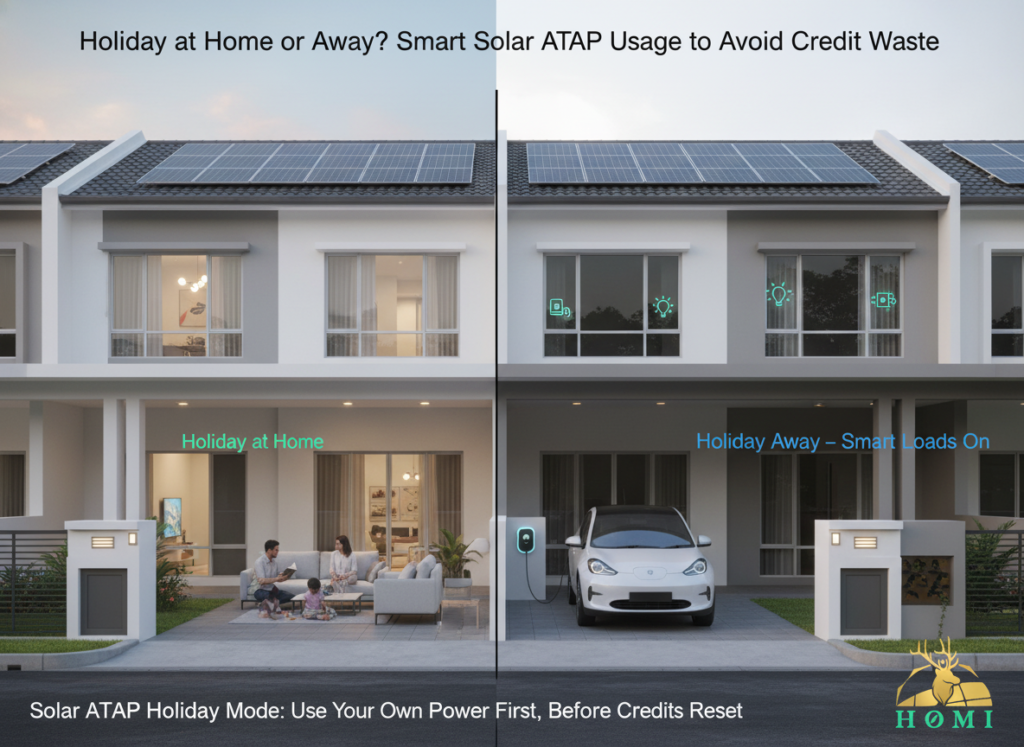
Under Solar ATAP, export credits for homes can only offset the energy charge component and they do not roll over to the following month. [web:33][web:147] In quiet months or when the family travels, a large chunk of the neighbour’s export simply expired with no impact on his TNB bill.
| Neighbour’s 10 kWp (Oversized) | HOMI “Just-Right” 7.2 kWp | |
|---|---|---|
| Monthly Solar Generation (Est.) | 1,350 kWh | 980 kWh |
| Daytime Self-Consumption | ~950 kWh | ~900 kWh |
| Surplus Export | ~400 kWh (up to 30% wasted under ATAP) | ~80 kWh |
| System Cost (Outright) | RM 38,000+ | RM 28,000–30,000 |
| Simple Payback | > 9 years | ~ 6–7 years |
The painful conclusion: The neighbour paid extra for panels that earn nothing most months. Meanwhile, a smaller, correctly sized system would have delivered a faster payback and higher percentage ROI.
Why Solar ATAP Punishes Oversizing
1. Credits Expire Every Month
Under earlier NEM schemes, export credits could roll over for up to 12 months, allowing oversized systems to bank summer surplus for later use. [web:8][web:33] Under Solar ATAP, unused credits expire at the end of the billing cycle. Oversizing means you simply donate energy back to the grid for free in low-usage periods. [web:33][web:147]
2. Credits Offset Only Part of Your TNB Bill
ATAP export credits for domestic users offset the energy charge only, not the full bill including network and capacity components. [web:33][web:64] Once your energy portion is fully offset, extra export has little or no financial impact, especially if your base usage is modest.
3. TNB Tariff Structure Is Tiered
The highest-value savings come from offsetting the expensive upper tiers of your TNB consumption, not the cheapest first 200 kWh. [web:124] A well-designed system focuses on shaving off those higher tiers instead of chasing a “RM 0 bill at all costs”, which often forces oversizing with poor marginal returns.
HOMI’s Precision Sizing Method (Data, Not Guesswork)
At HOMI, we built our Precision Sizing framework around how Solar ATAP really works, not around selling the biggest possible system. Industry guides and ATAP documentation highlight that systems should be designed for self-consumption first, export second. [web:8][web:33][web:147]
Step 1: Deep-Dive into Your TNB Bills
We request 12–24 months of your TNB bills to analyse:
- Average kWh usage by month
- Bill components (energy vs other charges)
- Seasonal patterns (school holidays, travel, WFH periods)
Step 2: Build Your Daytime Load Profile
Using your appliance list and occupancy pattern, we model when you actually use power: morning peaks, afternoon loading, evening peaks, and travel days. This aligns with the ATAP principle of using generation on-site first before exporting. [web:8][web:147]
Step 3: Simulate Multiple System Sizes
Instead of pushing a fixed “package”, our team simulates several kWp sizes and compares:
- Self-consumption percentage
- Export percentage and likely expired credits
- Payback period and internal rate of return (IRR)
Step 4: Choose the “Zero-Waste Zone”
The recommended size typically targets 80–95% self-consumption, keeping export minimal but still allowing some buffer for sunny days. This is the sweet spot where every panel is actually working for your wallet, not TNB’s.
Quick Self-Check: Are You at Risk of Oversizing?
Tick the statements that match your situation, then click the button.
HOMI’s Promise: “Not the Most Expensive, Just the Most Correct”
Many installers still sell solar as if NEM rollover credits exist forever. ATAP changed the game: you now lose unused credits every month, and export values are weaker than your import tariffs. [web:8][web:33] That is why HOMI’s consultants are trained to walk away from oversizing, even if it means a smaller invoice for us.
When you work with HOMI, your proposal includes a Conservative ROI Sheet based on realistic self-consumption, not on perfect export conditions. No inflated ROI, no “0 TNB bill” fantasy—just a system that fits your life and your TNB bill.
FAQ: Solar ATAP & System Sizing
Is a bigger Solar ATAP system always better for my TNB bill?
No. Under Solar ATAP, credits expire monthly and only offset the energy charge portion of your bill. Oversizing can lead to 20–30% of your generation having little or zero value, especially if your daytime usage is low. [web:8][web:33][web:147]
How does HOMI use my TNB bill to size the system?
We analyse 12–24 months of your kWh usage, seasonal trends, and tariff tiers, then simulate different system sizes to maximise self-consumption and minimise wasted export, following ATAP’s “self-consumption first” principle. [web:124][web:147]
Can I upgrade later if my consumption increases?
Yes. For many homes, it is safer to start with a right-sized system and add capacity later if your TNB usage genuinely grows (e.g., more ACs, EV, home office). HOMI can design your system with an expandable inverter and roof layout in mind.