


Solar ATAP Site Survey: What to Prepare Before the Installer Visits
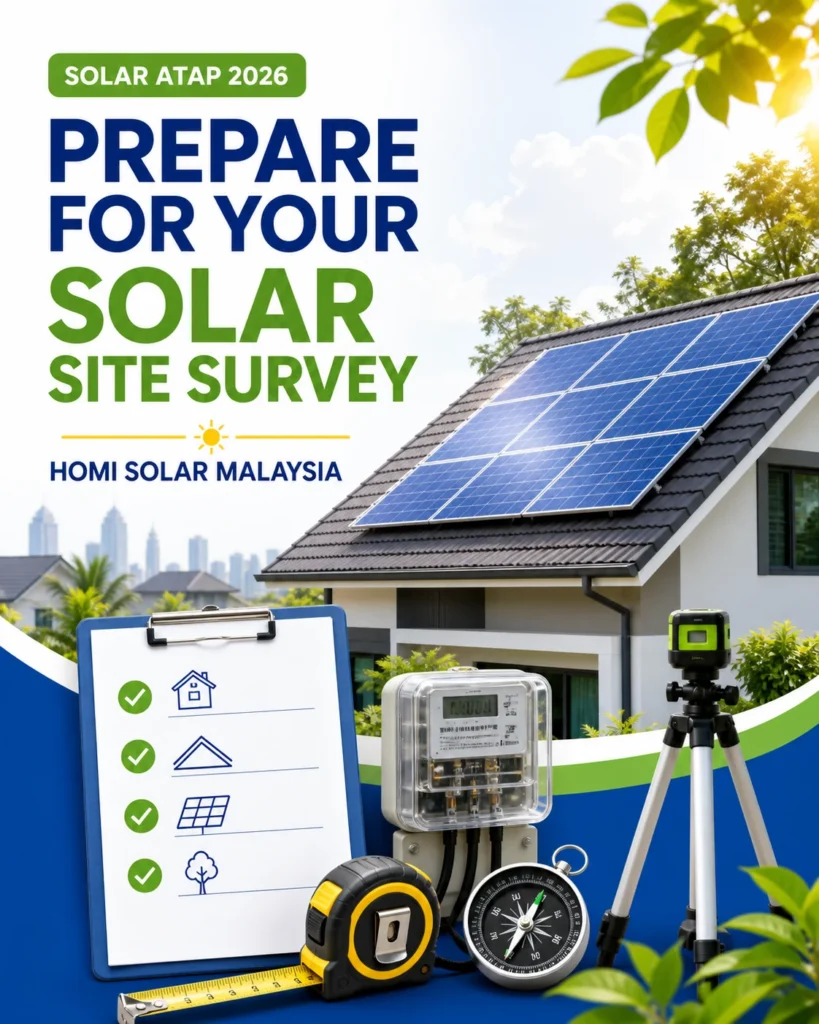
A useful solar site survey starts before the installer arrives. Prepare your recent electricity information, property access and future load plans so the visit can test real constraints instead of only counting how many panels fit on the roof.
Solar ATAP has continued Malaysia’s rooftop export-and-offset route from 2026, while SEDA acts as the implementing agency and the Energy Commission regulates the programme. The official process and capacity requirements depend on the customer category, supply and proposed system. A site visit therefore supports a proposal; it does not guarantee programme approval, a fixed system size or a fixed saving.
1. Prepare recent TNB bills and account details
Bring several recent bills rather than one unusually low or high month. The installer should review monthly kWh, tariff category, account name, supply phase and the pattern of daytime and night-time use. If the account holder and property owner are different, flag that early so the correct supporting documents and authorization can be confirmed.
2. List your daytime loads and future changes
Write down air-conditioning, pumps, refrigeration, office equipment, water heating, EV charging and other major loads. Note when they normally operate. Also mention a planned EV, renovation, new air-conditioner, business expansion or battery because future load can change the design discussion.
3. Make safe roof and electrical access possible
Tell the team the roof type, approximate age, known leaks, previous repairs and any fragile or restricted area. Provide existing roof photos if available, but do not climb onto the roof for the sake of a quotation. The survey should also identify the meter, distribution board, inverter location, cable route, earthing and a practical maintenance path.
4. Gather property and ownership information
Depending on the applicant type and official route, documents may include identity or company records, authorization, the latest bill and technical drawings prepared or endorsed by the relevant competent parties. The SEDA Solar ATAP guideline lists supporting documents for the formal application, but an installer should distinguish what is needed for an early survey from what is only produced after design, installation, testing or commissioning.
5. Ask what the survey will deliver
- Usable roof area, shading and access observations.
- Proposed DC panel capacity and AC inverter capacity.
- Single-phase or three-phase implications.
- Daytime self-consumption and export assumptions.
- Technical assessment or connection-study direction where applicable.
- Roof, electrical, approval and utility items included or excluded.
- A generation and savings range with assumptions, not a guarantee.
Six questions before accepting a quotation
- Which bills and load assumptions were used?
- What roof repair or structural work is excluded?
- Which Solar ATAP submission and utility steps are included?
- Who is responsible for drawings, testing and commissioning records?
- Which warranties cover equipment, workmanship and roof penetrations?
- How will the design change if my daytime load or future plans change?
Use the Solar ATAP planning page for the programme overview and the project gallery for real installation evidence. Contact HOMI with your property location and recent TNB bills to prepare a structured site visit.
Frequently asked questions
How many TNB bills should I prepare?
Several recent bills are more useful than one month because they show seasonal and usage variation. HOMI will confirm the exact period required for the assessment.
Can a site survey guarantee Solar ATAP approval?
No. Approval and technical requirements remain subject to the latest SEDA, Energy Commission, TNB and programme rules.
Should I climb onto the roof to take photos?
No. Provide safe ground-level or existing photos and let suitable personnel assess roof access and condition.
Does the biggest roof layout give the best system size?
Not automatically. Daytime load, export treatment, supply, roof condition, approval and budget all affect a practical design.
This article reflects official information checked on 11 August 2026 and is general guidance. Programme rules, tariff treatment, approval and actual savings remain subject to the latest PETRA, SEDA, Energy Commission and TNB requirements plus the property bill, roof and usage pattern.
Official sources
Want HOMI to review your TNB bill?
Send your usage pattern and HOMI can estimate whether Solar ATAP makes sense for your home or business.
Prepare My Solar Site Survey