Solar ATAP Sizing in Malaysia: A One-Week Experiment Using 3 TNB Bills and HOMI’s Free Report to See If Your Home Really Fits Solar
Under Solar ATAP, domestic export credits only offset the **Energy Charge** and **expire at the end of each billing month with no rollover**, unlike NEM 3.0 where credits could roll forward for up to 12–24 months. [web:44][web:56][web:147][web:33] This makes “right‑sizing” your system to your real kWh usage and lifestyle far more important than chasing the biggest discount or the largest array your roof can physically take. [web:147][web:33][web:348]
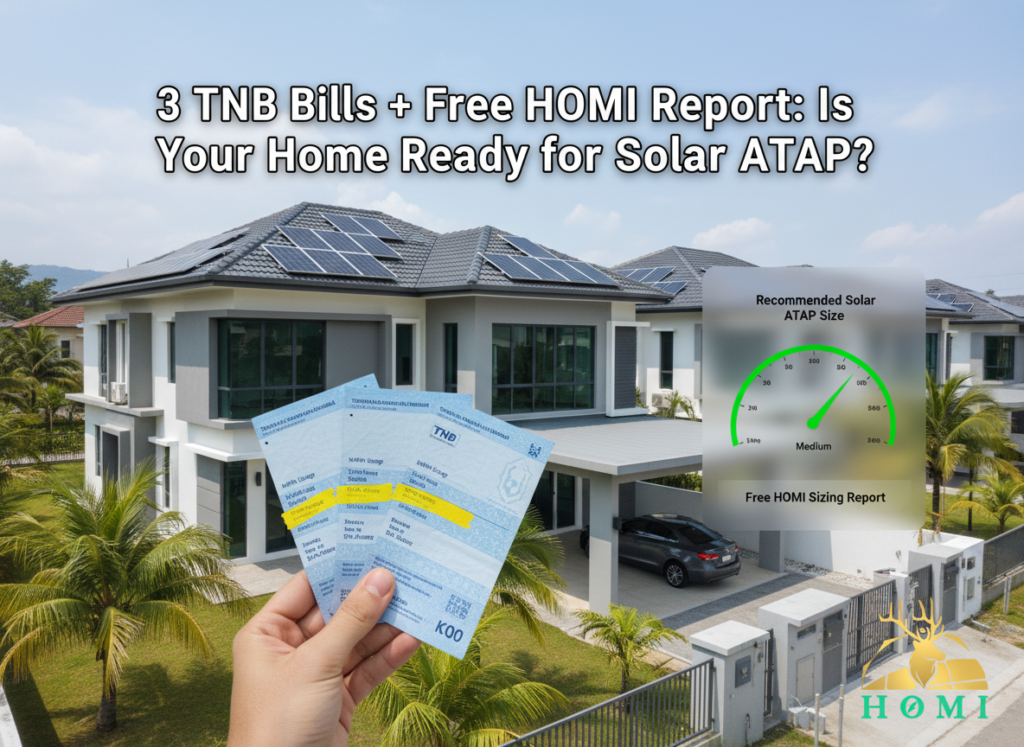
This article is your one‑week experiment: use three recent TNB bills plus a few questions about your daytime habits and roof to get a realistic first verdict on whether Solar ATAP fits your home—and how HOMI turns those bills into a proper sizing and generation report.
1. Step 1 – Collect Your Last 3 TNB Bills and Extract Daily kWh
The new TNB tariff structure from July 2025 itemises charges into Energy, Capacity, Network and Retail components, but your **kWh usage** is still the most important input for Solar ATAP sizing. [web:310][web:351]
How to calculate your 3‑bill daily average
- For each of your last three bills, find the total kWh used for that period (often labelled “Jumlah kWh” or similar). [web:353][web:355]
- Divide by the number of days in that billing period (for example, 30 days).
- Then average the three daily numbers to get a simple **3‑month daily kWh** baseline.
| 3-Bill Daily Average | Approx. Monthly Range | Solar ATAP Sizing Implication |
|---|---|---|
| ≤ 10 kWh/day | ≤ 300 kWh/month | Small user; solar still possible, but system size needs to be modest (2–3 kWp) to avoid chronic export under no‑rollover rules. [web:206][web:33] |
| 10–25 kWh/day | 300–750 kWh/month | Strong candidate; a 3–6 kWp system can match a large share of daytime use. [web:206][web:248] |
| ≥ 25 kWh/day | ≥ 750 kWh/month | High‑usage home; solar can work very well, but careful sizing is needed so ATAP credits are not frequently forfeited. [web:248][web:33] |
Rule of thumb: in Malaysia, **1 kWp of solar PV produces about 4–5 kWh per day** on average, depending on location and shading. [web:206][web:339] This is the key link between your daily usage and your “ideal” system size.
2. Step 2 – Add Your Lifestyle: Daytime at Home & Air-Cond Behaviour
With ATAP’s no‑rollover credits, it is not enough to know “how much” you use; **when** you use it matters too. [web:33][web:147]
Ask yourself three questions
- On weekdays, how many hours is someone at home between 9am and 5pm (WFH, retirees, kids)?
- How many rooms’ air‑cond run in the late morning and afternoon on hot days?
- Are your biggest activities (cooking, laundry, ironing) mostly daytime, evening, or mixed?
- Export credits only offset Energy Charge and expire monthly, so a system that mostly exports midday kWh to the grid on empty‑house days will have weaker payback. [web:44][web:56][web:33]
- Homes with consistent daytime usage—AC, fans, WFH devices—can self‑consume more solar and rely less on export credits. [web:33][web:206]
3. Step 3 – Check Roof Orientation and Shading
Most of Malaysia has strong solar resource; the main differences come from your roof and shadows. [web:206][web:339]
Quick roof checklist
- Do you have a roof face roughly south, southeast or southwest with a gentle slope (around 10–15°)? [web:206]
- Is this face largely unshaded between 9am and 4pm (minimal trees, nearby buildings, water tanks)?
- Roughly how many square metres of clear roof do you have (e.g. 20–30 m² for ~3–4 kWp, more for larger systems)?
Studies on Malaysian homes show good sites can achieve roughly **1,200–1,500 kWh per kWp per year**, equivalent to about 3.3–4.1 kWh/day per kWp on average. [web:339][web:206] A heavily shaded or poorly oriented roof will sit near the lower end of that range.
4. Interactive: 3-Bill ATAP Sizing & Savings Snapshot (Simple Calculator)
3-Bill Solar ATAP Sizing & Savings Snapshot
Use your 3‑bill daily average and a rough “roof quality” guess to see a very simple kWp suggestion and Energy Charge savings band.
Assumptions: 1 kWp ≈ 4.5 kWh/day average output; Solar ATAP credits offset Energy Charge only and expire monthly; savings estimate focuses on Energy Charge portion of TNB bill. [web:206][web:44][web:56][web:33]
5. Why “Right Size” Beats “Discount Hype” Under Solar ATAP
In a world where export credits reset every month, **system size and usage match** matter more than chasing a promotional “discounted” tariff or oversizing to fill your roof. [web:147][web:33][web:352]
| Approach | Short-Term Feeling | Long-Term Reality Under ATAP |
|---|---|---|
| “Max out the roof” without analysis | Feels powerful; big kWp number and sales pitch. | Frequent export above Energy Charge; credits forfeited at month‑end; weaker real ROI despite good pricing. [web:44][web:56][web:348] |
| Right-sized to usage & lifestyle | Maybe slightly smaller system than neighbours. | Higher self‑consumption %, fewer wasted credits, more stable savings versus Energy Charge, better payback. [web:147][web:33] |
Solar ATAP still works very well for the right households—but only if you match system size to your kWh profile and daytime habits, not just to the biggest “promotion” or dealer limit.
6. What HOMI’s Free Sizing & Generation Report Adds on Top of Your 3-Bill Experiment
Your three‑bill experiment is a good start, but HOMI goes several steps further using actual data and conservative Solar ATAP assumptions.
Step 1: 12–24 Month Bill & Load Pattern Analysis
- We pull 12–24 months of kWh data (where available) to capture hot months, festive periods and travel. [web:206][web:248]
- We map how often you fall in lower (<1,500 kWh) vs higher usage bands, which changes your blended Energy Charge. [web:310][web:351]
Step 2: Roof Simulation & Yield Modelling
- Based on your photos/location, we estimate roof orientation, tilt and shading, and apply Malaysia‑specific yield (≈1,200–1,500 kWh/kWp/year). [web:339][web:206]
- We simulate several candidate system sizes (e.g. 3, 4, 5, 6 kWp) and their monthly kWh output.
Step 3: Solar ATAP Credit Logic + TNB Bill Impact
- We apply ATAP’s rules: credits offset Energy Charge only, no rollover, no offset for Capacity/Network/Taxes. [web:44][web:56][web:33][web:352]
- We show how each kWp option changes your Energy Charge and total bill over a typical year, including months with travel or lower use.
You receive a **clear, data‑backed recommendation**: “For your house, X–Y kWp is the sweet spot under Solar ATAP; larger than this likely wastes credits, smaller than this leaves easy savings on the table.”
FAQ: TNB Bills, Solar ATAP Sizing and “Should I Install Solar?”
Why start with three TNB bills instead of a full year?
Three recent TNB bills provide a quick way to estimate your current daily kWh usage and see whether you fall into a low, medium or high consumption band. [web:206][web:248] While 12–24 months of data is ideal for final design, a 3‑bill average already gives a useful baseline for approximate system size and helps you decide if a deeper Solar ATAP assessment is worth pursuing.
How does Solar ATAP change what “good sizing” means compared with NEM?
Under NEM 3.0, export credits could roll over for up to 12–24 months and offset a broader portion of the bill, so larger systems that exported heavily could still work financially. [web:56][web:147] Under Solar ATAP, export credits for homes only offset the Energy Charge, do not roll over and cannot offset capacity or network charges, so oversized systems that frequently export more than your monthly Energy Charge tend to waste value when credits reset each month. [web:44][web:33][web:352]
What information does HOMI need to prepare a free Solar ATAP sizing report?
Typically we ask for at least three to six recent TNB bills, a short description of your daytime habits (WFH, retirees, kids), an estimate of how many rooms are air‑conditioned and a few photos or a sketch of your roof. [web:206][web:353] With this, we can model several system sizes, apply Solar ATAP credit rules and show you a realistic range of savings and payback times specific to your house rather than using generic assumptions.