


Solar battery warranties in Malaysia: compare years, throughput and end-of-warranty capacity
A ten-year battery warranty is not a ten-year promise of unchanged capacity. The useful comparison sits in the complete document: time, lifecycle energy or cycles, usable capacity, end-of-warranty capacity, operating conditions and the evidence required for a claim. Two proposals can both say “10 years” while allocating very different limits and responsibilities.
Malaysia’s Energy Commission treats battery energy storage as an electrical system with design, installation, operation and maintenance duties. Its 2026 BESS safety guideline covers BMS/EMS monitoring, competent-person involvement, firmware or software updates where required and maintenance records. Those duties do not disappear because a product has a warranty, and a warranty does not prove licensing, approval or safe commissioning.
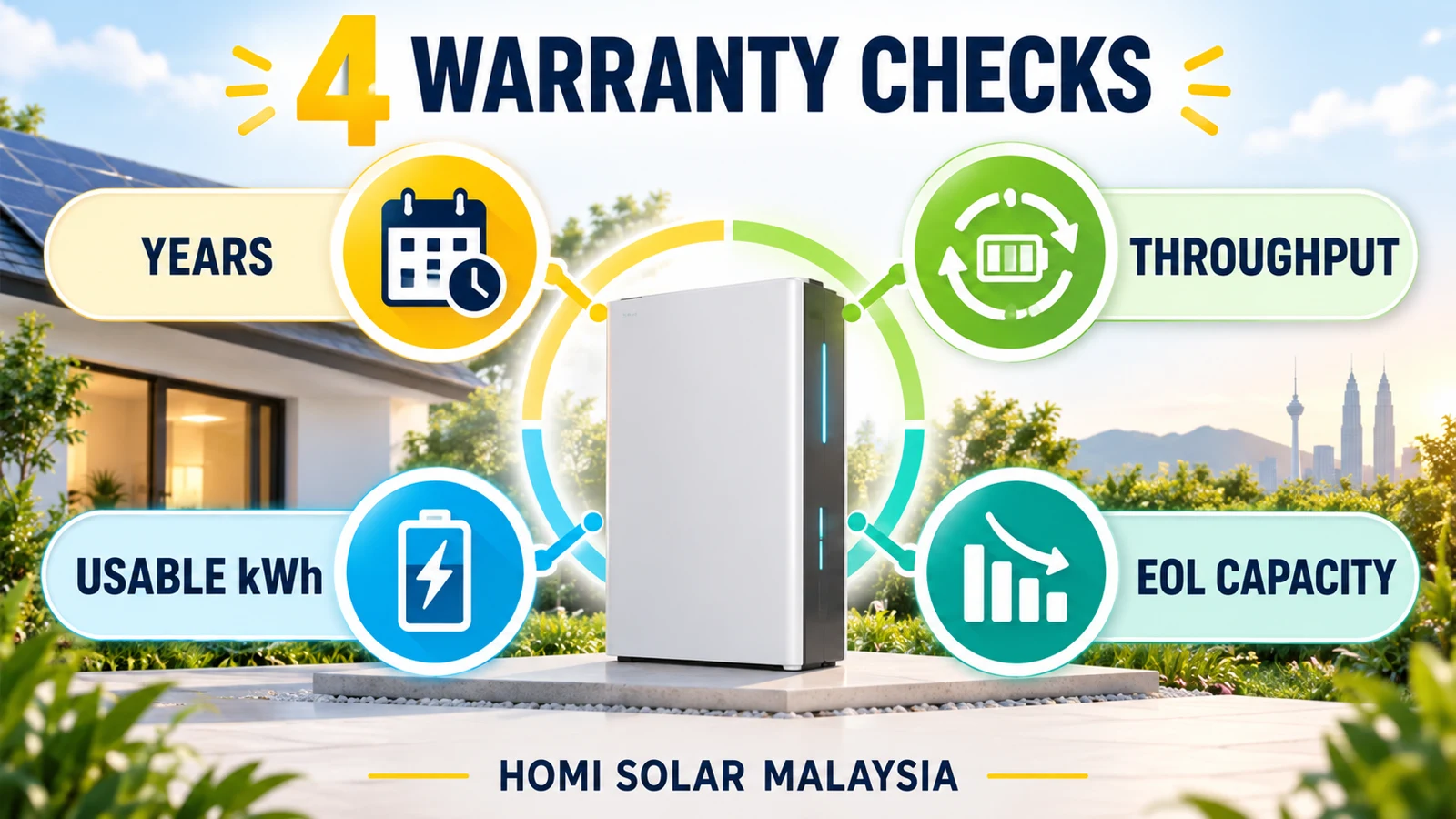
The four numbers to place side by side
Start with four comparable fields. Calendar term tells you how long coverage may run. Lifecycle energy or throughput tells you how much cumulative energy may pass through the battery before a limit is reached. Usable capacity tells you the energy available under the stated operating window, not merely the nameplate figure. End-of-warranty capacity tells you the remaining-capacity threshold used by the contract.
A current global manufacturer policy illustrates why all four matter: certain battery-pack terms end at the stated years or lifecycle electricity, whichever comes first, and specify an end-of-life capacity percentage. The same policy says local service policies and signed contracts take precedence. That is an example of contract structure, not a recommendation of that brand or a promise of terms for a Malaysian customer.
Worked example: when throughput can arrive first
Hypothetical only: the figures below are not measured HOMI project data, a product quotation, a savings forecast or a design recommendation.
| Contract field | Offer A | Offer B | What to ask |
|---|---|---|---|
| Nominal / usable energy | 10 kWh / 9 kWh | 10 kWh / 8 kWh | Which figure is used for operation and capacity testing? |
| Calendar term | 10 years | 10 years | When does the clock start: shipment, installation or commissioning? |
| Lifecycle energy | 18 MWh | No stated MWh; cycle conditions apply | Is coverage limited by years, energy, cycles, or the earliest of them? |
| End capacity | 60% under stated test conditions | 70% under stated test conditions | Who performs the test and at what temperature, power and state of charge? |
| Illustrative use | At 5 kWh discharged daily, 18 MWh is about 3,600 days, before losses and operational variation. | A cycle count cannot be compared without its depth-of-discharge and measurement definition. | Ask for the calculation in writing using the actual operating plan. |
The simple division, 18,000 kWh ÷ 5 kWh/day = 3,600 days, only explains how a throughput cap works. Real battery control, losses, temperature, outages and changing loads alter the result. It is not a prediction of lifespan or savings.
Conditions that can change claim eligibility
- Connectivity and firmware: some coverage may depend on the battery remaining connected to an approved monitoring service or receiving required updates.
- Installation and environment: location, ventilation, temperature, water ingress, clearances and authorised installation can be material.
- Operating window: charge level, discharge rate, backup reserve and compatible equipment may affect how capacity is measured and whether use stays within specifications.
- Records: serial numbers, purchase and commissioning dates, alarms, logs, service records and proof of maintenance can determine whether a claim is diagnosable.
- Remedy: replacement may be new, equivalent, refurbished, prorated or limited to a component. Labour, transport and reinstatement may be treated separately.
Practical comparison checklist
- Ask for the exact Malaysian warranty document and version before approval, not only a brochure summary.
- Write the start date, calendar end, throughput or cycle limit and end-capacity threshold into one comparison sheet.
- Confirm whether the battery pack, power module, inverter, gateway and labour have separate terms.
- Record all connectivity, firmware, maintenance, temperature and compatible-equipment conditions.
- Ask how usable capacity and end capacity will be tested, by whom and at whose cost.
- Keep the approved design, single-line diagram, serial numbers, commissioning result and maintenance history.
- Confirm the current Energy Commission, grid-code and local-authority route for the exact site. Do not infer approval from the warranty.
Homi Solar Malaysia can help turn competing battery proposals into a like-for-like comparison and identify the questions that need written answers. See the current solar service route or contact a person at HOMI. Keep bills, account numbers, serial numbers and customer data out of public comments and AI tools.
Regional boundary: This is general education based on official and manufacturer information checked on 13 October 2026. The exact Malaysian regulatory route, grid code, local-authority requirements and warranty contract depend on the site, product and supplier. Sabah, Sarawak and Peninsular Malaysia may follow different electricity-system requirements. This is not legal advice, product certification, engineering approval, a warranty interpretation for your contract, or a guaranteed lifespan, approval, saving or return.
Frequently asked questions
Is a longer battery warranty always better?
No. Compare the calendar term with throughput or cycle limits, end-capacity threshold, exclusions, service remedy and claim conditions. The earliest limit or a restrictive condition may matter more than the headline years.
What does 60% end-of-warranty capacity mean?
It normally refers to a capacity threshold measured under defined test conditions, not a promise that daily usable energy will feel unchanged. The exact definition, test method and remedy must come from the applicable contract.
Does one full discharge every day equal one warranty cycle?
Not necessarily. Cycle definitions can depend on depth of discharge, cumulative energy and the manufacturer’s counting method. Throughput in MWh may be easier to compare, but only when the measurement boundary is clear.
Does a product warranty mean the BESS is approved for my site?
No. Product coverage is separate from competent design, installation, licensing, grid-code compliance, local-authority requirements, testing and commissioning.
Official sources checked
- Energy Commission Malaysia: BESS Safety Guidelines, GP/ST/No.62/2026
- Energy Commission Malaysia: BESS licensing requirements page, published 1 July 2026
- Huawei Digital Power: Residential Smart PV Warranty Policy (Global), Issue 04
This article reflects official information checked on 13 October 2026 and is general guidance. Programme rules, tariff treatment, approval and actual savings remain subject to the latest PETRA, SEDA, Energy Commission and TNB requirements plus the property bill, roof and usage pattern.
Want HOMI to review your TNB bill?
Send your usage pattern and HOMI can estimate whether Solar ATAP makes sense for your home or business.
Arrange a Battery Warranty Review